What we know so far about the US fighter jet shot down over Iran
A search is under way for a missing crew member after a US F-15 fighter jet flying over southern Iran was shot down on Friday.
One of two crew members was rescued by US forces, but the search for the second continues, US media report.
Iranian officials said the warplane was shot down by its air defence system. There has been no official US comment.
Where and when was the jet shot down?
Iranian state media first claimed on Friday that the country's forces shot down a US jet over its southern region.
A search-and-rescue mission successfully recovered the pilot of the jet, but what happened to the jet's second crew member, a weapons systems officer, remains unknown.
The rescue operation reportedly included an A-10 Warthog aircraft that was hit over the Persian Gulf, with its pilot ejecting before being rescued.
One helicopter carrying the rescued pilot from the F-15E jet was hit by small arms fire, injuring crew members on board - but it landed safely, US media report.
Iran's Islamic Revolutionary Guard Corps (IRGC) has said that nomadic tribes living in the country's mountains shot two Black Hawk helicopters that were part of the US rescue mission.
BBC Verify has confirmed a video from Friday showing what appears to be three armed individuals firing towards at least two Black Hawk helicopters.
Iran's top joint military command has credited new Iranian air defence systems with the downing of both US warplanes, according to Iran's state-affiliated IRNA news agency.
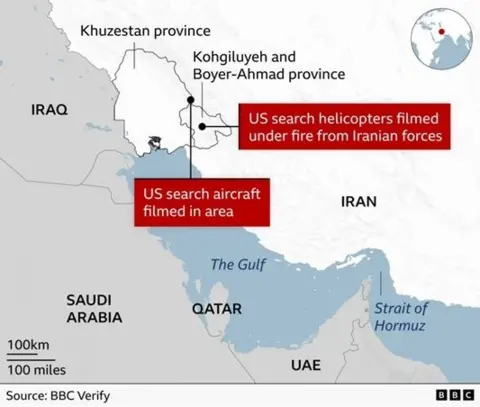
The exact location where the F-15 was reportedly downed is unconfirmed, but two possible provinces have been mentioned in Iran's state media - Kohgiluyeh and Boyer-Ahmad, and Khuzestan.
Kohgiluyeh and Boyer-Ahmad, a mountainous south-western province, is home to more than 700,000 people, including nomads.
The nomads in the area are known to carry rifles to protect their herds and camps from wild animals and theft in the remote highlands.
The province of Khuzestan is a powerhouse for oil and several other industries. It is home to more than 4.7 million people, with a diverse population, including Arabs, Persians, Lors and other ethnic groups.
What do we know about the jet's purpose?

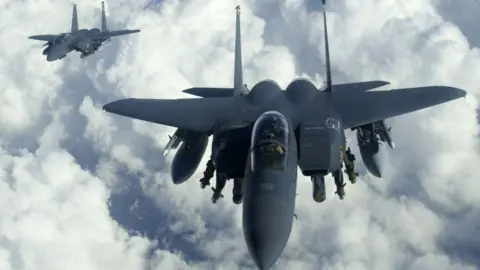 US Air Force via Getty Images
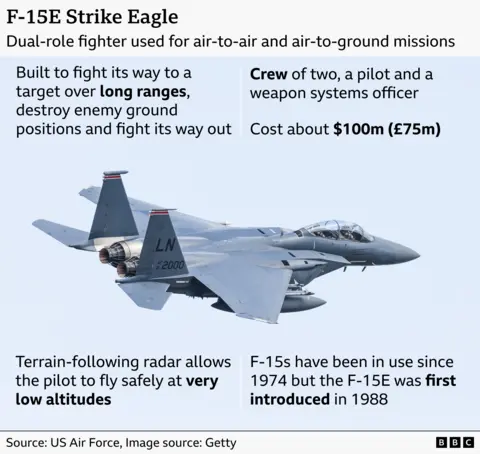
The F-15E is designed for both air-to-ground and air-to-air missions. In Iran, they are most likely to have been involved in defensive roles to shoot down Iranian drones and cruise missiles.
In its air-to-ground strike role, the jet is capable of dropping laser and GPS guided precision munitions, as well as other bombs.
The aircraft has two crew: the pilot and a weapons systems officer in the back seat. The weapons officer, known as a "Wizzo", is responsible for selecting targets and making sure the weapons are programmed for the appropriate attack.
This two-crew system allows the workload to be divided up, particularly in a congested environment where the pilot is trying to evade threats.
We do not know what specifically brought down this US jet, but if it was taken down by the Iranians, the most likely reason is a surface-to-air missile (SAM).
What is happening with the rescue effort?
The rescue of crew members of a downed jet is one of the most complex and time-sensitive operations - known as combat search and rescue (CSAR) - that the US military and its allies prepare for.
The air force units behind CSAR missions include some of the most highly trained and specialised members of the military.
"It's the most dangerous military mission that I know of," James Jeffrey, a military strategist and top US diplomat for the Middle East, told the BBC.
"These are Air Force special operations people who are trained almost to the level of Delta Force and Navy SEAL Team Six, but they also have medical capabilities," Jeffrey said. "They will not give up until they can find a pilot if they think there's any chance."
CSAR missions are often conducted by helicopters, which fly low over enemy territory, alongside other military aircraft that conduct strikes and patrol the area.
A former pararescue commander told CBS News that a rescue operation like the reported one in Iran would involve at least 24 jumpers scouring the area in Black Hawk helicopters.
They added the team would be prepared to jump from planes if needed, and once on the ground their priority would be to contact the missing crew member.
The crew of the downed jet are also highly trained for such situations.
"Their number-one priority is to stay alive and to avoid capture," Jennifer Kavanagh, director of military analysis at think tank Defense Priorities, told the BBC.
"They're trained to - assuming that they're physically capable, and not so injured that they can't move - to try to get away from the ejection site as quickly as possible, and to conceal themselves so that they are safe."
They're also trained on survival techniques so that they can go without food or water, or find resources from the local terrain, for as long as possible, Kavanagh said.
Iran is offering rewards of about £50,000 ($66,100) to citizens who help capture the missing airman, state media has reported.
The reward could have been a trigger for some to start looking for the US crew member, said Sina Azodi, assistant professor of Middle East Politics at the Elliott School of International Affairs at the George Washington University.
"When you bomb people who are angry and have just lost their families, they have every reason to attack you or try to capture you, and the money is an additional incentive," Azodi told the BBC.
"It's clear now that it's a war against the country; it's no longer an attack against the Islamic Republic."
Additional reporting by Ghoncheh Habibiazad, BBC Persian.