Meet the dogs sniffing out leaking water pipes

 BBC
BBCDogs have been drafted in to help in the search for leaks in the water pipe network, with a utility company praising their "phenomenal" noses.
Since December, Southern Water has been working with canine-led detection company CAPE SPC.
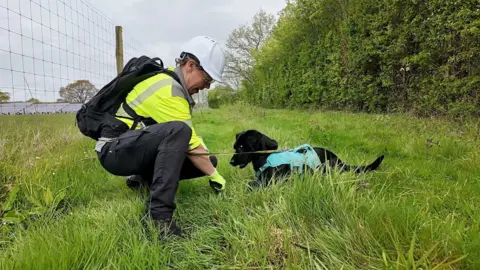
Dogs Milo, Kilo and Tico have been trained to sniff out chlorine present in treated water and detect leaks in pipes in areas that are hard to access.
Handler Steph Barrett said the dogs cause "no damage" in detecting leaks compared to what heavy machinery would.
Southern Water supplies on average 566 million litres of drinking water every day.
But the company loses 91 million litres daily through leakage.
With about 90% of leaks not visible from the surface, more innovative techniques for leak detection include the assistance from animals.
While out detecting leaks near Romsey, Hampshire, Barrett explained the dogs help achieve what humans and technology cannot, while having fun on the job.
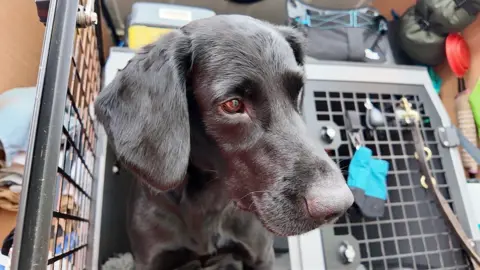
Her dog, Tico, is an eight-year-old Labrador cross Cocker Spaniel, which Barrett describes as having "huge zest for life".
"He's clearly all revved up and ready to go - it's not work for him, it's just a big game."
The handler said they always stopped search activities if the dogs indicated that they were not having fun.
They are predominantly used in rural areas where access is sometimes difficult and traditional acoustic listening methods cannot be used.
Barrett said: "We train on chlorine, which obviously all treated water has a small tiny percentage of chlorine within.
"We take that element out and we train them on that."
The company includes former army personnel who have trained dogs to search for explosives.
Barrett, who has worked with dogs in farming and police work, said it was like going to work "with your best friend".
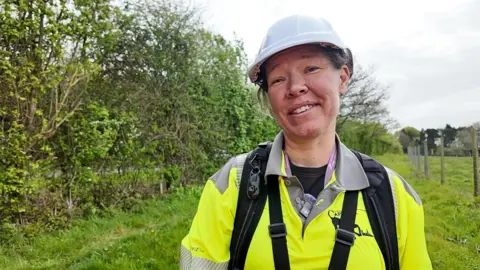
Nick Mills, director of environment innovation at Southern Water, said that since the start of the trial, the dogs had found 17 leaks and 95% of the locations they identified turned out to be leaks.
"We've effectively gone to the location the dogs found and checked and we can hear the leak or see the leak in many cases," he said.
Mills explained that engineers normally used acoustics to find leaks, a technique which works better in urban than rural settings.
"The dogs use scent, not acoustics, and they've been really successful," Mills said.
"Some of the leaks that we have found here we would not have found with traditional techniques either because the sound doesn't travel, it's a different material in the pipe or the accessibility is really difficult.
"Big woodland or bushes are really hard and the dogs can get through that foliage."
Mills said they had even found leaks in pipes under streams and under a waterlogged field.
Mills said that after the initial results, the use of dogs would be a "permanent fixture".
"It's phenomenal what the dogs' noses can do," he said.
You can follow BBC Hampshire & Isle of Wight on Facebook, X (Twitter), or Instagram.