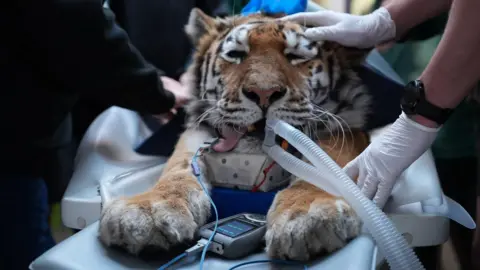
The tiger who came for CT

 Shaun Whitmore/BBC
A CT (computed tomography) scanner has been used for the first time at a Norfolk zoo to give vets a clearer picture of its animals' complex or long-standing conditions.
Some residents of Banham Zoo, near Attleborough, including penguins, a vulture, a cheetah, a tiger and a sloth, were scanned using the equipment, which produces detailed images of bones, organs and soft tissue.
Ross Snipp, zoo director, said the zoo was excited to be using specialist equipment to check so many animals in one day.
"I have been doing this for a very long time, but these days don't come round a lot. It is a real privilege for me, as it is for the rest of the team," he said.
"What we really hope is to add to that pool of knowledge for each individual species.
"Not everyone gets a chance to do this. We are really fortunate. Anything we learn today we will share with our animal and veterinary colleagues around the world."
The scans were carried out with radiographers from Burgess Diagnostics, who said exotic animals made up just 3% of their clientele, compared with dogs comprising 90%.
Dr Elliott Simpson-Brown, a zoo vet with the International Zoo Veterinary Group, said being able to bring the CT scanner to the zoo meant the checks could be carried out in a safe and controlled environment.
 Shaun Whitmore/BBCShaun Whitmore/BBC
Mishka the Amur tiger was sedated in her habitat and transported to the scanner, where vets were looking for any bone and spinal changes.
"The keepers are looking after her really well," said Simpson-Brown.
"She's actually currently really comfortable, so we are using this as the gold standard re-check to be able to ensure we are not missing anything else going on there."
He said work with animals in captivity had a "ripple effect" for big cats in the wild and treatment protocols.
The CT scanner enabled any underlying health issues to be ruled out quickly and non-invasively, he added.
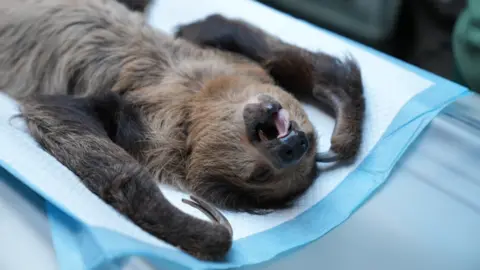
Bob, a one-eyed African black-footed penguin, and Grub, a meerkat, were also scanned, along with a sloth named Arlo.
Keepers had raised concerns that Arlo seemed particularly lethargic, even by sloth standards.
"Looking at a sloth and trying to determine if they are lethargic or not cannot be the easiest," said Simpson-Brown.
"Luckily the keepers here are incredibly diligent, so they are noticing the subtle changes in an animal."
Do you have a story suggestion for Norfolk? Contact us below.
Follow Norfolk news on BBC Sounds, Facebook, Instagram and X.