The construction boss who built a new life after three years in prison

 Traci Quinn
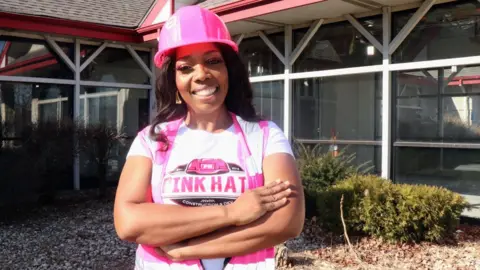
It is often said that the US is "the land of second chances". One Chicago-based woman has embraced hers, becoming the boss of a successful all-female construction company after three years in prison.
Traci Quinn, a mother and grandmother, spent two decades as a nurse.
It was while working in hospitals that she witnessed how cannabis helped some patients, such as those suffering from seizures. It inspired her to set up a company selling medical cannabis.
However, back in 2016 she was arrested after transporting 50lb (23kg) of the drug into Tennessee, which has some of the strictest cannabis laws in the US. Despite Traci having legally purchased the cannabis in California she was tried and convicted for trafficking.
She says the resulting prison sentence was traumatising. "I bawled, I cried, and asked God why. I'd taken care of people my whole life. God told me he didn't have me there as punishment, but on purpose."
It was while behind bars that Traci says she felt a calling to set up a construction company on her release. She wanted to specialise in redevelopment work in Chicago's poorest communities.
Her home city is one of the most racially and economically segregated in the US, with significant areas of poverty, particularly in its southern neighbourhoods.
Despite having no construction experience, Traci set up her business, Pink Hats, in 2020, at the height of the Covid pandemic, shortly after being freed.
Initially she used sub-contractors to undertake her projects, but she soon realised she was being taken advantage of.
"I relied on people who told me they could do the work; I learned the hard way that they couldn't," she says. "I had garages leaning to one side, everything looked torn up and ugly because I was using people with no experience."
 Traci Quinn
She grimaces at the sexism she has faced in what is still very much a male-dominated industry.
The number of women in the US construction industry may be growing, but they still only make up around 11% of the sector's workforce, according to official figures. And the number of black women in the field is fewer still, at less than 7%.
"It's a male-dominated world and they don't always respect you," she sighs. The language from one particularly difficult sub-contractor when she was just starting out was "horrible", she recalls. "He would often tell me to shut up."
Traci says she has also faced racism. "You absolutely have to work harder as a black woman. There will always be people who think you're less qualified when you step in the room," she explains.
"I've dealt with that all my life; even in nursing people would assume I was a nursing assistant when I was the director of nursing."
Undeterred, Traci started taking construction classes, and joined mentorship programmes with established companies in the industry to gain valuable experience. "You really have to be bold as a woman working in construction," she says. "And you've really got to know your stuff."
 AFP via Getty Images
Her lack of business skills was another obstacle she had to overcome.
"When I started applying for municipal contracts with the City of Chicago, they wanted me to pay for projects upfront and get reimbursed later. But I didn't have the capital," Traci explains.
So instead she applied for loans, but she was "too embarrassed" to say that she didn't understand the financial jargon. "Finally I broke down and said I needed help."
Traci was directed to various non-profit groups who assisted her with everything from organising her accounts to showing her how to bid for jobs. Pink Hats earned $125,000 (£95,000) in its first year, rising steadily to more than $1m in 2025.
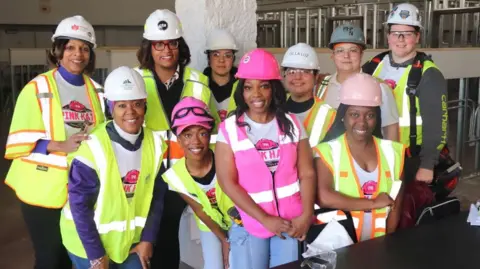
Traci now employs all four of her daughters as her main team, aided by six part-time female staff. They specialise in transforming residential and commercial spaces with an emphasis on helping marginalised people.
Last year, Pink Hats renovated a 30-room home for women recovering from substance abuse in Chicago's Austin neighbourhood. And it won a Builder of the Year award from the Southland Development Authority, a non-profit business organisation designed to help grow the economies of Chicago's southern suburbs.
Pink Hats is currently starting its first new development, building 10 affordable, single-family homes for a Christian organisation in the west of the city.
 Traci Quinn
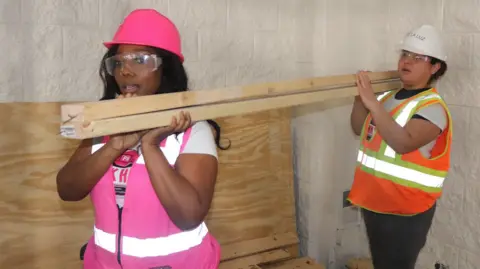
The company also prides itself on using sustainable building materials, such as insulation made from hemp. "It's been pretty cool learning about hemp. I love using it because it's non-toxic, pest-resistant, fire-resistant and mould-resistant," Traci says.
The irony of incorporating the same plant that landed her in prison into her work is not lost on her, she notes wryly.
Traci has lofty plans for the road ahead. Last summer Pink Hats was among 14 small businesses to receive a city government grant. Traci is using the $250,000 to transform an office space into classrooms to teach trades ranging from painting to plumbing.
While the courses will be open to anyone interested, her passion is to work with ex-convicts, easing them back into society.
"My ultimate goal is to create transitional homes for women coming out of prison," Traci continues. "They would be able to stay in it for a year, get some work under their belt, learn about financial literacy, and then have the chance to purchase it."
Irma Holloway, head of the Chicago-based Black Contractors Owners & Executives organisation, of which Pink Hats is a member, says Traci and her team are helping reshape the construction field.
"Traci has carved out a distinctive niche by leading with professionalism, precision and purpose," says Holloway. "Her work proves that when women stay the course and remain committed to their craft, they not only reach the finish line - they redefine it for others."
Today, Traci is philosophical about her painful past.
"I used to be prideful and probably would've looked down on somebody coming out of prison," she admits. "I told my daughters things had to happen this way - for their growth and for mine. It's been an amazing journey."