Iconic 19th Century painting sets Indian art record with $17.9m sale

 Saffronart
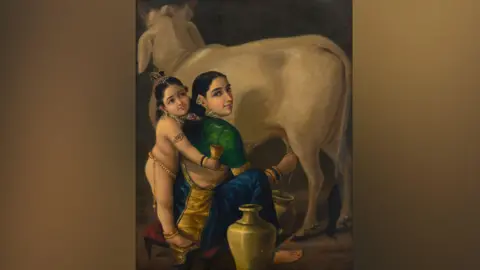
A 19th Century painting by iconic artist Raja Ravi Varma has become the most expensive Indian artwork ever sold, setting a new auction record.
The painting, Yashoda and Krishna, was sold for 1.67bn rupees ($17.9m; £13.6m) at a Saffronart auction in Delhi on Wednesday. It beat the previous record set by MF Husain's Untitled (Gram Yatra) which fetched $13.8m last year.
The surge in sales and records highlight growing demand for Indian and South Asian art, with collectors pushing prices to new highs.
Varma, who was born in 1848 in what is now the southern state of Kerala, is widely regarded as a pioneer of modern Indian painting and one of the most influential artists from the subcontinent.
The painting was bought by billionaire businessman Cyrus Poonawalla, founder and managing director of Serum Institute of India, one of the world's largest vaccine producers.
In a statement released by Saffronart, Poonawalla described the work as a "national treasure", adding that it "deserves to be made available for public viewing periodically".
"It will be my endeavour to facilitate this going forward," he said.
Varma's works have been classified as "art treasure" under India's Antiquities and Art Treasures Act, which means that they cannot be exported and can be sold only to Indian buyers.
Minal Vazirani, president and co-founder of Saffronart, said that the valuation was a "powerful reminder of the enduring cultural and emotional resonance of Indian art".
Ashish Anand, CEO and managing director of DAG (formerly Delhi Art Gallery), said that the impact of the record sale would percolate down to the art market, "giving rise to Indian art being viewed as a serious financial asset and beyond its value for aesthetics and personal delight".
According to Saffronart's catalogue, the work was put up for auction by a private collector.
 Getty Images
Varma's realistic depictions of scenes from Hindu epics and mythology are widely recognised in India - so much so that prints of his works are often found in household shrines.
Yashoda and Krishna is an oil-on-canvas painting from the 1890s, when Varma was at the height of his career. It portrays a sweet moment between Hindu deity Krishna as a child and his foster mother Yashoda.
In the painting, Yashoda is seen milking a cow, while Krishna stands beside her holding a cup and waiting. The child has a mischievous look in his eyes while Yashoda's face reflects warmth and care. Their ornaments are minimal, but intricately detailed.
"Varma's genius lies in this very balance: the sacred rendered through the familiar," the Raja Ravi Varma Heritage Foundation, which promotes and preserves Varma's legacy, wrote in an Instagram post last month, before the auction.
"The textures of silk, the gleam of jewellery, the softness of skin and the gentle stillness of the cow together create a scene that is both devotional and intimate."
The image of Krishna and Yashoda has long inspired artists across South Asia, who have depicted them in songs, temple carvings and local painting traditions. But Varma portrayed them in a more natural way, as art historians have noted.
Artist A Ramachandran wrote that while an "iconographical image of god [usually] evoked awe and not love and affection", Varma changed that, breaking the distance between Krishna and the person looking at the painting.
The record sale also spotlights how collectors are increasingly willing to pay a premium for Indian art which has historical and cultural significance.
Anand of DAG told the BBC that there is a "clear shift in how Indian art is being perceived".
"As the market matures and benchmarks rise, collectors are recognising both its cultural and financial value," he said, adding that fundamentally, it was quality that was driving this momentum.
"The best works - those with provenance, rarity and historical significance - are now commanding extraordinary prices, reflecting the maturing of the market."
Experts add that exclusivity is also pushing prices higher. Many masterpieces by artists such as Varma, Amrita Sher-Gil and VS Gaitonde are either in private collections or rarely come up for auction.
There is also a growing recognition of mythology as a serious and desirable genre within the global art market, Anand said.