Church dismantles a huge pipe organ and finds an older history

 BBC
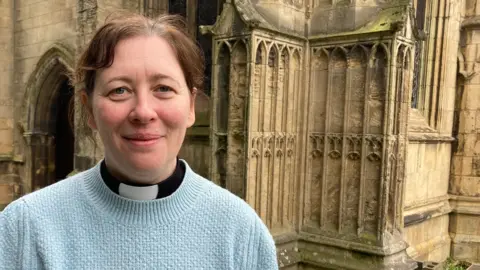
BBCWhen leaders at St Mary's Church, Beverley, decided to give away their towering pipe organ, they were thrilled to find a church in Oslo happy to take it. So began a major operation to move the instrument – and uncover the secrets of a part of the building unseen for more than a century, as Hidden East Yorkshire has been hearing.
But how do you dismantle such a massive structure and ship it hundreds of miles across the North Sea?
That was the question the team at St Mary's found themselves asking when they realised they could no longer keep the stately organ, which has pipes up to 32ft long, because it was too expensive to maintain.
They managed to find it a new home in Oslo, Norway, but that meant taking it apart piece by piece.
"It's been a massive job and we've had the most amazing team working on it," the Rev Becky Lumley explains.
"Some of the guys are apprentices from the college helping out.
"Watching it come down was phenomenal. Thousands – I don't know how many thousands – of pieces. Little, tiny pipes to massive pipes."
St Mary's was founded in the 12th Century and is described by Pevsner's architectural guide as one of the most beautiful parish churches in England.
The pipe organ was installed about 100 years ago when an earlier instrument was rebuilt.
But it needed a vast amount of restoration work.
"We were quoted over a million pounds to restore it and we simply don't have the funds to be able to do that," Lumley, 49, tells the Hidden East Yorkshire podcast.
Adding to the problem was the fragile state of the roof in that part of the church, which meant the organ had to be removed to allow repairs to take place.
"It made a lot of sense to see if anyone else wanted this organ," adds Lumley.
"We put it on the internet and we had this reply from Oslo saying we're really interested in your organ, we'd like to take it and put it in our church."
While it would be difficult to part ways with a piece of church history, Lumley and her team knew the change would also bring opportunities.
A part of the church would be opened up and a door behind the organ could be used to create a new access route for people with mobility problems.
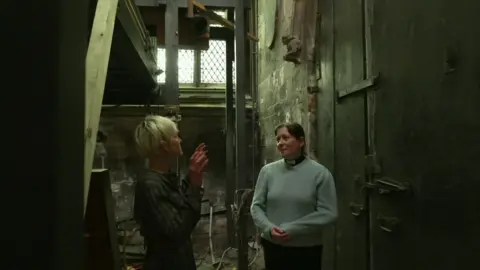
"There's a sense of sadness in a way, because that's been part of our history, but also a sense of unveiling an older part of history that most of us have never seen," says Lumley.
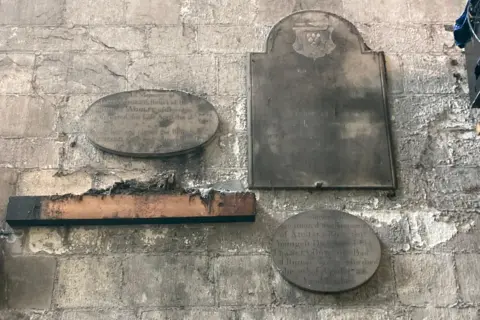
Hidden behind the organ were beautiful carvings and windows that flood the church with light.
"There are memorial stones that most of us have never seen before," Lumley says. "You can relive some of their stories as you encounter them."
Other highlights include roof bosses – architectural decoration found where ceiling beams intersect – from the medieval and Tudor eras.
"They'd have probably been hand-carved by women.
"We're seeing these really for the first time, so we don't know what all the stories are and what the symbols mean, but we'll investigate them, because across the church we've got 680 of these bosses.
"They're fascinating. We've got everything from mermaids to temptresses, to Bible stories, to things to do with the local culture at the time. There was bear-bating, believe it or not.
"Some of the carving is just exquisite – it's as good as any cathedral. And we've not been able to see it, but now we can."
Two gargoyles, on either side of a doorway, have a more surprising story behind them.
"These gargoyles will be medieval," says Lumley, with a smile. "They were supposed to represent people pooing out evil from the back of the building.
"So he looks a little bit like he's having a few problems doesn't he, bless him."
According to the organ preservation charity Pipe Up, about five pipe organs each week are going to landfill. Others are being found new homes abroad.
The group says there were about 40,000 pipe organs in the UK in 1915, but estimates that figure has fallen to 15,000.
The organ from St Mary's will be rebuilt at the Trinity Church in Oslo.
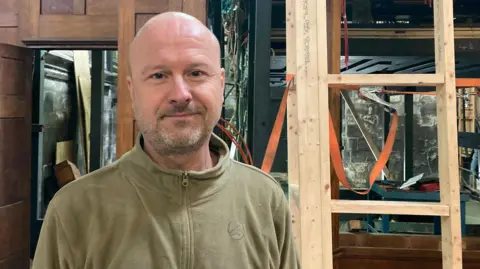
Marius Skjolaas, Trinity's director of music, has been in Beverley to oversee the move.
"Trinity Church is a fairly big church and we needed a big organ, so we're going to merge it with some Norwegian redundant organ pipes and parts," he says. "So it will be a really nice English-Norwegian merger.
"It's lots and lots of work. We have been here now for two, three weeks taking it down.
"But you know, the process of restoring it and repairing everything and putting it back together and installing it in the Trinity Church, it will be a major task."
Trinity Church has been undergoing restoration and will have 1,300 seats when it reopens.
"There will be a lot of cultural events and concerts," Skjolaas adds. "The organ will be a perfect fit for us."
Lumley says St Mary's will continue its "fabulous choral tradition" with a digital organ.
And she is pleased that their old pipe organ will now make music again across the North Sea.
She adds: "It just felt like the most perfect solution, to be able to bless another church community with an instrument that's blessed us."
This article was updated on 30 March to clarify the length of the longest pipes was 32ft, rather than 40ft, a figure that had been estimated by staff overseeing the removal.
Listen to highlights from Hull and East Yorkshire on BBC Sounds, watch the latest episode of Look North.
Download the BBC News app from the App Store for iPhone and iPad or Google Play for Android devices