Record number of breeding pairs of cranes in Scotland

 Andy Hay
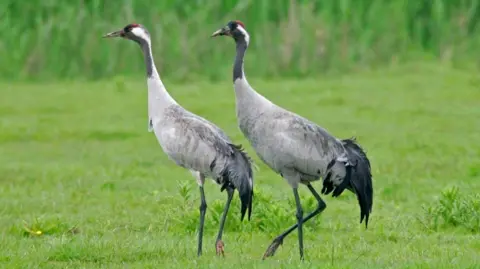
Cranes had their most successful breeding year in Scotland since the 16th Century with a record-breaking number of pairs, a nature conservation charity said.
The common crane became extinct 400 years ago due to habitat loss and hunting but re-emerged in Aberdeenshire in 2012.
A survey by the RSPB has now revealed 10 pairs across Scotland bred in 2025.
Andrew Stanbury, a conservation scientist at the RSPB, said: "We're so lucky to live in a time where these birds are once again part of our landscape".
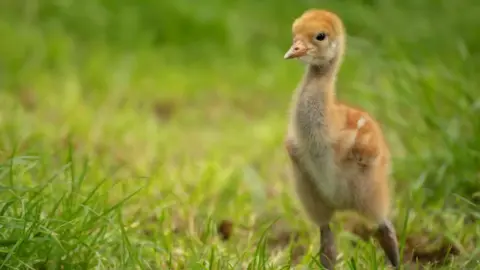
The latest breeding survey in Scotland found that the 10 pairs fledged nine chicks last year.
Four pairs were confirmed to have bred in 2024, the RSPB said.
Adult cranes stand at around 1.2m (4ft) tall and are known for their complex "display" behaviour, where they perform bows, pirouettes and bobs.
But they are naturally secretive and can be difficult to spot.
Cranes first recolonised the UK in 1979, when a small number of birds from mainland Europe were spotted in Norfolk.
Since then their numbers have increased and it is thought there are a total of 520 cranes in the UK
The birds are making a comeback thanks to restoration and protection of their wetland habitats.
 Ben Andrew
Ron Macdonald, a RSPB Scotland volunteer who helped carry out the counts, said: "There's something primeval in the way the crane looks, reminiscent of a pterodactyl that in the distant past probably flew over our ancient woodlands and raised peat bogs.
"One of my first sightings of breeding cranes was seeing and hearing a lone crane flying towards an established pair, bugling as it did so.
"Local farmers tell us that they also bugle at night, a melancholy sound that carries some distance if the night is still."
Their "bugling" call can be heard up to 3.5 miles (5.6km) away.
But despite the increase in numbers and breeding, cranes are still at risk in the UK.
"We hope that the record breeding success of 2025 is not set back by the impact of avian influenza," Macdonald added.