Union angry at no 'social value' score in new shipbuilding contract

 CMAL
CMALPlans for the next new CalMac ferry contract have taken a step forward but a trade union has criticised the absence of any "social value" scoring of competing bids.
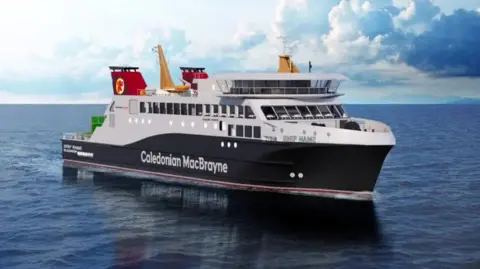
Ferries agency CMAL has published a procurement notice to replace MV Lord of the Isles which indicates the winning bidder will be chosen based on cost and quality.
The GMB union said the scoring should also include wider social and economic factors which would help UK shipbuilders compete against firms in "low-wage economies".
CMAL recently awarded a £200m contract for two freight vessels for the Northern Isles routes to a Chinese shipyard, with no UK shipyards putting forward a bid.
CMAL confirmed the procurement was now live but said it was unable to comment further at the current time.
Previously it has said there is no legal requirement for social value scoring and the international nature of the tender would make it hard to do so without unfairly treating overseas shipyards.
 GMB Scotland
GMB Scotland general secretary Louise Gilmour said procurement rules should be overhauled to slow a "stream of taxpayer-funded contracts being sent overseas to low-wage economies bringing no benefit to the Scottish economy, supply chains or communities".
She added: "Our procurement process must deliver value for taxpayers' money but, as a default, whenever possible, it must support Scottish jobs, skills, supply chains and communities."
CMAL's latest contract notice says bidders should outline their approach to community benefits "such as apprentice and student outreach" but this will be "non-scored".
Shipyards are invited to express an interest and provide information, and a shortlist of up to six bidders will be invited to tender for the contract in July.
As with previous CMAL contracts, community benefits will be discussed after the successful firm has been named preferred bidder.
Gilmour commented: "For CMAL to politely suggest to foreign firms that providing a little social value would be nice, if possible, only adds insult to injury.
"Social value should not be an optional afterthought for companies bidding for these contracts but must be absolutely integral to the process and the foundation of any successful bid."
Bespoke design
The new ferry will be specifically designed to sail between Lochboisdale on South Uist and Mallaig on the mainland, replacing the current 37-year-old vessel.
Due to the constraints of Mallaig harbour, it is expected to be about 85m (279ft) long, which is 10m (39ft) shorter than the new Turkish-built Islay class ferries being constructed for other CalMac routes.
However, CMAL has previously said the new ship design should be standardised as far as possible with these ships "to allow interchangeability".
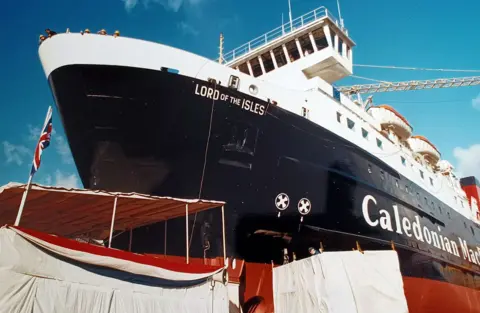
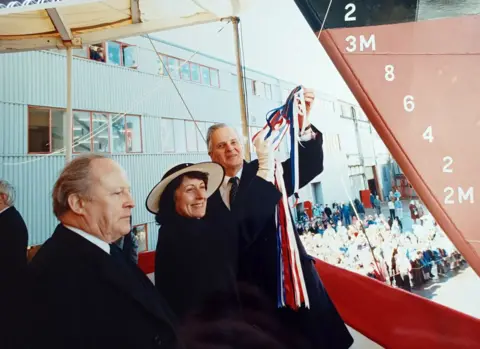
The current MV Lord of the Isles, or Loti as it is often known, was built in 1989 by the Ferguson shipyard, which is now owned by the Scottish government.
It is not yet clear if the Port Glasgow shipyard intends to submit a bid to build the ship's replacement.
 Ferguson Shipbuilders
 Ferguson Shipbuilders
In September, trade unionists, local politicians, civic leaders and the Bishop of Paisley wrote to the first minister urging a direct award of the Loti replacement contract to Ferguson's to help it rebuild its reputation after a "bruising 10 years".
The size of the proposed new ship is seen as well-suited to the yard, unlike the overbudget dual-fuel ferries Glen Sannox and Glen Rosa, which at 102m (335ft) were at the very limit of the yard's capabilities.
But a month ago, Scottish ministers rejected the appeal when they announced that the Loti replacement contract would go to competitive tender.
At the same time they signalled their intention to directly award contracts to Ferguson's for four future ships - two fisheries vessels and two small ferries - if they remain in government after the election.
Why do UK shipbuilders think social value scoring is fair?
Naval shipyards such as BAE Systems in Glasgow and Babcock in Rosyth benefit from a tradition of only awarding contracts for complex warships to domestic yards.
But commercial shipbuilders, such as Ferguson Marine, Cammell Laird in Merseyside and Belfast's Harland & Wolff, struggle to compete with overseas competitors on cost.
Last summer Tom Chant, from the Society of Maritime Industries, told MPs that a mix of better state support, tax breaks and cheaper labour costs mean shipyards in countries like Poland and Turkey typically undercut UK shipbuilders by 10-20%.
He argues that too much focus on the headline cost ignores the extra value of investing in the local supply chain which can be lost if the investment goes abroad.
The UK's most recent national shipbuilding strategy called for minimum 10% social value weighting in publicly-funded procurements to maximise opportunities for UK suppliers.
The Procurement Reform (Scotland) Act 2014 which applies to bodies like CMAL does allow for "community benefit" requirements provided they do not conflict with the principles of equal treatment and non discrimination.
Last April, Ferguson's bid for the contract to build seven small ferries fared well in the quality evaluation but it was undercut by the Polish firm Remontowa on cost.
After naming Remontowa preferred bidder for the £147.5m order, CMAL agreed a community benefit that involved some Ferguson apprentices taking part in sea trials of the new vessels.