'Having trees in our cities is increasingly important'

 Getty Images
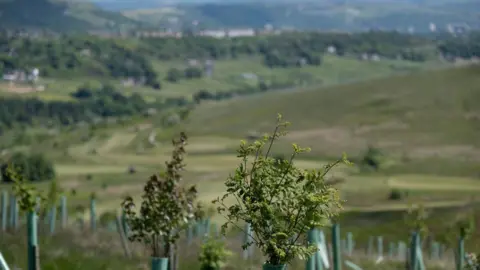
From forest bathing to tree hugging, we have long known woodlands are good for us but alongside the mental health benefits they also help fight climate change and prevent flooding. Now North and West Yorkshire are set to see thousands of hectares of new woodlands planted.
Residents and experts have welcomed the announcement that funding has been approved to extend the White Rose Forest programme, which is led by Kirklees Council.
The scheme supports landowners to plant trees in towns and cities and along river catchments to combat flooding.
Last week funding for the tree-planting programme - which has already seen three million trees planted - was approved to continue up to 2030.
Dr Cat Scott, an associate professor at the University of Leeds, has been collaborating with the White Rose Forest scheme and researches the environmental benefits of woodlands.
"There's increasingly more evidence to suggest when people spend time in nature, it has really positive benefits for stress levels [and] increases levels of calmness and we think that's really important for people's well-being," she says.
"We know that being able to access green spaces is really important but we also know that for some parts of the city, they really don't have as much green space and canopy cover as other parts of the city.
"So the more we know about how beneficial it is to spend time in forests, in woodlands, the more important it is that we make sure that everyone gets access to these spaces."
 Getty Images
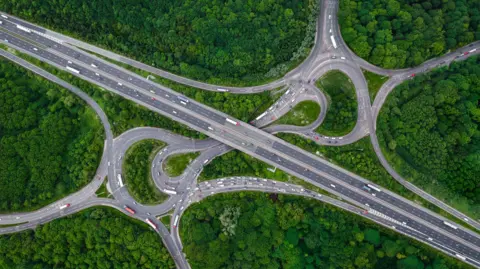
Dr Scott says one of the most important measures is "canopy cover" which is how much of a city is covered by green when seen from above.
"If you add up all the individual trees in people's gardens... we might not think about that as being kind of a continuous canopy but actually, when you add it all together, that's how we work out the percentage of canopy cover that a city or a town would have," she says.
The goal is to increase tree canopy cover across the White Rose Forest region from the current level of 12% to 16.5-18.5%.
"Not only do trees take in carbon but they're providing shade, they're providing cooling through a process called evapotranspiration," she explains.
"That means the trees are taking water from under the ground, transporting it through their trunks, out of their leaves and into the air. That process actually cools down the local environment.
"That's why we think that having trees in our towns and cities is important and it's going to become more important the hotter things get."
 Walkers Are Welcome
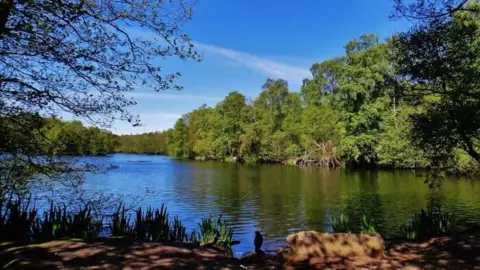
Pam Laking is a volunteer with the Friends of St Ives whose members look after the 550-acre country park and ancient woodland in Bingley on the suburban edges of Bradford.
The park compromises a mix of wooded areas, pine plantations, meadows, moorland and ponds.
The group recently started a planting project after nearly 5,000 Larch and Sweet Chestnut trees on its land were hit by the disease Phytophthora Ramorum.
"One of the woodlands that went when it was all chopped down, I always used to think of it like a cathedral," says Laking.
"That might sound a bit romantic but they were so tall and they were so high and the ground was full of the little spindly bits that you get off fir trees so that as you walked your footsteps were completely silent."
Now the group is replanting the area with indigenous trees such as oaks.
"It will come back but probably not in my time," she says.
 Friends of Judy Woods
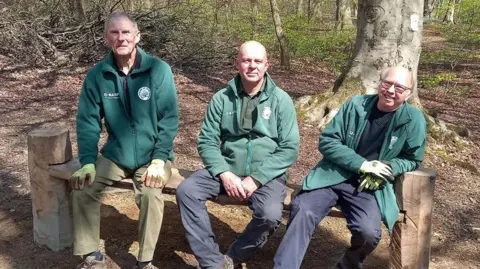
On the other side of Bradford is Judy Woods, which extends for about 1.25 miles (2km), and is owned and managed by Bradford Council and maintained by the Friends of Judy Woods.
The group has about 130 members, 30 of whom are active volunteers, helping to build dry stone walls, paths and fences.
Volunteer Stuart Tordoff says it is recognised as ancient woodland and was part of the Royds Hall estate before it was purchased by the council in 1982.
"I was brought up in the area and I used to play in the woods when I was young," he says.
"We've got a lot of squirrels, we get deer in the top end of the woods where there's more undergrowth and I think somewhere there is a badger set."
He finds being in the woodlands relaxing and says volunteering for the group is not just doing good for the environment but for the community too.
 Getty Images
Part of the White Rose Forest project is encouraging people to plant trees in their own gardens - but it is important to think about what sort of tree is appropriate.
"If you have a house with a small area of land and you plant a great big oak tree within about 30 or 40 years you're going to find your house subsiding all over the place," says Laking.
"Think about the kind of size of tree that you might like to end up with," says Dr Scott.
"I would encourage people to think about the fact we are heading into a warmer climate and we might want to be planting trees now to create shade and to create cooler places in our gardens in the decades to come."
And of course one tree can become something much bigger.
"If you grow your own baby tree and look after it and nurture it, you're seeing the whole cycle," says Laking.
"A few years ago, there was a big fire at York Minster and they put out a call for anywhere that could spare very tall, long oaks and we provided one.
"So part of York Minster is a great big enormous long lump of oak tree from Bingley."
Listen to highlights from West Yorkshire on BBC Sounds, catch up with the latest episode of Look North.