State-owned shipyard 'blocked' from bidding for new CalMac ferry

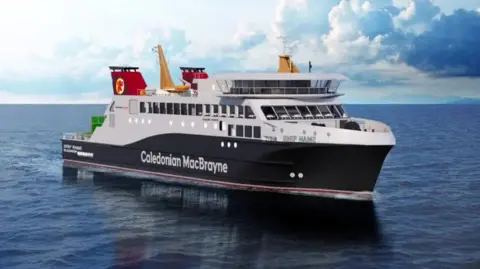 CMAL
CMALScotland's publicly-owned shipyard says it has been blocked from bidding to build the next large CalMac ferry.
Ferguson Marine said it was unable to bid to build a replacement for MV Lord of the Isles because eligibility rules set by ferries procurement agency, Caledonian Maritime Assets Limited (CMAL) have, in effect, excluded UK shipbuilders.
The GMB union said it "beggars belief" and called on the board of CMAL - which is owned by Scottish ministers - to pause and review the tendering process
CMAL said it had chosen a selection system which it believed would ensure the best outcome for island communities.
Shipyards are not automatically allowed to bid for taxpayer-funded ship orders in Scotland.
First they have to complete a Single Procurement Document Scotland (SPDS) - a questionnaire asking about things like financial status, capability and previous experience.
CMAL then draws up a shortlist of about six firms which are invited to tender detailed bids for evaluation.
The latest SPDS asks for a minimum of two examples of ships longer than 75m delivered by the shipyard in the past five years, but this does not include ongoing projects - something which was allowed in previous procurements.
Ferguson Marine delivered MV Glen Sannox in November 2024 but a second large CalMac ferry MV Glen Rosa is not due for delivery until the end of this year.
UK shipyards 'at a disadvantage'
Ferguson Marine has now confirmed it will not submit a bid for the Lord of the Isles replacement vessel because of CMAL's eligibility criteria and the lack of "social value" scoring in the evaluation process.
Chief executive Graeme Thomson said: "While we were eager to bring this project back to the Clyde, a rigorous review of the tender prequalification criteria indicates that, in our view, it is unlikely that any UK shipbuilder would meet the stipulated minimum qualification requirements.
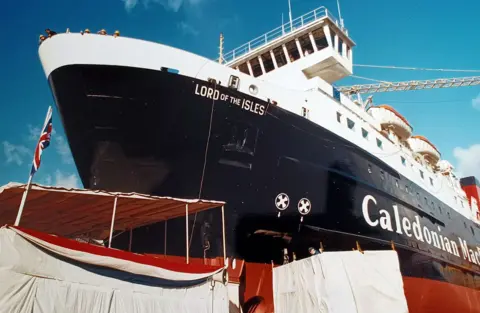
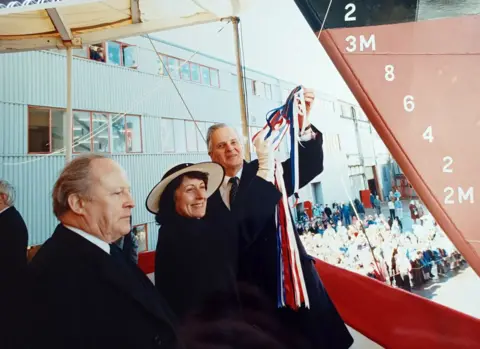
"The original vessel was built here at Ferguson's and has served the CalMac fleet for 36 years, a testament to the enduring quality of Scottish craftsmanship.
"However, without a procurement model that scores UK social and economic value and builds domestic supply chain resilience, which is in line with government nationwide guidance, UK shipyards remain at a disadvantage against heavily subsidised foreign competitors."
BBC Scotland News reported earlier this month that social value scoring would not be part of CMAL's evaluation and that "community benefits" would only be negotiated after a preferred bidder was named.
 GMB Scotland
The GMB, the main trade union representing Ferguson workers, called on CMAL to "urgently pause" the tendering process and explain why Ferguson's and other UK yards have been "effectively blocked from bidding".
GMB Scotland general secretary Louise Gilmour said: "It beggars belief that a Scottish public body would bar a publicly-owned Scottish shipyard from even bidding to build a Scottish ferry."
She added: "There could not be a clearer example of the self-harming procurement policies that have sabotaged our country's industrial capability and economic growth for too long.
"There can be no other country in the world as happy to send contracts abroad instead of using them to support jobs, apprenticeship and communities at home.
"Taxpayers deserve value for money but the bottom line of any bid means nothing if the social and economic value to our communities is not properly taken into account."
CMAL defended the wording of the questionnaire, and is understood to have turned down a request to modify it.
A spokesperson said: "The questions in the SPDS (Single Procurement Document Scotland) have been designed to ensure the best outcome for island communities."
 Ferguson Shipbuilders
 Ferguson Shipbuilders
While delays and overspends with the dual-fuel ships MV Glen Sannox and MV Glen Rosa are well documented, the GMB has argued that the smaller and less complex Lord of the Isles replacement vessel is a good fit for Ferguson's capabilities.
Both the union and the shipyard had asked for a direct award of the contract.
This was rejected in March, although Scottish ministers signalled an intention to directly award four other vessels in future if they remain in power.
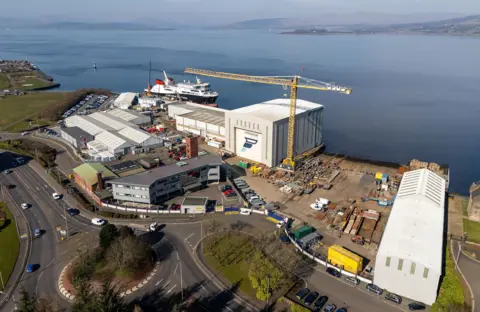
Ferguson's, founded in 1903 and now the last remaining shipyard on the lower Clyde, has built about half of CalMac's current large vessels fleet, including the existing Lord of the Isles, known as Loti, in 1989.
Since the early 2000s, however, it has struggled to compete on cost with overseas competitors in countries like Poland and Turkey.
While it has plans to raise productivity with promised investment including a new semi-automated plating line, the firm faces a potential order gap next year after delivery of Glen Rosa.
Last year the Society of Maritime Industries told MPs that a combination of better state support, tax breaks and lower labour costs typically allowed overseas shipyards to undercut UK yards by 10-20%.
The UK's National Shipbuilding Strategy has called for social value - things like training and supply chain benefits - to be scored as part of publicly-funded orders, in order to give UK shipbuilders a better chance of winning contracts.
CMAL has rejected this, arguing it could conflict with its duties under Scottish procurement law which requires it to adhere to principles of "equal treatment" and "non-discrimination".
CalMac ferries were among a 150 vessel, 30-year pipeline of potential orders listed in the 2022 refresh of the National Shipbuilding Strategy
But since then many of those vessels have gone to overseas shipyards.
A Ministry of Defence contract to provide 24 Royal Navy support vessels such as tugs was subcontracted to Serco which then gave the shipbuilding order to Dutch firm Damen.
An order for a new Northern Lighthouse Board vessel, Pole Star, went to Spain and CMAL has placed ferry orders worth about £570m with overseas companies in Turkey, Poland and China since 2022.