Swinney softens stance on North Sea drilling as oil prices soar

 Getty Images
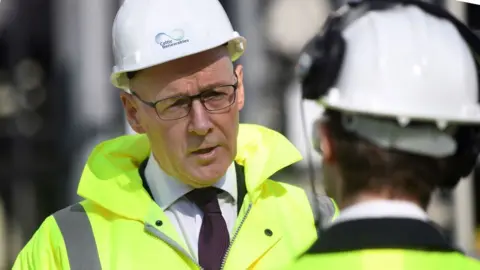
First Minister John Swinney has signalled a softening of his stance on new oil and gas drilling in the North Sea.
The SNP leader said that energy security should be considered in any new decisions on further exploration - which are made by the UK government - as oil prices soar due to the war in Iran.
The Scottish government set out a presumption against licensing new offshore fossil fuel developments in 2023, but Swinney repeatedly refused to confirm the SNP's commitment to that position.
The Scottish Greens said the SNP were no longer serious about tackling the climate crisis.
Oil prices spiked on Wednesday after US President Donald Trump said his military would hit Iran "extremely hard" in the ongoing conflict.
The US-Israeli war with Iran has led, in effect, to the closure of the Strait of Hormuz, a key shipping lane which a large proportion of the world's energy supply passes through.
The price of brent crude oil, the international benchmark, increased from about $70 in late February to well over $100 by late March - leading to a record rise in petrol and diesel prices.
Control of licensing for oil and gas exploration in the North Sea lies with the UK government, which under Labour has a policy of not permitting new developments.
However, that opposition has softened since the last general election, with permission for new drilling on or near existing fields, known as "tiebacks", being granted last year.
UK Energy Secretary Ed Miliband and the industry regulator, the North Sea Transition Authority, are currently considering whether to give final approval to two major oil and gas fields - Rosebank and Jackdaw.
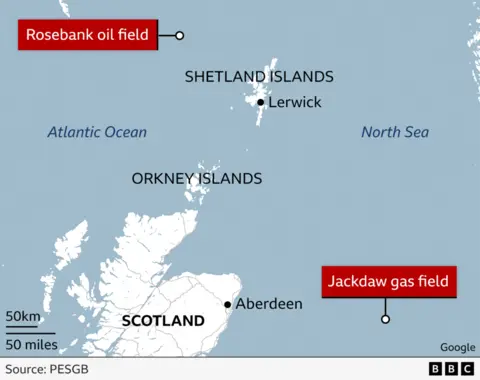
Jackdaw, which is about 150 miles east of Aberdeen, is a gas field which could be connected to the UK network within months.
Rosebank, about 80 miles north-west of Shetland, is Britain's largest untapped oil field - which would also produce some gas - and would take longer to become operational.
Both sites have already been granted licences, though work to begin extracting oil and gas from them has been halted due to legal challenges from environmental groups.
Energy firms have been told they will not be able to begin production at Jackdaw or Rosebank until a fresh decision has been made by the UK government.

Swinney has consistently said new oil and gas projects would have to comply with climate compatibility tests.
But campaigning in Edinburgh ahead of next month's Holyrood election, the first minister said energy security had become a "more significant" issue when deciding whether to back new drilling in the North Sea due to the crisis in the Middle East.
He told BBC Scotland News that any proposed projects "must take into account the need for energy security for households and businesses in Scotland".
The first minister repeatedly refused to confirm if the SNP had dropped its presumption against new North Sea developments.
Speaking to the Holyrood Sources podcast on Wednesday, Swinney said the war in Iran and the consequential threat to the UK's energy supply had changed the "balance of arguments" about North Sea drilling.
'Drill baby drill'
In Edinburgh, Scottish Liberal Democrat leader Alex Cole-Hamilton said permission for Rosebank and Jackdaw should be seriously considered if it is found to be more environmentally sound than importing oil and gas from "potentially sketchy regimes".
Labour's Anas Sarwar, who has has backed drilling at Rosebank and Jackdaw, called for a "balanced approach" of using oil and gas, renewables and ending the Scottish government's effective ban on nuclear power.
Scottish Conservative leader Russell Findlay, in Midlothian, called for the UK to "drill baby drill".
While backing a long-term transition to renewables, he said oil and gas will also be needed for years to come and that uncertainty over the UK policy had cost jobs.
However, Scottish Green co-leader Ross Greer told BBC Scotland News that increasing dependence on oil and gas would weaken the country's energy security.
He added that the answer was to switch to "clean, green renewable electricity".
Reform UK, which did not hold a media event on Thursday, has committed in its Holyrood manifesto to North Sea oil and gas exploration and opposition to "all SNP net-zero related targets".
 Getty Images
Although offshore drilling is controlled by Westminster, the Scottish government can make decisions on planning and onshore facilities which can affect offshore production.
Nicola Sturgeon's government called for the "fastest possible managed and just transition away from dependence on oil and gas".
Her successor as first minister, Humza Yousaf, said consent for the Rosebank oil field was the "wrong decision".
But Swinney's view was clouded by the fact his government did not publish an energy strategy before the Scottish Parliament broke up for next month's Holyrood election.
The last draft plan, published in 2023, included a "presumption against" new oil and gas developments.
In 2024, Swinney accused the former Conservative UK government of "climate denial of the first order" when it announced plans to open 100 new oil and gas fields without scrutiny.
Chancellor Rachel Reeves told the BBC this week she was "very happy" to support drilling at Jackdaw and Rosebank because of the positive impact on "jobs and tax revenue".
But Energy Secretary Ed Miliband recently told the BBC that the lesson from the current crisis was that the UK needed "home-grown, clean power that we control".
Would North Sea drilling improve energy security?
According to industry body Offshore Energies UK, oil and gas supplies about 75% of the UK's energy needs and will meet about a fifth of demand by 2050.
Prof Paul de Leeuw, director of the Energy Transition Institute at Robert Gordon University, said that while is was essential to make the world greener and cleaner, having the North Sea on its doorstep was helpful for the UK during an energy crisis.
"It is particularly helpful on gas, which can pump straight into the gas system here," he told BBC Scotland News.
"And it is helpful for oil resilience in the region, because, even if we might not be able to refine the crude oil ourselves, we get it back as refined products, and that, of course, is benefiting all the consumers here."
Prof de Leeuw said that Jackdaw could produce about 6% of the UK's gas demand.
He told BBC Scotland News that the UK gets about 85% of its gas from the North Sea - from both UK and Norwegian sites - with the rest predominantly made up of liquified natural gas shipped from the US.
Due to the crisis in the Middle East, demand and prices for the US gas supplies are increasing.
 PA Media
Prof de Leeuw said Rosebank would take longer to come "on stream".
Most of its oil - which is owned by multinational companies - would be sent to the Netherlands because the UK's remaining refineries are not set up to process the heavier type of crude oil extracted from the North Sea.
The refined products - such as diesel or jet fuel - would then have to be reimported to the UK.
Prof de Leeuw added that opening up Rosebank and Jackdaw would help increase energy security in Europe, which is heavily reliant on imports from elsewhere, as Sir Keir Starmer aims to forge closer economic ties with the EU.
How would Rosebank and Jackdaw affect climate emissions?
Shell estimates that gas from the Jackdaw field could produce 35.8m tonnes of carbon over its lifetime, the equivalent of 90% of Scotland's emissions for 2023.
However, the energy giant says the field would be more likely to produce about 23.6m tonnes - equivalent to 60% of the 2023 figure, and the figure is less than if gas has to be imported from abroad.
The downstream/end use emissions from Jackdaw are a fraction of those estimated for the Rosebank oil field, where the extracted oil is expected to produce almost 250m tonnes over its lifetime.
Paul Morozzo, senior climate campaigner for Greenpeace UK, said more North Sea drilling would not improve energy security "one jot".
"Any oil and gas belongs to the company that drills it and will be sold at global market prices to the highest bidder," he said.
"Homegrown renewables are already providing far more of our electricity than fossil fuels, and as the economy electrifies the role of oil and gas will continue to shrink."
Morozzo said more wind and solar power would reduce dependence on oil and gas and create more secure jobs.
He added: "They are also our best insurance policy against the fallout from wars and the impacts of climate change."

Would you like to be in the audience for BBC Scotland's leaders debate?
The special episode of Debate Night, hosted by Stephen Jardine, will take place between 19:00 and 20:30 on Sunday 12 April in Paisley Town Hall.
The leaders of the Scottish Conservatives, Scottish Greens, Scottish Labour, Scottish Liberal Democrats, Scottish National Party, and Reform UK have been invited to take part.
You can apply to be part of the audience at bbc.co.uk/debatenight or by clicking this link.