Gannet population falls by almost a third since bird flu outbreak

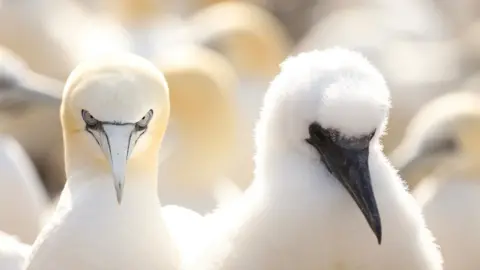 Pete Ivin
The population of the world's largest northern gannet colony has fallen by nearly a third since an "unprecedented" outbreak of bird flu.
Researchers believe the Bass Rock, which stands off North Berwick in the Firth of Forth, is home to more than 100,000 seabirds, but breeding success remains "low".
Drone surveys carried out last year found colony numbers had "stabilised" since the high pathogenicity avian influenza (HPAI) virus decimated breeding season in 2022.
However, the overall population is believed to have fallen by about 30% since then.
An estimated 52,459 Apparently Occupied Sites (AOS) used for nesting were identified via aerial photography carried out in July 2025.
It marks a rise of about 6,000 AOS since 2024 but remains about 22,800 below the last complete pre-HPAI count in 2014.
A 'site' in the colony is an area being occupied by a single bird or a pair of birds.
The research was carried out by a team from the Scottish Seabird Centre, Edinburgh Napier University, the University of Edinburgh's School of Geosciences, and the UK Centre for Ecology and Hydrology.
They said declines were observed across most count areas with "no evidence of a major population recovery".
Emily Burton, conservation manager at the Scottish Seabird Centre, said: "It has been devastating to see the impacts of avian flu on seabirds in recent years, including on the Bass Rock where the gannet population has plummeted by almost a third.
"It's critical that every effort is made to reduce pressures on these incredible birds to help them recover.
"It's an astonishing island and home to one of the world's great wildlife spectacles that we must conserve for future generations."
 University of Edinburgh
Nature Scot estimated a minimum of 11,175 gannets died during the 2022 outbreak.
Populations of great skua, guillemot and kittiwake were also badly affected.
An estimated 97 million birds were killed worldwide.
The team also monitored how successfully gannets were raising chicks using remote ground-based cameras.
They found the loss of experienced adult birds and ongoing challenges faced by seabirds at sea had impacted breeding success.
Dr Sue Lewis, of Edinburgh Napier University, said: "By combining drone surveys with remote camera technology, we've been able to gain an unprecedented level of insight into breeding success across the colony.
"The drone imagery has allowed us to estimate population size with far greater clarity than previously possible, making the counting process much more accurate and efficient, while the cameras have provided a uniquely detailed view of breeding behaviour."
Dr Lewis added: "Following the devastating impacts of 2022, these technologies have been invaluable in helping us better understand how the colony is recovering."