Philippine ex-president Duterte to stand trial as ICC confirms crimes against humanity charges

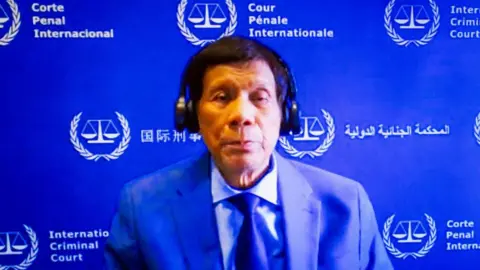 International Criminal Court / Handout/Anadolu via Getty Images
Rodrigo Duterte, the former president of the Philippines, will stand trial for crimes against humanity after judges at the International Criminal Court (ICC) confirmed his charges.
The 81-year-old is accused of the extrajudicial killing of thousands during his deadly "war on drugs" between 2011 and 2019.
Those charges that were "unanimously confirmed" by pre-trial judges, who had "substantial grounds to believe" that Duterte had committed the alleged crimes, the ICC said in a statement on Thursday.
The confirmation of Duterte's trial comes after several appeals by the ex-president to be released from detention, where he has been held for more than a year.
Duterte has refused to recognise the ICC proceedings, arguing that during his presidency in 2019 the Philippines had pulled out of the Rome Statute, the ICC's founding agreement.
But on Wednesday, judges in the ICC's Pre-Trial Chamber ruled that the court could still hear Duterte's case, given that the alleged crimes had happened between 2011 and 2019 - while the Philippines was still a member of the ICC.
According to the ICC, judges have also authorised more than 500 victims to take part in proceedings.
At the heart of the trial is Duterte's "war on drugs" campaign, which human rights groups say targeted and killed small-time drug dealers while failing to nab the kingpins.
Duterte has denied the allegations - condemning the charges against him as "an outrageous lie". The police maintained that they only killed in self-defence.
Duterte's lawyers had argued that the former president was unfit to participate in ICC proceedings due to cognitive impairment.
But ICC judges rejected the argument and, citing medical experts' opinions, said they believed Duterte was fit to take part in the proceedings and effectively exercise his procedural rights.
Duterte's arrival at the Hague last year, after he was arrested at a Manila airport, was the result of a falling out between his daughter Sara and the incumbent president Ferdinand Marcos Jr.
A 'bittersweet' moment
The ICC trial has been hailed as a historic moment by critics of his deadly crackdown on drugs.
Leila de Lima, a member of the Philippines' House of Representatives and one of Duterte's staunchest critics, said the confirmation of his crimes against humanity charges marked "a great day for the fighters against impunity and state-sponsored violence".
"The wheels of justice should have not taken this long to turn. But we take what we are dealt with for the sake of the rule of law," she said.
"Today we celebrate even as we grieve for those we lost to Duterte's madness."
Human rights organisation KARAPATAN described it as "vindication of the Filipino people's efforts to uphold and pursue justice and accountability for the killings of thousands under Duterte's bloody regime".
They added, however, that the development was "bittersweet".
"The thousands of lives taken by those who spit on human dignity cannot be brought back. Their families remain stricken with grief on their loss, and the majority remain as poor as ever," they said.
"Extrajudicial killings continue... in most places in the country where injustice and impunity continues to reign."
Malacañáng Palace, the office of the Philippine president, also welcomed the news.
Ex-president Duterte, however, retains a fervent base of supporters who have staged protests against his detention.