Judge halts above-ground construction of Trump's White House ballroom

 Getty Images
A US judge has halted construction of the above ground portion of President Donald Trump's White House ballroom project, but has allowed plans for an underground bunker to proceed.
Judge Richard Leon wrote in his ruling on Thursday that Congress must approve the project, adding that Trump appeared to be trying to side-step a previous court order by reclassifying the ballroom plans as vital for national security.
"National security is not a blank cheque to proceed with otherwise unlawful activity," the judge wrote.
The justice department has filed a notice of an appeal. Trump wrote on social media that the ballroom was "needed now" and that "no judge can be allowed to stop" it.
It is the latest setback for Trump's ballroom plans after the judge temporarily halted the construction project in late March, ruling that proper procedures were not followed before it began.
That decision came after the White House was sued by the National Trust for Historic Preservation.
In the lawsuit, the preservation group argued that the White House had broken the law by beginning construction without filing plans with the National Capital Planning Commission, by not seeking an environmental assessment of the project and by declining to seek authorisation from Congress.
It also alleged Trump was violating the US constitution, "which reserves to Congress the right to dispose of and make all rules regarding property belonging to the United States".
Trump wrote in two Truth Social posts on Thursday that the project was being constructed on budget and ahead of schedule.
He accused the judge of "attempting to prevent future Presidents and World Leaders from having a safe and secure large scale Meeting Place".
He also said the underground portion of the ballroom - which he has described as a "shed" for the complex below - "doesn't work, isn't necessary, and would indeed be useless, without the above ground sections".
The president said the complex would include bomb shelters and medical facilities, along with other structures and equipment, though little is known about the overall plans.
"It's all tied together as one big, expensive, and very complex unit, which is vital for National Security and Military Operations of the United States of America!" Trump wrote.
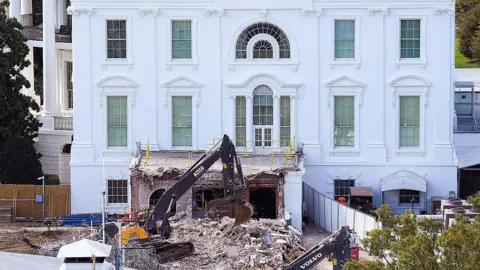
The East Wing of the White House, which was constructed in 1902, was demolished in October to make way for the multi-million dollar ballroom.
Since then, the proposed blueprint has expanded from a ballroom with a capacity of 500 people to a space that can fit 1,350 guests.
The White House has said the project was expected to cost $400m (£302m) and was being funded entirely by private donors.
The ballroom is just one of Trump's controversial plans to reshape Washington's landscape.
A federal panel gave preliminary approval on Thursday for his 250ft (76m) victory arch in the nation's capital, even as members of the public and preservationist groups gave overwhelmingly negative feedback.
Still, the Commission of Fine Arts, a panel made up of Trump allies, voted to move forward with the plans, with some tweaks.
The White House unveiled the plans for the gold-accented giant victory arch, dubbed the "Arc de Trump", last week.
The giant monument, if given final approval, would be taller than the US Capitol building and the Lincoln Memorial, and would feature a golden Lady Liberty-like statue with a torch and crown.
US taxpayers will help fund the project, according to a publicly available spending plan for the National Endowment for the Humanities (NEH) released by the White House.
The NEH will dedicate $2m (£1.5m) in special funds and $13m in matching funds to the project, it says.
Trump has previously said that since his ballroom project was "fully financed", some of the leftover money would be used to fund the arch.