Ex-BBC producer says 'someone else' downloaded child abuse images to his devices
 BBC
BBCA former BBC producer has claimed he is the victim of "someone else looking at pornography" on his devices, a court has heard.
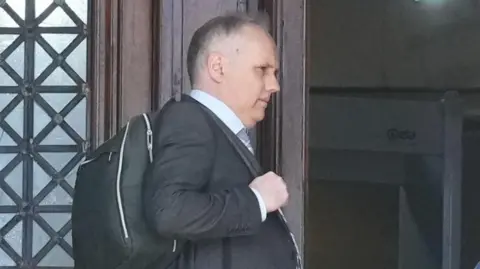
Dylan Dawes, 50, from Cardiff, is accused of six counts of possessing or making indecent photographs of children, after images were found on four devices that belonged to him.
Dawes said colleagues at BBC Wales' former headquarters in Llandaff would regularly use others' equipment, including a personal hard drive and laptop belonging to him.
In 2022, police seized the devices from Dawes' home and they contained more than 6,200 indecent images of children, including almost 200 category A images - the most serious.
Dawes denies all charges.
Cardiff Crown Court heard Dawes had worked in the building since 2001, mainly in a large, open-plan office.
Giving evidence, Dawes said staff did not have their own desks.
He was issued with a work laptop, which was not common at the time, but said he would also bring in his own devices from home for practical reasons, including some software not being available on his work computer.
This included his own Compaq laptop and Freecom hard drive, which were often left unattended in the office and which colleagues would use "on a regular occurrence" to store or move data.
"Other people would use it, in the same way other people would use all of my kit," he said.
"Storerooms were littered with other people's hard drives."
Dawes said the older of his personal iPads had "definitely" been taken to the office, but that he did not believe the newer iPad had been.
Andrew Taylor, defending, asked Dawes if he had an interest in "child pornography" to which he replied: "Absolutely not."
He said he had viewed "adult heterosexual pornography" on a family iPad, but cleared its search history because the device was also used by his children.
"Have you any idea as to how the [indecent] images may have found their way onto these devices?" asked Taylor.
"I have no idea," replied Dawes.
"Can you point your finger in any direction as to who might be responsible for these images?" asked Taylor.
"Absolutely not," replied Dawes.
During cross-examination, Harry Baker, prosecuting, asked Dawes why he had said in police interview he was "not aware" that he had viewed indecent images of children, rather than flatly denying it.
"That was the correct language [to use]," replied Dawes.
"It was extraordinarily stressful at the time."
Dawes denied having searched the term "jailbait" on his laptop, and said he had "never" seen pictures of underage girls while browsing adult pornography websites.
The court heard a Gmail account belonging to Dawes had been suspended about three or four weeks before his arrest on 28 February 2022.
That email address, he said, was quoted by officers when they initially arrived at his home.
Baker asked whether that account's suspension had prompted Dawes to "try and delete everything", to which the defendant replied: "No, that's not correct."
Baker said: "You realised there was something up when the account was suspended?"
"No, because there was nothing on that account," said Dawes.
Asked about the Freecom hard drive, Dawes said that although he had bought it initially, "it became a work hard drive by default" because of how often colleagues would use it.
He said there was an element of "trust" between colleagues who used each others' equipment, adding: "I'm not saying that was company policy, I'm just saying that's what people did to get their job done."
He said that devices would often be left unattended in the office, or even taken "out of the building".
Asked whether he had ever seen the indecent images found in the hard drive's recycle bin, Dawes replied: "Absolutely not."
"But they're in your recycle bin?" said Baker.
"Would you agree that it's an unfortunate coincidence that [indecent images have] been found on four of your devices?"
"It is unfortunate," said Dawes.
"Would you say a more sensible explanation is that the owner of the four devices might have put them there?" asked Baker.
"No, I would not, because I did not put them there," replied Dawes.
Baker then asked: "What we're saying is that you are the victim of someone else looking at pornography?"
"Most definitely, yes," said Dawes.
Asked why he had not tried to identify who that might be, Dawes said "it would be pure speculation", and that he would not "start throwing names around".
"Is the truth because you have no answers and you're hoping to bluff your way out of it?" asked Baker.
"I'm not trying to bluff my way out of anything," replied Dawes.
"The truth is that you have downloaded and viewed child pornography?" said Baker.
"That's categorically not true," said Dawes.
Witness Joseph Gooden, who worked at the BBC from 2000 until 2016, and shared an office with Dawes during that time, said he could not remember having his own "dedicated hard drive" during that time, and people would often "muck in and grab what we needed" for particular projects.
"In those days, was there any policy that said hard drives had to be locked away or password protected?" asked Taylor.
"In around 2014 we had a discussion about [it]," said Gooden. "But it was absolutely new to all of us at the time."
Forensic technology expert Jordan Myhill, who had examined Dawes' four devices, said a Google search had been made on the laptop for the term "jailbait", but that there was no timestamp listed.
Taylor said that Myhill would have been familiar with common search terms for child abuse images and "none of them appear to be on these computers, do they?"
"No," responded Myhill.
The trial continues.