A Kashmir tourist hotspot became a deadly bloodbath. A year on, the pain remains unbearable

 Tariq Khan/BBC Hindi
One year after a deadly attack on tourists in Indian-administered Kashmir, the families of the victims are still learning how to live with their losses.
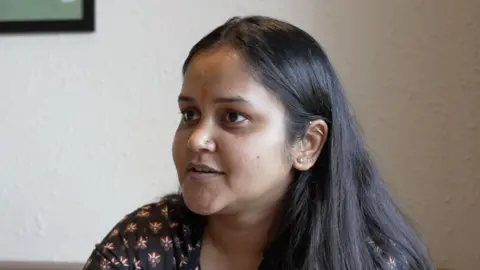
In the room she once shared with her husband, Aishanya Dwivedi points to a mirror on the wall.
"I once asked him why there was no mirror there," she said. "The next day, he got one."
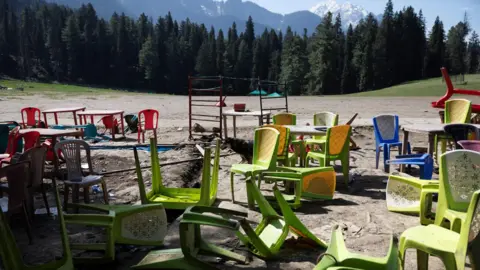
Aishanya's husband, Shubham Dwivedi, was among 26 people killed on 22 April 2025, when militants opened fire on tourists near the town of Pahalgam - one of the deadliest attacks on civilians in Kashmir in decades.
The region is claimed in full by both India and Pakistan but administered in parts by each, and has been the cause of wars between them.
Delhi blamed Pakistan for the attack in Pahalgam, alleging the killings were carried out by a group based in the country - a charge Islamabad denied. Two weeks later, India launched air strikes at what it said were bases used by militant groups. What followed were four days of intense shelling and aerial attacks between the two nuclear-armed neighbours, until a surprise ceasefire was announced.
In India, outrage spread also over the nature of the Pahalgam attack, which targeted mostly Hindu men. Several of the victims were young travellers - at the beginning of marriages, careers, their lives brutally cut short.
Warning: Some readers may find the details below upsetting
In the year since, the scale of the tragedy has been measured in official statements, security reviews and tightened restrictions.
But its consequences are felt most heavily in private spaces - in homes where grief has not receded with time, only changed shape.
For Aishanya, the bedroom has become a way of holding time still.
The things she keeps are not, at first glance, remarkable.
But nothing has been moved. The bed, the cupboard, the mirror Shubham bought, have all been preserved exactly as they were.
"That side of the bed is Shubham's," she said, pointing at the bed. "I don't sit or lie down there. Even in sleep, I avoid it. I keep pillows on that side."
 Reuters
She still remembers the day in detail - how ordinarily it began.
The couple had got married just two months earlier and were on a short holiday in Kashmir with nine other family members.
On the day of the attack, Shubham and Aishanya went to Baisaran valley, a gorgeous meadow high above Pahalgam, while the rest of the group stayed behind in the main town.
In interviews later, Aishanya spoke about how, as they walked through the meadow, a man approached them, asked her husband what his religion was and then shot him. She pleaded with the attackers to kill her as well, she has said, but they did not.
"I did not get enough time to make a lot of memories," she told BBC Hindi. "Yet, Shubham gave me so many memories to live with."
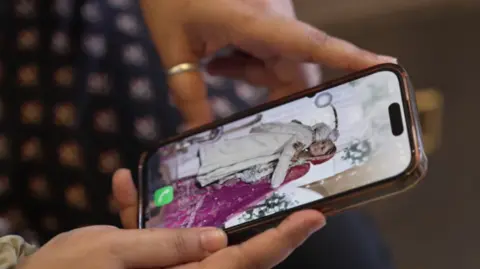
On her phone, the lock screen still has a candid moment from their wedding, while in her gallery she scrolls back, further and further, to find Shubham again.
Sometimes she plays old videos of him, listening closely, trying to hold on to the smallest details. "I try to remember how his voice sounded... how he would giggle," she said.
 Tariq Khan/BBC Hindi
In the months after the attack, Aishanya began speaking about Shubham often. At first, because people asked. Then because it helped.
"Speaking to the media has been like therapy for me," she says. "I have become immune to it."
But public expressions of grief, too, have brought their own complications.
Dwivedi described being trolled online after she said that Prime Minister Narendra Modi should have named the victims in his speech in parliament after India launched air strikes. The backlash, she said, has not deterred her.
"I will speak, I will go out, I will do everything I want," she said. "Those people [trolls] are nobody to dictate how I should behave after I have lost my husband."
For Aishanya, speaking has given grief a kind of structure. But for others, it is held in place by what is left unsaid.
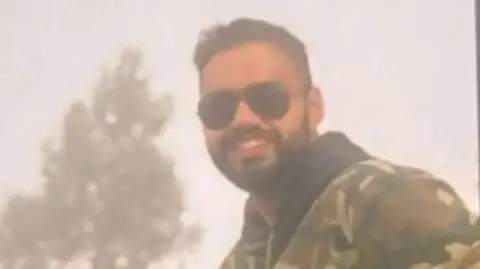
Rajesh Narwal's son, Vinay Narwal, was also among those killed. Married for less than a week, the 26-year-old Indian naval officer was on his honeymoon in Kashmir when he was shot dead. In the hours after the killings, a photograph of his wife sitting motionless beside his body went viral across social media.
 BBC Punjabi
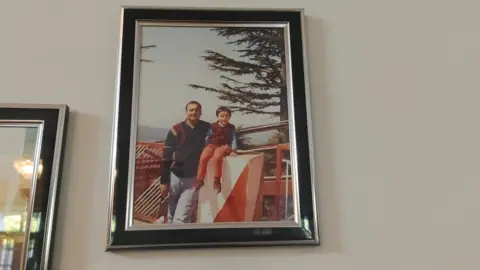
In his house, Vinay's belongings still remain packed and unopened. Many family members refuse to say his name, or talk about what happened to him.
"None of us are able to muster up the courage," Rajesh said. "We can't even bear to put his photo up anywhere in the house."
But the memories follow him everywhere.
When Vinay was a child, father and son would play cricket in the courtyard. Every day after Rajesh got back from work, the routine was the same: Vinay would be waiting, asking him to play. On holidays, the game would continue through the day.
"We are simply unable to deal with grief. We are still grieving," Rajesh said.
"I get distracted when I am working," he continued. "But the moment I come home... it feels like someone has touched a raw nerve. The pain is unbearable."
Both families have learned to live with absence in different ways.
One keeps memories alive through speaking about the person; the other preserves it through silence - but both are now trying to build lives around what is no longer there.
 Kamal Saini/BBC Punjabi
Back in Kanpur, Aishanya is still learning to pick up the pieces.
Every evening, she sits with her in-laws and speaks about Shubham for an hour - a conversation that circles around the same person and the same details, slightly reshaped each time.
"The grief of losing a son or a husband will never go away," she said. "But that does not mean we stop living our lives."
She listens to music. She writes.
"I end up crying while writing," she said. "But it is important that you cry, even scream."
A trained dancer, she has not yet been able to return to the art.
"My feet would just not move," she said, though she hopes that might change.
There are moments she cannot quite account for, except to say they felt like something.
On a flight, listening to a song Shubham liked, she looked out of the window and saw a rainbow. One evening, she stepped into the balcony and saw the Moon, and felt, for a second, as if Shubham was looking at her.
These passing instances, she said, feel like signs that Shubham is still with her.