From Epstein to sock puppets: Key takeaways from Kevin Warsh's Fed confirmation hearing

 Reuters
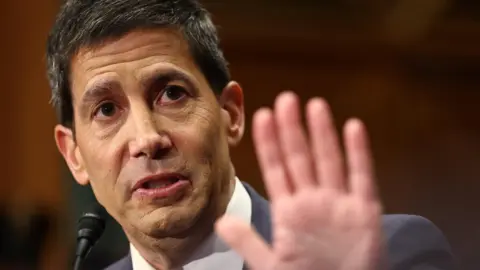
Kevin Warsh has clashed with Democratic senators during a fiery confirmation hearing to decide whether he should be installed as Federal Reserve chairman.
From suggestions that he would be President Donald Trump's "sock puppet" to questions over his links to paedophile financier Jeffrey Epstein, here are the key takeaways from Tuesday's showdown in the Senate.
Warsh denies being Trump's 'sock puppet'
Senator Elizabeth Warren, the ranking Democrat on the banking committee that is overseeing his confirmation, said Warsh would be little more as Fed chairman than Trump's "sock puppet".
Trump has suggested that, if confirmed, Warsh would conform to his agenda and lower interest rates, which the president argues is necessary to boost the US economy.
Warren said that "having a sock puppet in charge of the Fed would give the president access to the Fed's powerful authorities to enrich himself, his family and his Wall Street buddies".
Asked whether he would indeed be the president's sock puppet, Warsh said: "Absolutely not."
The former Fed governor said the independence of America's central bank "is essential" and vowed that he would be committed to preserving its self-governance.
Warsh questioned over Epstein ties
Warren, who opposes Warsh's appointment, also questioned Warsh over his potential links to Jeffrey Epstein.
Warsh has disclosed hundreds of millions of dollars in financial holdings, including an investment fund worth at least $100m (£74m), in which the underlying assets have not been detailed.
"Do the [funds] invest in any companies affiliated with President Trump or his family, companies that have facilitated money laundering, Chinese-controlled companies or financing vehicles established by Jeffrey Epstein?" Warren asked.
Warsh declined to answer the question directly, but said he planned to divest his holdings if and when confirmed as Fed chairman.
His name crops up several times in the justice department's Epstein files, though simply appearing in the records does not imply wrongdoing.
Warsh denies deal with Trump
Warsh used Tuesday's hearing to deny having agreed a deal with Trump to cut interest rates in return for being offered the job.
"The president never once asked me to commit to any particular interest rate decision, period, and nor would I ever agree to do so if he had, but he never did," he said.
Senator Ruben Gallego, an Arizona Democrat, noted the Wall Street Journal had reported last year that Trump pressed Warsh at a meeting to reduce borrowing costs.
Tuesday's hearing began just after Trump was asked in an interview on CNBC if he would be disappointed if Warsh failed to immediately cut rates.
"I would," said the president. The Fed interest rate affects everything from mortgages and car loans to business borrowing.
Thom Tillis withholds support
While backing and opposition to Warsh fell largely along party lines, Senator Thom Tillis was the lone Republican to withhold support.
Tillis, who is not running for re-election, said he actually backs Warsh's appointment to the role, praising his "extraordinary credentials".
But the North Carolina senator said he wants an inquiry into outgoing Fed chairman Jerome Powell to be dropped before he will vote to approve his successor.
Trump has frequently clashed with Powell over monetary policy.
The probe relates to an overspend on renovations to the Federal Reserve building.
Tillis said the cost overruns, while "unfortunate", were "legitimate".
Powell plans to remain in post beyond the date his term ends, 15 May, if Warsh is not confirmed. Tillis's ongoing blockade could make that prospect a reality.
Warsh wants Fed 'regime change'
Warsh vowed to introduce "regime change" at the Fed if confirmed, including an overhaul of how it measures inflation and communicates policy changes.
In his own opening remarks, he criticised the Fed's "forward guidance", which indicates the future path of interest rates.
He said this policy was "unhelpful" and he preferred "messier" Fed meetings without "rehearsed scripts".
Warsh also promised a "new inflation framework", suggesting he would deviate from the Personal Consumption Expenditures (PCE) price index used by the Fed.
It is unclear how exactly Warsh would change the way the Fed considers inflation.