Trump says he will attend birthright citizenship arguments at Supreme Court

 Getty Images
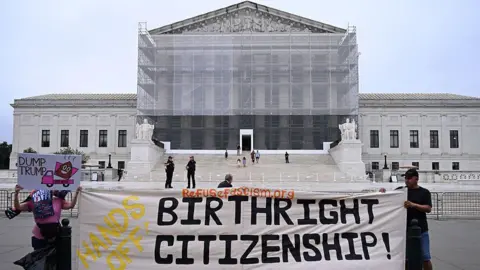
President Donald Trump has said he plans to attend the US Supreme Court arguments on Wednesday on whether the US should end its longstanding right to citizenship for anyone born in the country.
On his first day back in office, he ordered an end to automatic - or birthright - citizenship for babies born to parents who are in the country illegally or temporarily.
His executive order faced immediate opposition from those who said it went against the constitution's amendment that grants citizenship to anyone born in US territory.
The Trump administration says the order will combat "significant threats to national security and public safety". A decision is expected in the summer.
The January 2025 executive order is part of Trump's effort to reform the nation's immigration system, a cornerstone of his second-term agenda.
If he does attend the court, it is believed it would be the first time a sitting president attends oral arguments there. It would also point to the importance he sees in this change becoming law.
"I'm going," Trump told reporters in the Oval Office on Tuesday. "Because I have listened to this argument for so long."
Opponents of his executive order, including more than a dozen states and five pregnant women, quickly filed lawsuits that challenged its legality under the 14th Amendment.
That amendment was added to the US Constitution after the Civil War, partly to guarantee citizenship for former slaves.
Federal judges in three US states temporarily blocked Trump's order by issuing nationwide injunctions.
Although months away, the decision will reflect both how the six conservative and three liberal justices view Trump's immigration policies and the reach of presidential power.
Most legal scholars have said the president does not have the power to change the law with an executive order.
Last summer, the Supreme Court considered the order as part of a separate appeal on the injunctions and ruled that judges in lower courts have limited ability to block presidential orders.
In the 6-3 ruling, which Trump deemed a "giant win", the justices said they were not addressing Trump's attempt to change birthright citizenship and were only focused on the power of judges.
Now, the justices will turn to the question of birthright citizenship outright with the case Trump v Barbara, which was brought by the American Civil Liberties Union (ACLU) and other legal groups on behalf of all babies who would be affected by the order.
They argue that the order violates the part of the 14th Amendment that established that "all persons born or naturalized in the United States, and subject to the jurisdiction thereof, are citizens of the United States and of the state wherein they reside".
"Subject to the jurisdiction" means they are subject to US laws, they say, which would apply to those in the country illegally, as well as legally, and the 14th Amendment only allows for a few narrow exceptions, such as children of diplomats.
The ACLU has argued that birthright citizenship is "fundamental to who we are as a country" and it was largely followed in the US before the amendment was added.
The Trump administration, though, has taken issue with the word "jurisdiction", saying it signifies that the amendment excludes children of people not in the country permanently or lawfully.
On Monday, Trump criticised the current system of birthright citizenship.
Referring to people from other countries who come to the US to have babies and then return home, he wrote on Truth Social: "The World is getting rich selling citizenships to our Country, while at the same time laughing at how STUPID our US Court System has become (TARIFFS!)"
He also said that the 14th Amendment was meant for "BABIES OF SLAVES".