'I knew something was wrong, my baby was so purple'

 PA Media
An inquest into the death of a seven-day-old baby has found that an NHS trust failed a mother by not recognising and appropriately managing complications following a high-risk home delivery.
Poppy Hope Lomas died on 26 October 2022, a week after her birth at her home in Enfield, north London.
Royal Free London NHS Foundation Trust had agreed to support what the coroner described as "an unsafe home delivery that was against medical advice". Poppy's mother, Gemma Lomas, told BBC London she felt that the home birth team did not act fast enough.
"She was so purple, and her head flopped back," she said. "I remember saying, 'There's something wrong.' They said, 'No, she's fine, the baby's fine.'"
She told Barnet Coroner's Court that she had not been informed that her pregnancy and planned birth were high risk and "would never have made a decision to harm my baby or myself".
Lomas explained that she had been given a checklist by midwives ahead of Poppy's birth outlining potential warning signs, including scar pain, prolonged pushing and abnormalities in the baby's health.
Looking back, she believes several of those red flags were ignored.
 PA Media
The mother of two said she had experienced scar pain during labour, had been pushing for an extended period and that Poppy had shown two heart-rate decelerations.
She said all of these should have prompted an emergency response.
"It broke my heart," she said. "I trusted them. They were senior midwives and they were so relaxed."
Describing the moment of birth, Lomas said she saw an image she would never forget.
"She had her hands above her head, floating and lifeless, with blood coming out of her mouth," she said.
She said that when the midwives handed Poppy to her, they told her everything was fine and that they just needed to "get her going" by rubbing her back.
But she described her newborn as "purple" and unresponsive.
"She's gone, she's gone," she said.
'Serious failure'
In a written statement read to the court, midwife Sasha Field said an ambulance should have been called around 90 minutes before the birth, when the baby's heart rate slowed after a contraction.
The finding had also been identified in a report by the Healthcare Safety Investigation Branch.
However, the inquest heard that an ambulance was not called until two minutes after Poppy was born, when it had become clear she showed no signs of life.
Senior coroner Andrew Walker said the failure to act on warning signs amounted to a serious lapse in care.
"To not discuss deceleration and a return to hospital was likely to be a really serious failure to provide basic medical care," he said.
During proceedings, he also suggested that Lomas should not have been in a position to deliver a high-risk baby at home.
"There was an argument you should not have been put in a position to deliver a high-risk birth without the necessary equipment available at hospital," he said, adding that the midwife had "done the best [she] could in the circumstances".
 PA Media
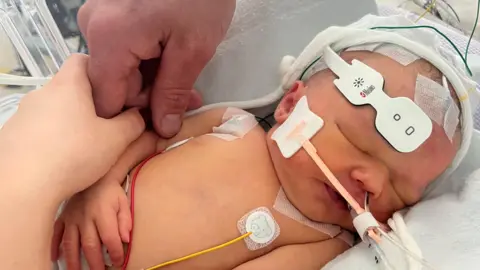
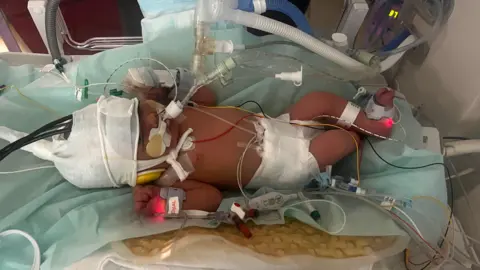
Poppy was taken to Barnet Hospital, where she received therapeutic cooling, a treatment used for newborns with brain injuries.
She was transferred to University College London Hospital but died a week later.
Lomas said she was told her daughter's brain injury had been so "catastrophic" that she could not have survived.
A subsequent investigation by the Healthcare Safety Investigation Branch, published in April 2023, identified multiple failings in the care provided.
It found that maternity teams at the Royal Free London NHS Foundation Trust failed to provide Lomas with timely and consistent VBAC counselling, and that no single clinician took responsibility for her care.
Poor communication of risks meant she was not fully supported to make an informed decision about where to give birth.
During labour, midwives from North Middlesex University Hospital NHS Trust missed key warning signs, including abnormal foetal heart patterns and scar pain, which were not properly recognised or acted upon.
This led to delays in escalation, a failure to call an ambulance when needed, and insufficient planning for emergencies.
At birth, the report found a failure to promptly recognise the baby was in a critical condition, alongside deviations from resuscitation and monitoring guidance.
North Middlesex University Hospital NHS Trust was acquired by the Royal Free London NHS Foundation Trust in January 2025.
The report also highlighted communication breakdowns between NHS trusts and shortcomings in support for the family after Poppy's death.
The coroner issued four recommendations to the Department of Health and Social Care, including the introduction of a consent form for mothers who choose to proceed with what is considered an unsafe home birth against medical advice.
The hope for 'lessons learned'
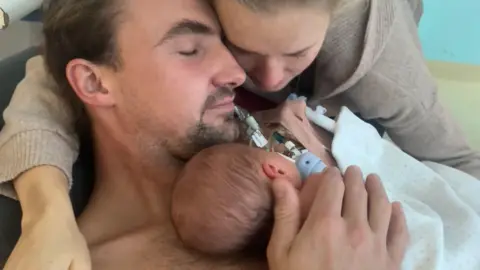
Outside the court, Lomas said: "We came here for the truth because Poppy's life mattered and because she deserves to be remembered for more than the circumstances of her death.
"Nothing will ever bring her back but hearing the truth today acknowledged means everything to us.
"We trusted the professionals who were guiding us, and Poppy should have had the safest possible start in her life.
"Our hope is that by hearing Poppy's story, lessons will be learned and changes will be made so that no other family has to endure the pain that we will carry for the rest of our lives."
A spokesperson for Royal Free London NHS Foundation Trust sent "heartfelt condolences" to the family.
They added: "Following an investigation, we have introduced a number of measures to improve care for women delivering their baby at home.
"This includes ensuring midwifery teams are aware of the guidance around transferring mothers to hospital and improving communication between clinicians and women.
"We will carefully review all the matters raised by the coroner and will respond to him in due course."
Listen to the best of BBC Radio London on Sounds and follow BBC London on Facebook, X and Instagram. Send your story ideas to hello.bbclondon@bbc.co.uk