Historic 1926 census shows Protestant population drop in Irish Free State

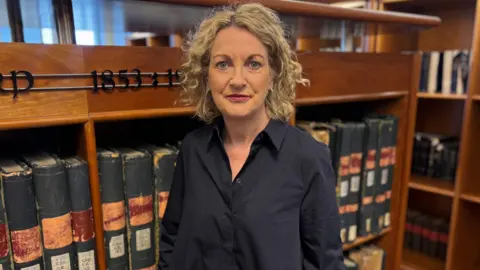 BBC
BBCOne of the most significant demographic shifts in the early years of the Irish Free State was the drop in the country's Protestant population, newly available papers from a 100-year-old census have revealed.
The 1926 census is available online from Saturday morning and the public are able to look up their own families.
The data shows that between the 1911 census, when Ireland was part of Britain, and 1926, there was a one-third decline in the non-Catholic population, which was mostly Protestant.
This compares to just a 2% drop among Catholics.
The years between the 1911 census and 1926 were some of the most tumultuous in Ireland's history, including the Easter Rising and two-year War of Independence.
That war led to the creation of the independent Irish Free State in 1922, which would later become the Republic of Ireland, and Northern Ireland, which remained part of the United Kingdom.
The decision to split Ireland in two followed decades of turmoil between nationalists, who wanted independence from British rule, and unionists, who wanted to remain in the United Kingdom.
Protestants were on the whole more likely to be unionists, while Catholics were more likely to be nationalists.
The 1926 census reflected the first few years of the new state's life.
Census officials estimated that about a quarter of the overall Protestant decline could be explained by the withdrawal of the British Army and their families.
Protestant communities were unevenly spread across the state, and the rate of decline varied by region.
Munster saw the sharpest fall (42.9%), followed by Connacht (36.3%) and Leinster (32.4%), while the Ulster border counties (Donegal, Cavan and Monaghan) experienced the smallest decline (22.5%).
However, even though their population declined, Protestants remained strongly represented in many professional, commercial and agricultural occupations in 1926.
They accounted for a high share of employers (17%), managers and professionals (18.4%), chartered accountants (46%) and barristers (39%).
The number of non‑Catholic farmers and their families had actually risen slightly since 1911 (by almost 4%).
'Significant drop'
Protestants continued to be over‑represented among larger farms, partly because many had benefited from land reform or retained demesne land after the break‑up of estates, according to analysis by historians working through the census by the National Archives.
Orlaith McBride, director of the National Archives, said it was safe to assume that while people with other religions lived in the Free State at the time, the majority were Protestants.
"Between 1911 and 1926, in terms of the 26 counties, we see a drop in the non-Catholic population of 32%. That's very, very significant. There is a drop in the overall population in the 26 counties of about 5%," she added.
"We can see that between 1911 and 1926, that people who were perhaps of the Protestant faith, they moved into the six counties [in Northern Ireland] and then you saw people of the Catholic faith from around the border moving down into the 26 counties [in the Irish Free State]."
'Life wasn't bad'
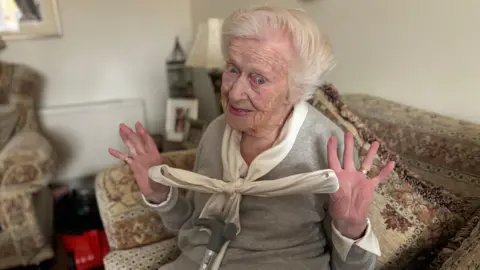
Anne Carey, who lives in County Meath, will turn 102 in November and is in the 1926 census.
She is one of the 48 centenarian ambassadors chosen from almost 100 people who were alive at the time the census was taken in 1926 and who contacted the National Archives.
Carey has three daughters, six grandchildren and five great grandchildren.
She was a seamstress and made her own clothes - and she worked making fur coats in Dublin.
Carey lived through both world wars and remembers when German bombs were dropped in Dublin in 1941.
"[Life] wasn't bad. I remember the bombing on South Circular Road. My mother woke me up to say we were being bombed. But I said, 'Why did you wake me up?'" she said.
And the secret to living past 100 years?
"In my bedroom, I have a window and I look out. And I say to myself: 'I'll never see this day again, don't bang it up.'"
What was life like 100 years ago?
Even though a Northern Ireland census was also carried out in 1926, it has been lost.
But the Irish Free State census also sheds a light into the life our ancestors lived a century ago.
The total population had fallen - it was recorded at 2,971,992, down from 3,139,688 in 1911.
It was split into 49% female and 51% male.
Dublin was the only county to record an increase in population since 1911 (up almost 6%), while all other counties recorded a loss.
It shows that 92.6% of the population was Catholic and 18.3% of people could speak Irish.
The 1926 census also shows what jobs people worked.
Some 51% were in agricultural occupations, 4% were fishermen, 14% worked in manufacturing and 7% were domestic servants.