The 'dumb machine' promising a clean energy breakthrough

 Proxima Fusion
"I remember a few people said that the place where Proxima is today was impossible," says Francesco Sciortino, the co-founder and CEO of Proxima Fusion.
Being accused of attempting the impossible is not unusual for the scientists and engineers working on nuclear fusion projects around the world.
After all, they are attempting to capture, on earth, the reaction that powers the Sun.
Success could mean abundant, cheap and emission-free electricity. But the challenges are daunting and a working power stations remains a long way off.
Fusion is the process of fusing hydrogen nuclei together, which releases immense amounts of energy.
On the Sun huge gravitational forces help keep the reaction going.
To maintain fusion here on earth, extremely high temperatures - many times those found on the Sun - are needed.
So, a fuel (usually a combination of the hydrogen isotopes tritium and deuterium) is heated until it becomes a burning hot plasma, which then has to be controlled and manipulated to spark fusion.
There are a number of ways to do this, and Germany's Proxima Fusion is attempting one that is considered difficult, even by the extreme standards of the fusion industry.
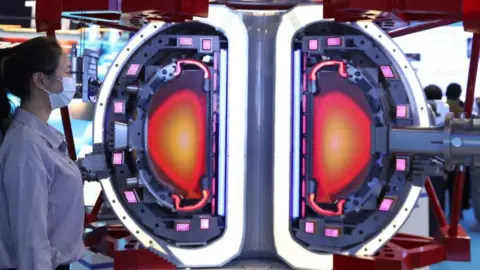
A common approach to fusion is to build a tokamak. It's a doughnut-shaped device, which uses powerful magnets to contain the plasma.
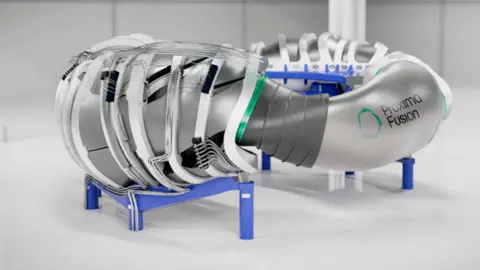
But Munich-based Proxima is working on a stellarator. It also uses magnets to manipulate the plasma but the reaction container has a more complicated shape, with twists and turn, making it much more difficult and expensive to build.
 Proxima Fusion
So why go down this torturous path?
Well, if the design works, the twists and turns of a stellarator make the burning hot plasma easier to control than in the rival tokamak design, says Sciortino.
When comparing the two systems, he says a tokamak is a "beast" while the stellarator is a "little cat".
"A stellarator is a thing that is objectively very difficult to design, objectively very difficult to build. But if you do it, it is a dumb machine... just like a microwave oven," says Sciortino.
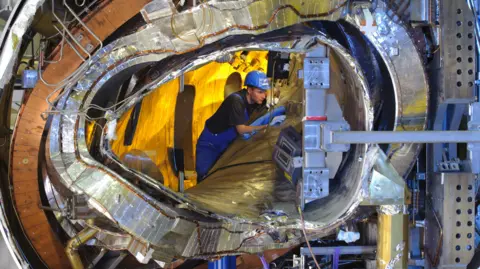
Proxima's "dumb machine" will be a stellarator called Alpha. It will draw on decades of work done by Germany's Max Planck Institute for Plasma Physics and its stellarator the W7-X.
The aim of Alpha is to produce more energy than it uses to operate, and the lessons learned are helping to design of an even more advanced device - a fusion power plant, called Stellaris.
But first, Alpha will need a lot of investment, which is being gathered at the moment. Proxima recently won €400m (£340m; $460m) from the state of Bavaria and is bidding for more than a billion dollars of funding from the federal government - a decision is expected next year.
 MPI for Plasma Physics/Wolfgang Filser
Proxima is racing other groups developing fusion technology - 53 according to the Fusion Industry Association (FIA) which represents the fusion industry and tracks developments.
One project using the tokamak approach is UK-based Step (Spherical Tokamak for Energy Production).
Backed by the UK government, the plan is to build a prototype powerplant on the site of a former coal-fired power station in West Burton, Yorkshire.
"Tokamaks have the advantage of a deep experimental foundation built over decades. They have demonstrated plasma performance closer to what's required for a fusion power plant, including operation with fusion fuel," says Ryan Ramsey, the director of Organisational Performance at Step and formerly captain of the nuclear submarine HMS Turbulent.
And in this kind of fusion, the expensive and powerful magnets should be relatively simple to build.
"They [tokamaks] benefit from comparatively simpler magnetic geometry, with fewer and more regular coils. That has real implications for manufacturability, maintainability, and cost," Ramsey says.
 Getty Images
Sciortino is well aware of the challenges ahead for Proxima. He "loses sleep" over whether Proxima will be able to build the magnets, with their intricate shapes, at a speed and cost that will make the stellarator an economic proposition.
"The first magnet that we make will be very complicated and very expensive. But can we make it faster than people would expect, and can we drive down the cost?" Sciortini asks.
In their favour is Germany's expertise in manufacturing. For example, Sciortino cites the impressive number of workers who can operate CNC machines - a type of computer-controlled machine tool which can cut, carve, or shape materials including wood, metal, or plastic.
Sciortino estimates that there are 550,000 CNC machinists in Germany, compared with 350,000 in the whole of the US.
This matters for Proxima which uses a very expensive type of steel in its magnets, which needs machining to a high level accuracy.
While maintaining high levels of precision, keeping up the pace of development is crucial for Sciortino.
The W7-X took more than a decade to get running - he wants to get Alpha operational in a third of that time.
So a prototype magnetic coil is under construction and the plan is to test it next year.
Its twisted geometry makes it one of the most complex magnets in the world, according to Proxima.
Once the testing is complete, Proxima will build 40 more magnetic coils that will go into its Alpha machine.
To do that, a magnet factory is in the early stages of construction.
"In, 2028, 2029 we need to be able to make magnets at a crazy, crazy speed," says Sciortino.
The work is not just in Germany. Sciortino says that across Europe, there are key suppliers, which means Europe might well be at the forefront of a future fusion industry.
"We [Europeans] missed the digital wave, didn't we? But it turns out that we still have people being trained in manufacturing," he says.
At Step, Ramsey stresses that the fusion industry is well beyond a physics experiment now.
"There's real momentum across fusion right now, and that should be seen as a strength rather than something to divide. This isn't a single-path race, it's a set of approaches exploring different trade-offs. The real question now is not which concept is most interesting, but which can credibly deliver a power plant."