Sectors facing funding cuts are 'life saving' for young people

 BBC
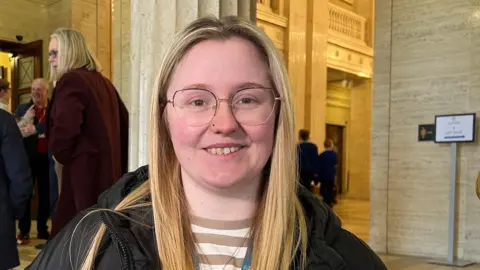
BBCA woman who benefited from an organisation that is facing potential funding cuts said the "services are life saving for a lot of young people".
Katie Heagarty-Biggerstaff was among those protesting at Stormont on Monday against changes that could lead to cuts across the voluntary and community sector.
Some 64 organisations are facing the prospect of job losses when the UK Shared Prosperity Fund (UKSPF) is replaced by the Local Growth Fund on 1 April.
The Northern Ireland Council for Voluntary Action (Nicva) has said that the change will lead to a "dismantling of community-level expertise" across Northern Ireland that will not be rebuilt.
Heagarty-Biggerstaff, who said she had been in care, told BBC News NI about how one of these groups helped her.
"Me and my husband were both on the programme. We say what would we have done without it, we would have been lost.
"It actually worries me to think of where we would have been if we didn't have it," Heagarty-Biggerstaff said.
'Really upset and angry'
After gaining qualifications she started a programme with Include Youth, a group which helps young people learn new skills.
"These services are life saving for a lot of young people. They changed my life and I know the young people that I am working with, it's making a massive impact."
When asked about what message she had for politicians, she added: "I think people need to fight for us more and show that they care about our services and that they care about the most vulnerable young people instead of leaving them."
"It makes me feel really upset and angry. These are the most vulnerable young people."
Stephen Barr, director of services at Start 360, a charity that delivers person-centred support to over 20,000 people per year in Northern Ireland, said the potential cuts could have a "serious impact".
Speaking with BBC Radio Ulster's Evening Extra programme, Barr said: "When you look at the implementation of the Local Growth Fund from 1 April, it's implementing a 70/30 split of capital revenue, and what that means is there'll be a focus on the purchase of buildings and fixed assets, and improving the lifespan of those.
"But it means a drastic cut around new existing services around supporting economically inactive people, and, for me, that's going to have a serious impact."
Barr said a significant funding reduction to the voluntary and community sector could be "decimating" for some of the people Start 360 works with, leaving them exposed to risks such mental health deterioration and suicide.
"As well as that, it'll have a secondary impact through increased demand on public services, and obviously you'll see a further drain on the public purse because of that," he added.
What is changing?
The UKSPF replaced EU funding which ceased due to Brexit.
The Local Growth Fund will see day-to-day funding available to groups in NI drop from £25m per year to just over £9m.
The Local Growth Fund is being introduced by Westminster.
The scheme is being overseen by the Department for Housing, Communities and Local Government and brings a crucial change to how the funding is designated.
The Shared Prosperity Fund was three quarters resource funding, but the Local Growth Fund is one third resource funding with the bulk going towards capital instead, having a direct impact on jobs.
Celine McStravick, chief executive of Nicva, has said the proposed shift would take a "sledgehammer" to services supported by the funding in Northern Ireland, such as training and employability schemes.