UK must back North Sea oil and gas drilling, says trade body

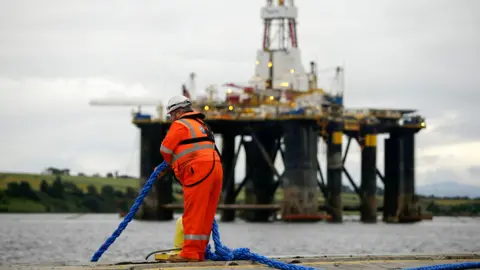 Matthew Lloyd / Bloomberg via Getty Images
The offshore energy industry has warned that the UK "urgently" needs to produce its own oil and gas and called for the government to support North Sea exploration.
Offshore Energies UK (OEUK) said without more domestic production, the country risks becoming reliant on imports "at a time of rising global instability".
Oil and gas prices have spiked since the US-Israel war with Iran began and Tehran effectively shut the Strait of Hormuz, a key route for global crude supplies.
The Labour government has banned new licences for new oil and gas fields in the North Sea and a government spokesperson said issuing exploration permits "cannot give us energy security and will not take a penny off bills".
It added: "Regardless of where it comes from, oil and gas is sold on international markets, which set the price for British billpayers, making us a price taker."
Energy Secretary Ed Miliband recently told the BBC that the lesson from the current crisis - which has seen the oil price rise by more than 30% - is "we need home-grown, clean power that we control".
But OEUK said it was "not an either renewables or oil and gas scenario".
In a report out on Tuesday, it claims oil and gas still supplies around 75% of the UK's energy needs and will meet around a fifth of demand by 2050.
It also said that demand was rapidly increasing as domestic production declined, leaving the public vulnerable to potential price shocks.
"Recent events have shown how quickly energy markets can tighten and how easily cargoes can be diverted away from the UK when other buyers bid higher," said OEUK chief executive David Whitehouse.
"We urgently need greater supplies of secure, domestically produced energy including oil and gas, which will remain a critical part of the UK energy system and economy for decades."
The industry group said it wanted the government to review its approach to offshore oil and gas exploration licences after last year's ban.
Currently, developers can only increase production in areas that are already part of an existing licensed field, or adjacent to them, to ensure they remain viable.
OEUK wants the Energy Profits Levy (EPL), often dubbed the "windfall tax", to be replaced as soon as possible with the new tax measure that was outlined by the government at the Budget in November.
Corporation tax, which is levied on energy firms' profits at 40% in total, will remain. But the EPL, currently set at 38%, will be replaced with the Oil and Gas Price Mechanism (OGPM).
The OGPM will not apply to profits, but to sales revenues above a price threshold ($90 a barrel for oil or 90p per therm for gas if it were introduced this year).
As a result the tax rate paid by energy firms could vary over the price cycle, but the overall tax burden on energy companies would be lower, between 40% when energy prices were lower and 75% when prices were higher. That compares to the current overall tax rate of 78%.
OEUK claims the new approach on tax would unlock £50bn of new investment in UK oil and gas.
On Tuesday, the Conservative Party will use its Opposition Day debate in parliament to call for an end to the EPL and the ban on new oil and gas licences.
It also wants the government to approve two new Scottish oil and gas fields. A court ruling last year, in a case brought by environmental campaigners, meant that the firms involved needed to submit further data about the climate impact of the projects and seek fresh approval before they could go ahead.
Claire Coutinho, shadow secretary of state for energy security, said: "Turning our backs on domestic gas that could heat millions of homes would be madness in normal times, but it is sheer lunacy in the midst of a gas supply crisis."
But researchers at the University of Oxford have disputed claims the UK could significantly lower its energy bills by extracting more of its own oil and gas.
They found that even if the UK maximised North Sea extraction and returned revenues directly to households, the cost savings would be far smaller than those expected from accelerating the shift to renewable energy.
Mel Evans, head of climate at Greenpeace UK, said: "The [oil and gas] industry does have billions of reasons to want the UK to cut their taxes and license more drilling.
"While it wouldn't take a penny off energy bills or petrol prices, it would maximise the potential oil and gas revenue during an oil war, when prices spike and fossil fuel companies can profiteer more than ever."
Correction 25 March: This article originally said that the new Oil and Gas Price Mechanism (OGPM) would introduce a 35% tax rate, contrasting that with the current overall tax rate that energy companies pay of 78%. The article was amended to make clear the tax burden will actually be around 75% when prices are high, but 40% when prices are below the threshold at which OPGM is applied.
The article also originally suggested that the firms developing oil and gas fields at Jackdaw and Rosebank had failed to fully assess the environmental impact. We have amended the article to reflect that a subsequent legal ruling obliged the firms to provide additional data and request government approval again.

Get our flagship newsletter with all the headlines you need to start the day. Sign up here.