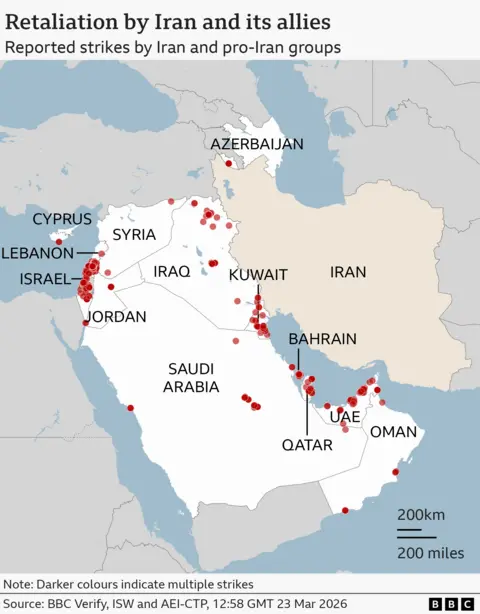
In maps: Attacks across the Middle East

 BBC
BBCUS President Donald Trump has postponed his threat to strike Iranian power plants for five days after what he said were "productive conversations" between the US and Iran.
On Saturday evening, the president said that if the Strait of Hormuz was not opened "without threat" in 48 hours then the US would "obliterate" Iran's power plants.
Iran responded by saying the shipping channel would be "completely closed" if the US followed up on Trump's threat.
On Friday, Centcom, which oversees US military operations in the Middle East, said it had flown more than 8,000 combat flights since the conflict began on 28 February.
The US-based Human Rights Activists News Agency (HRANA) said 1,407 people, including 214 children, have been killed since the conflict began. Thirteen US service personnel have been killed since the start of the conflict, according to the Department of Defense.
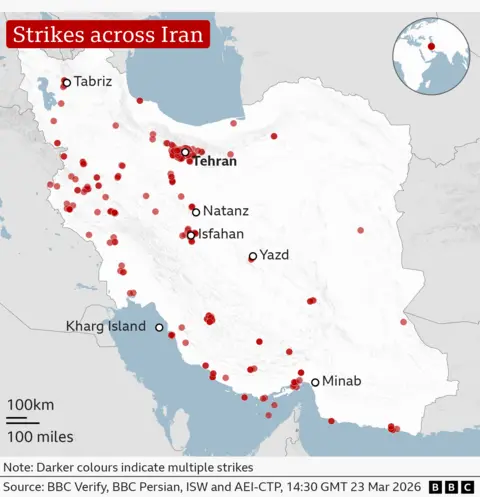
US and Israeli strikes across Iran
The first US-Israeli strikes on Iran began on 28 February with Israel's military saying it had targeted Iran's leadership and military infrastructure. The Supreme Leader of Iran, Ayatollah Ali Khamenei, was killed in Tehran during the initial strikes.
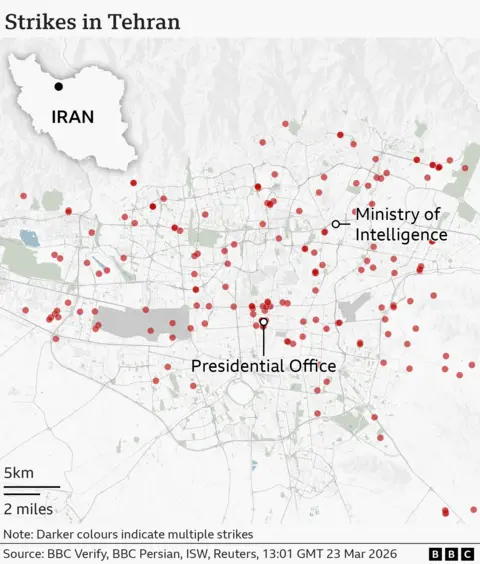
BBC Verify has so far confirmed visual evidence of at least 191 attacks across Iran, including at least 81 strikes in Tehran. Internet connectivity remains highly restricted across the country, according to the monitoring group Netblocks, meaning it is difficult to establish a full picture.
Last Wednesday the Israel Defense Forces (IDF) hit Iran's South Pars - part of the world's largest natural gas field. Satellite images reviewed by BBC Verify showed extensive damage to the facility, with black scorch marks clearly visible along with plumes of smoke.
At the start of the war, at least 168 people including children were killed when a primary school in Minab, southern Iran, was hit on 28 February, Iranian authorities said. Experts who analysed a video showing a missile moments before it struck the IRGC base next to the school told BBC Verify the munition was a US Tomahawk. Neither Israel nor Iran are known to possess Tomahawks, experts said.
Trump postpones threat to strike Iran's power plants
Trump said on Saturday the US would "hit and obliterate" Iran's power plants unless it reopened the Strait of Hormuz within 48 hours.
On Monday, Trump said he would "postpone any and all strikes against Iranian power plants and energy infrastructure" for a five-day period.
Iran's energy network comprises about 500 power plants, according to the database OpenStreetMap, a mapping tool that allows volunteers to enter information on sites of interest.
One of the largest, the Damavand power plant, provides electricity for approximately 10 million people in the province of Tehran.
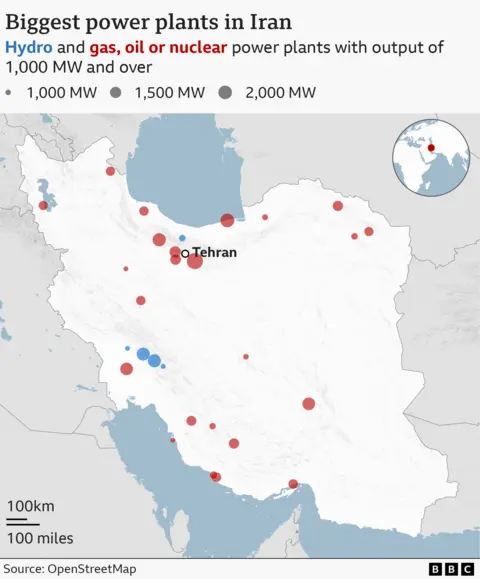
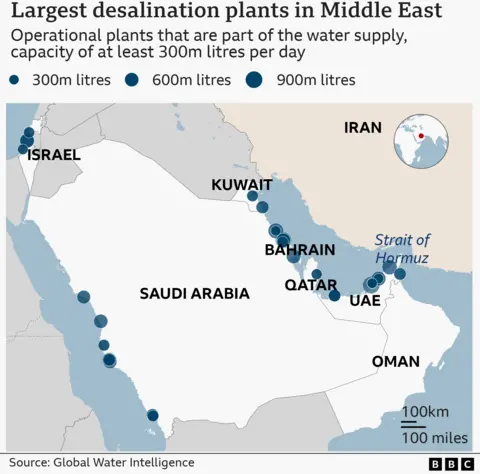
The government in Tehran said it would respond by targeting power and desalination facilities - which turn seawater into fresh water - in the Gulf region, the IRGC-affiliated Fars news agency reported.
According to the US-based think tank the Center for Strategic and International Studies, Qatar gets 99% of its drinking water supplies by desalination and in Bahrain the figure is more than 90%.
Iran launches missiles at Israel as IDF expands Lebanon operation
Israel's health ministry says 180 people were injured in what it said were Iranian missile strikes on two southern Israeli towns close to a nuclear facility.
Iranian state TV said the strikes were in response to an attack on Iran's Natanz nuclear facility on Saturday.
On Sunday, at least seven people were injured in an Iranian missile attack on Tel Aviv, emergency services say.
The Israeli Air Force says Tehran has fired 400 missiles towards the country since 28 February.
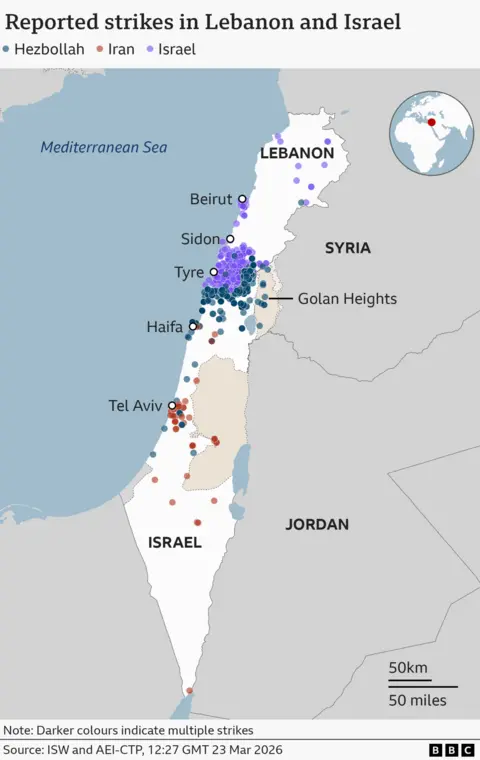
The IDF has intensified ground and air attacks against the Iran-backed Hezbollah group in Lebanon. It fired rockets into Israel following the killing of Ayatollah Khamenei at the start of the war.
Since then more than 1,000 people have been killed in Lebanon, according to the Lebanese health ministry, including at least 118 children and 40 health workers.
Israel defence minister Israel Katz said the IDF had been instructed to destroy crossings over the Litani river in southern Lebanon that were reportedly being used by Hezbollah.
An Israeli air strike damaged the Qasmiye bridge on one of the main routes linking southern and central Lebanon near the coastal city of Tyre.
Gulf states hit by Iranian drone and missile attacks
Iran has continued to launch missile and drone strikes against the Gulf nations and has targeted energy facilities following the Israeli attack on South Pars.
In Qatar, the state-run energy company said "significant damage" was caused after missile attacks on the Ras Laffan Industrial City - the country's main gas facility. Officials said the attacks had cut its export capacity by 17%.
Iran has also launched a wave of strikes against shipping in the Strait of Hormuz. At least 100 ships have passed through the Strait of Hormuz since the start of March, according to data analysed by BBC Verify. About a third of these recent crossings were made by ships with connections to Iran.