Tankers urged not to pay toll to Iran for use of strait

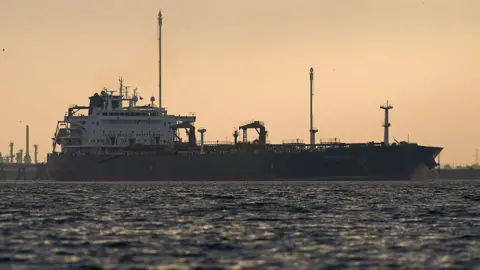 Ian Forsyth/Getty Images
Tankers that want to pass through the Strait of Hormuz are being advised not to pay money to Iran to allow them through, after a ceasefire agreed on Tuesday failed to get traffic moving through the waterway again.
The agreement was supposed to include reopening the strait but Iran has suggested that ships must seek its permission or they may still be "targeted and destroyed" and has said it could levy a fee in return for safe passage.
"We do not believe the payment of tolls is the right way to go about this," said Phillip Belcher, from Intertanko, a group representing tanker firms.
"We are amazed that this appears to be one of the starting points of negotiations," he told the BBC.
US vice president JD Vance is meeting representatives of the Iranian government in Islamabad in Pakistan on Saturday to try to nail down details of a ceasefire deal that already appears to be in jeopardy after continued air strikes in Israel and Lebanon and a stalemate over the vital shipping lane.
Belcher said Intertanko, which represents 190 independent tanker operators and more than half of the world's oil tanker fleet, was still advising members not to use the strait as "an attack could take place at any time".
"We do not believe the Strait is safe until there is a lasting cessation of conflict, where all attacks against ships have halted and where there is some sort of coalition-of-the-willing oversight for ships to go through, where Iran does not have sovereignty of the strait," he said.
Charging a toll was "against the whole idea of international laws and free passage through international waterways", he said.
"At the moment the Strait of Hormuz is under the de facto rule of the Iranian military," Belcher said.
The Iranian Revolutionary Guard Corps (IRGC) a branch of the Iranian military oversees much of Iran's economic activity, but has been listed as a terrorist organisation by the US and the EU.
"The IRGC is a designated terrorist organisation and so the payment of monies to a terrorist organisation should be avoided," said Belcher.
Since the current war started, Iran has indicated it wants to impose new rules for traffic moving through the pivotal waterway.
Some media reports have suggested that Tehran's plan includes the right to demand transit fees to the tune of $2m (£1.5m) per ship, with the proceeds shared between Iran and Oman - the two countries which border the strait.
Earlier this week President Trump suggested the US and Iran could levy fees as a "joint venture".
However he later appeared to backtrack, posting on social media: "There are reports that Iran is charging fees to tankers going through the Hormuz Strait. "They better not be and, if they are, they better stop now."
Arsenio Dominguez, secretary general of the International Maritime Organisation, the United Agency responsible for the safety and security of shipping, told the BBC that countries should respect the already established right to freedom of navigation.
"International straits in accordance [with] international law are actually for the use of everyone and that's why no toll restrictions should be imposed," he said.
The war has reduced the passage of tankers through the strait to a trickle. Only 15 vessels have made the trip since Tuesday, compared to an average of almost 140 each day prior to the outbreak of the conflict, carrying a fifth of the world's oil and gas supplies. Almost 800 ships have been left stranded in the Gulf, most of them loaded with cargo.
The longer the blockage lasts the greater the impact on global supplies of oil, gas and fertiliser, with a worldwide knock-on impact expected on the prices of fuel, electricity, food and medicines.
The chief executive of Swedish tanker firm Stena Bulk, Erik Hanell, said it was not yet clear when the disruption would end but that his firm would not make any moves to use the disputed Strait until they were 100% certain it was safe for the crews on board.
"We need safety guarantees," he said.
"I know there are discussions going on between the US and the different shipping communities, and maybe Iran as well, but at this stage we have limited information."
Stena did not have any direct contact with the Iranians, he said, and would not pay any tolls "as a standalone company" or while there was no information from official channels.
"Longer term, paying fees to travel through the Strait of Hormuz would be like paying fees to use the English Channel," he added.
"That's not a world we would like to continue with. It's definitely something we want to avoid in the long term."