Silvertown Tunnel is 'tackling chronic congestion'
One year after the Silvertown Tunnel opened, Transport for London (TfL) said the project had reduced "chronic congestion" and improved journey times.
New data suggested that drivers who used the neighbouring Victorian-era Blackwall Tunnel saw journey times reduced by more than 10% during weekday peak periods, TfL said.
Before the new £2.2bn link opened, the Blackwall Tunnel saw 700 closures a year, often caused by stuck HGVs, TfL said.
Sheila Keeble, a member of the Greenwich Society who opposed the project before it opened, said the new tunnel had "displaced" congestion to other routes.
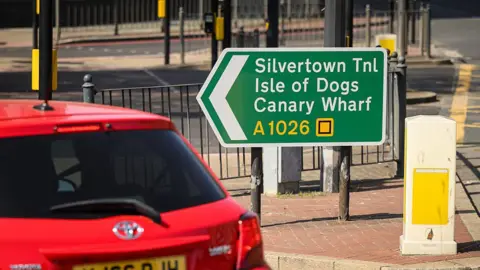
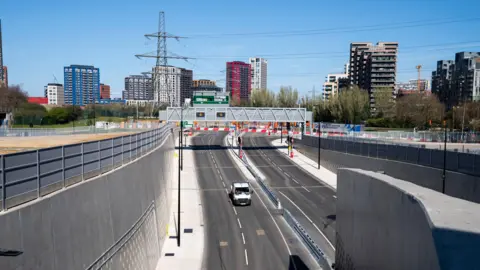
The Silvertown Tunnel stretches almost a mile (1.4km) under the River Thames from Greenwich to Newham, next to the Blackwall Tunnel.
First announced in 2012, mayor of London Sir Sadiq Khan reviewed the scheme when he came into office, and said it would be a vital link across the river to east London.
Both tunnels are subject to tolls and cost £4 for a car in peak times. Not everyone has to pay, and there are some exemptions and fee reductions.
The tunnel was paid for with private borrowing which will be paid back via the tolls over an estimated 25 years.
David Rowe, director of investment planning at TfL, said: "Before the Silvertown Tunnel opened, east London residents and businesses faced chronic congestion in the area."

 Getty Images
Keeble said the tunnel fees had pushed traffic towards toll-free crossings including the Woolwich Ferry, Tower Bridge, and the Rotherhithe Tunnel.
"People don't like tolls and sat navs will just direct them to the free crossings," she said.
Keeble said the Woolwich Ferry was "absolutely overloaded all the time".
BBC London asked TfL for figures on the use of the Woolwich Ferry.
Keeble said that while Greenwich still saw congestion, the Silvertown Tunnel was a "net positive" as it stopped the "enormous traffic jams" that used to plague the Blackwall Tunnel.
 PA Media
TfL said the Silvertown Tunnel was driving a vital shift toward public transport.
New zero-emission double-decker buses use a dedicated lane through the tunnel, and daily cross-river bus trips have increased from 2,700 to 10,400 in the last year.
Rowe said: "We're pleased to see that one year after opening, the Silvertown Tunnel, supported by user charges, is reducing congestion around the Blackwall Tunnel and improving journey times.
"We are continuing to monitor the impact of the Silvertown Tunnel both on congestion and the surrounding areas and environment as we pass this important milestone."
Listen to the best of BBC Radio London on Sounds and follow BBC London on Facebook, X and Instagram. Send your story ideas to hello.bbclondon@bbc.co.uk