Housing shortage 'makes me feel unwanted in my city'

 BBC
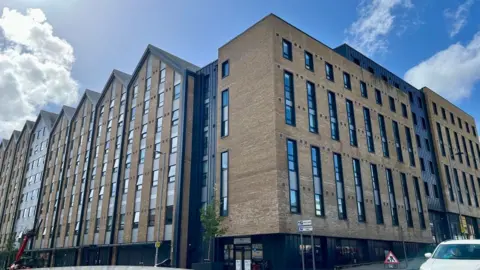
BBCHundreds of new homes are being built in and around Exeter but what is being described as a housing crisis is continuing ahead of city council elections on 7 May.
Residents, politicians and a charity boss say large amounts of student accommodation and co-living apartments - studio flats with shared facilities - are making the situation worse.
One young worker said "it feels like Exeter doesn't want me" as he can't find housing that suits his needs and budget.
The University of Exeter said it was "committed to reducing pressure on the city's housing stock by accommodating more students on campus".
Andy Fletcher said it was incredibly difficult for a young working person to find decent accommodation to rent in Exeter with the monthly cost for a one-bedroom flat of about £800 plus bills.
He is currently living in YMCA supported accommodation in the city and working for the charity but cannot find any affordable flats.
He said: "To me it feels like Exeter doesn't want me.
"It feels like they're happy enough to welcome all the students in - yes, they're really important for the economy - but it's pushing residents like me out of the city."
The joint CEO of Exeter YMCA, Si Johns, said: "Not everyone can live in co-living, it's probably not the preference for most and when you create a lot of things that are not the preference it's simple supply and demand.
"It makes the accommodation that is people's preference more valuable because there's less of it."
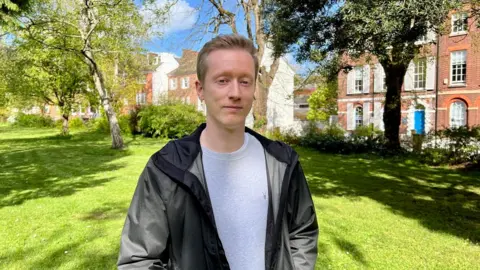
Ryan Hill is a retail services manager who returned to Exeter four years ago after living in London.
He said: "The only place I could find to rent was about £750 - it was above a takeaway and really smelly and in a bad condition."
Hill had managed to save enough for a deposit and took out a primary mortgage but then also needed a second mortgage - sometimes known as a second charge mortgage - to pay for his £175,000 flat.
He said: "I took the second charge mortgage just to afford something that was safer, that didn't have mould all over it, that didn't have the ceiling leaking - but that's what the housing stock is like in Exeter when you do viewings."
Hill said he felt young working people were being "pushed out of the city centre" or "pushed into financial pressure" due to the number of student flats and co-living blocks.

The Gorge co-living block in Exeter is opposite the Waitrose store and was built in 2023 with about 130 studios, a gym and shared social spaces.
Healthcare professional Sachin Bhardwaj said it provided everything he needed and the process of renting a studio was far simpler than trying to rent a flat or a house.
He said: "It's really difficult to find, for example, a two-bedroomed house - it takes a lot of time and they need advance payments of two or three months."
Bhardwaj said he was paying £1,100 a month with council tax of about £200 on top and was sharing the studio with his partner.
Next to The Gorge on the old police station site, planning permission was given in December for another 414 co-living studios and 399 student flats with work yet to start.
Work is currently going on to build another co-living development for about 140 units on Summerland Street and permission has been given for almost 300 student flats on the Western Way roundabout and for more than 100 student flats next to John Lewis.

The number of students at the University of Exeter has doubled in the past 20 years and makes up about 20% of the city's total population while supporting almost 10,000 jobs in the city.
The university says there are now more than 27,000 students at the two campuses in the city - Streatham and St Luke's - and that number is for full-time equivalent students so the actual number of people will be higher.
A report by the Devon Housing Commission in 2024 said: "Whilst the economic and wider social impact of the university is significant this comes at the expense of increased housing pressure in the city."
Students themselves have also had to deal with increasing rents which were almost £9,000 a year in 2024 according to the report.
A spokesman for the university said it had "long been committed to reducing pressure on the city's housing stock by accommodating more students on campus".
The spokesman said: "In recent years, with our partners UPP, we have built new, on campus student accommodation, and are currently creating 1,800 student bedrooms on the west side of our Streatham Campus, while continuing to invest in improving existing facilities and accommodation across our campuses."
What do councillors say?
While the government sets housing targets for local councils to meet - it is the council that decides how to meet those targets and which planning applications to approve.
Labour is the party in power on Exeter City Council with local elections being held in 14 of the 39 seats on 7 May.
Phil Bialyk, leader of the Labour group, said: "Co-living is an important part of our overall policy for housing in Exeter - it gives young people the opportunity to get a place of their own and to start.
"I know it's expensive, so is renting a flat or anything else in Exeter."
Bialyk said the city was, to an extent, a "victim of its own success" in attracting people to Exeter and also pointed to social housing developments the council is building on Vaughan Road.
The Green Party leader, Diana Moore, said students and residents in Exeter were "struggling with the same issue that housing is way too expensive to rent or to buy".
She said: "We need to be bold on the council and have policies that prevent the conversion of homes into houses of multiple occupation, actually build affordable homes and do that working with communities if necessary."
Moore said Exeter City Council was encouraging co-living developments by setting a Community Infrastructure Levy - a charge to developers which can be spent on public works - at £50 per sq m for co-living compared to £136 per sq m for residential development.

The Liberal Democrat leader, Michael Mitchell, said: "The answer is we want more one and two-bedroomed accommodation for young people and for families to start off.
"Co-living is just student accommodation by another name - it was to dress up the problem of having too much student accommodation in the city centre."
Mitchell said there were several applications for co-living sites in Exeter that had been granted permission but were not being developed, such as the Harlequins shopping centre site.
Conservative group leader Peter Holland said: "There is an unmet demand for social housing, whether that be affordable housing or housing for rent.
He said the amount of development of student flats and co-living blocks was "taking from the city an opportunity to provide for those people".
Alison Sheridan from Reform UK, said Exeter City Council should "pursue policies that encourage students to live in student accommodation rather than houses of multiple occupancy, and wait for the inevitable decline in student numbers.
"Then, as demand for student houses of multiple occupancy falls, those houses will become available for local families.
"This will not only address the need for housing but lead to improved city centre neighbourhoods and a more resilient local economy."
Elections will take place on 7 May and a full list of all of the candidates is available on the Exeter City Council site.
Follow BBC Devon on X, Facebook and Instagram. Send your story ideas to spotlight@bbc.co.uk.