Prison phone call recordings raise questions over ex-Abercrombie boss' fitness for trial

 Reuters
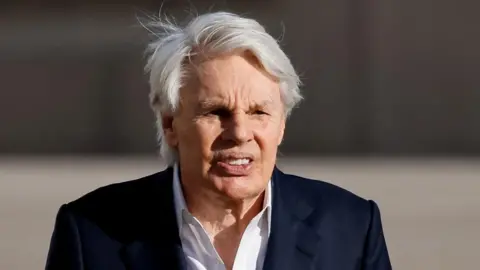
Former Abercrombie & Fitch CEO Mike Jeffries was recorded telling his British partner "we're screwed" and in "big trouble" if he was found fit to stand trial on sex trafficking charges later this year, a New York federal court has heard.
The audio was part of more than 100 phone calls between the ex-fashion boss and Matthew Smith referred to during a four-day mental competency hearing this week on Long Island.
Jeffries' lawyers argue that he is suffering with dementia and late onset of Alzheimer's disease and is unfit to face trial alongside his partner and their alleged middleman in October.
However, prosecutors say their medical experts found his condition has improved and that the calls reveal he is "incredibly focused" on being found incompetent.
In further recordings, Jeffries says he is "hoping for a good outcome", describing being found fit as a "disaster", and tells a doctor: "you better find me incompetent", Central Islip court heard.
The calls were recorded last year while he was being treated for four months in a mental health unit at a federal prison in North Carolina to see if he could regain competency.
The 81-year-old had previously been found mentally incompetent last May but prison officials then declared in December that he was fit for trial following his hospital stay.
Prosecutors told the court Jeffries frequently complained about prison conditions and was caught on tape describing to Smith how "horrible jail was", adding: "that's why we got to pull this off".
Jeffries, his partner Smith, 62, and their alleged middleman James Jacobson, 73, were charged with running a global sex trafficking and prostitution business in October 2024.
They have pleaded not guilty to the charges, which carry a maximum sentence of life in prison.
Their arrests followed an October 2023 BBC investigation and ongoing podcast series that revealed the trio had been at the centre of a sophisticated operation scouting young men for sex around the world while Jeffries was CEO of Abercrombie & Fitch.
Judge Nusrat J. Choudhury will decide in May whether Jeffries will stand trial after considering the testimony of six experts - forensic psychologists, psychiatrists and neurologists, including prison doctors - who were cross-examined in court this week.
'Disinhibited' behaviour
Three defence experts, Dr Jacqueline C. Valdes, Dr Alexander Bardey and Dr Miranda Rosenberg, maintain that Jeffries is mentally incompetent due to the residual effects of a traumatic brain injury, probable Lewy body dementia and Alzheimer's disease.
They testified that Jeffries demonstrates "disinhibited" and socially "inappropriate" behaviour, which is part of a range of dementia symptoms, the court heard.
Examples include Jeffries calling the prosecutor's professional psychologist a "cunning bitch" and complimenting her hair, telling Bardey his clothing was "poorly tailored", and describing his partner Smith as a "dwarf", they say.
He was also recorded in "excruciating detail" on about 20 prison calls discussing his international travel plans for the next few months, despite having been on house arrest since 2024.
"I don't want to go on trips without you," Jeffries was heard telling Smith from prison in the context of their looming trial, which prosecutors argue shows his awareness that he would regain his freedom if he was ruled incompetent and the charges were dropped.
Rosenberg and Bardey, the defence's expert witnesses, disagree, saying it instead highlights that Jeffries does not remember his legal restrictions and the seriousness of the situation.
"There wasn't the appropriate emotional response that I would expect someone to have who is facing such grave charges, who might end up, if found guilty, dying in prison," says Bardey, a forensic psychiatrist who reviewed Jeffries over four days in 2024 and 2026.
"Instead, his manner throughout the evaluation, back then, as well as earlier in the year, was almost like we were having lunch at his country club. There was no sense of alarm or distress."
Valdes told the court there is evidence that Jeffries' mental decline began in 2013, when MRI and CT scans showed "mild atrophy", or shrinking of the brain, which was exacerbated by a fall in Cape Town, South Africa in 2018.
Jeffries had been drinking alcohol at the time of the 2018 incident and his medical records showed that he continued to drink after being hospitalised, but Bardey told the judge he did not think his general alcohol consumption had a "significant effect" on his condition.
Following the fall, Jeffries became psychotic, and his partner Smith reported to Valdes, who first assessed Jeffries in October 2023, that he began hallucinating and was found in his underwear, unable to move, in his neighbour's garden in 2019.
Dr Tracy O'Connor Pennuto and Dr Cassondra Morris, from the Federal Medical Center in Butner, testified that Jeffries was competent after assessing him over four months in prison.
They say his cognitive abilities "were not consistent with Alzheimer's disease", which the court heard could not be conclusively diagnosed until an autopsy could be performed after his death.
"Even given the declines that Mr Jeffries has suffered in his cognitive functioning, he still is brighter and more capable cognitively than probably 95% of the patients that we assess for competency," says Pennuto, the only neuropsychologist at the federal prison.
Jeffries, wearing a suit and tie in the courtroom, waved to Pennuto and laughed as she was sworn in. The multi-millionaire was "jovial" and "fairly charismatic" during their interactions in prison, she says, and was "purposely testing the limits, sometimes" calling her a "girl".
"He, at one point, was laughing and joking about how much fun he was having with the testing and said: 'We can be married. I'm gay, but that doesn't matter,'" she told the court.
They diagnosed Jeffries with "mild neurocognitive deficits" and she says his testing scores may have improved since 2023 from "borderline" or "impaired" to "average" because of abstinence from alcohol and better medication management during his stay, the court heard.
Morris, a forensic psychologist, says Jeffries was "very interested" in increasing his prison privileges and was moved from a "semi secure unit" to "general population" with his cell door unlocked most of the day, showing he did not need round-the-clock care as the defence argue.
"Mr Jeffries laughed when I asked him if he was able to drive and he said, 'I haven't driven in 20 years,'" she recalled during one interaction.
"He has someone to drive for him and he has somebody to manage his finances. So, it was clear that he wasn't doing those things, but not because he wasn't able. It was because he had made other arrangements."
In July 2025, the month Jeffries was admitted to the prison hospital, she says he told her he was there to "prove" he was "incompetent". When she asked if that was what he was hoping for, the court heard he responded: "Yes, sounds terrible, but it's the right thing to do."
109 prison calls raise questions
Central to determining competency is whether Jeffries understands the charges against him, their consequences, the legal proceedings, and can assist with his own defence.
The defence's medical experts argue he cannot and is unable to name his charges and has "significant gaps in his biographical narrative", such as the dates of his education.
Jeffries described being found guilty "as a money grab" and not that he could end up in prison, Bardey told the court, suggesting he did not understand the criminal process.
"If the judge knew who I was, she would know that there's no way that I could be found guilty," he recalled him saying.
But prosecutors told the judge that both could be true: Jeffries has already had $11m in cash seized by the US government and if found guilty, may be ordered to compensate victims.
Valdes testified that Jeffries shows some difficulties with his processing speed, attention, and problem-solving. His ability to list as many fruits and vegetables in a minute was in the bottom 3% of his peers, she says, and his recall of a list of 16 words was at the bottom 1% for his age.
Neither the defence's witnesses nor the prison's doctors believed Jeffries was "malingering" - or intentionally fabricating or exaggerating his symptoms.
However, prosecutors argue that his 109 prison phone calls to Smith last year, comprising over 22 hours of audio, along with his recorded evaluation with the defence experts from January this year, tell a different story.
Jeffries is heard discussing possible defence strategies, such as discrediting witnesses and saying, "these people were adults, there was no force involved", they told the judge.
In other recordings played in court, Jeffries praises a "fascinating book" he read on the history of Conde Nast and discusses the passionate TV series Heated Rivalry about two queer hockey players — though he misremembers the title as Fierce Rivalry - and cites an editorial he read suggesting how the show "represents a change in the gay world".
Prosecutors say this is evidence that Jeffries can understand, retain information and read - something his partner, Smith, had told the defence experts he was unable to do.
Jeffries is also heard lamenting about his 22-year career at Abercrombie & Fitch and tearfully reminiscing about store openings, including "driving down Fifth Avenue" as the retailer's flagship shop was opened in New York City in 2005.
"Build a story about that. Around that," he is heard telling the defence's experts of his success in business during their 2026 evaluation.
In court, US prosecutor Erin Reid questioned how Jeffries could "remember important moments from his career" but forgotten the "50 to 60 wild orgies he attended" around the world during the same years.
Jury selection is currently scheduled for 26 October and a trial is expected to continue with Smith and their alleged middleman Jacobson, even if Jeffries is ruled incompetent.
Last year, a court ruled that Abercrombie & Fitch must pay for Jeffries' criminal defence bill - a figure lawyers say is likely to run into millions - as a result of an indemnification agreement he signed while stepping down as chief executive in 2014.

You can listen to the podcast series, World of Secrets: Season 1 - The Abercrombie Guys on BBC Sounds.
If you're outside the UK, listen to the podcast series, World of Secrets: Season 1 - The Abercrombie Guys, wherever you get your podcasts.