Has US achieved its war objectives in Iran?

 Getty Images
In the weeks since the US and Israel launched strikes on Iran, the battle for the narrative over the war's progress has been taking place at the heart of American military power.
From week one, I've been inside the Pentagon press briefings given by US Defence Secretary Pete Hegseth, the former Army National Guard Major and Fox News pundit.
From the first update to reporters, when he set out America's war aims, until the latest which followed the announcement of a two-week truce, the man running the world's most powerful military has brought his TV-style, on-screen monologue to the Pentagon podium.
The briefings have been chest-thumping affairs, revelling in portrayals of American military supremacy. Hegseth said on Wednesday the US had scored "a capital V military victory". At another briefing, he said the US had dealt "death and destruction from the sky all day long".
Getting to the truth of the war's progress and its toll on the US, however, has taken deeper interrogation. So with a tenuous ceasefire in place that is already being tested, what can we say the US has achieved? And at what cost has it come?
Little progress on nuclear issue
President Trump's core war goal was to deny Iran the ability to develop a nuclear weapon, something Iran has said it never planned to do.
This, however, had also been a years-long objective of US-led diplomacy. Ultimately, Trump believed the 2015 Obama-brokered global nuclear deal with Iran - the Joint Comprehensive Plan of Action (JCPOA) - was too weak.
In his first term Trump violated it, effectively pulling the US out by reapplying sanctions on Iran, which had been in compliance with the deal. This was ultimately a choice of force over diplomacy (he later killed the Islamic Revolutionary Guard Corps officer General Qasem Soleimani), setting a pattern with Tehran in which he has zigzagged between diplomatic outreach and military action. It is that pattern that culminated in the current war.
But as the tenuous ceasefire remains in place, there is little evidence of any significant result for Trump on the nuclear issue.
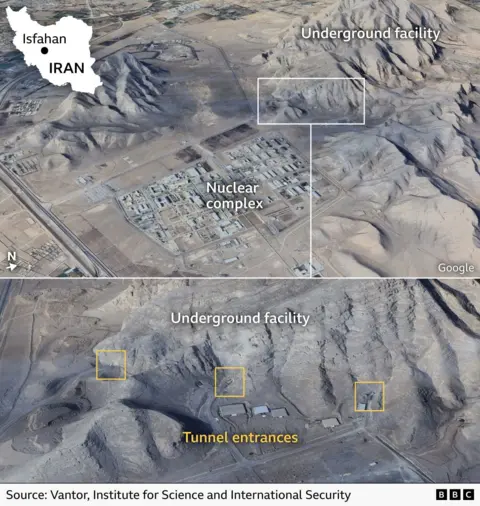
He said last June that Iran's nuclear capabilities were already "obliterated" by his bombing raids on nuclear sites at Isfahan, Fordow and Natantz. After a further five weeks of war, today Iran maintains its stockpile of near-weapons grade enriched uranium which is thought to be contained in gas cylinders under rubble.
In the third week of the war, Rafael Grossi, the head of the global nuclear watchdog the IAEA, told me there could ultimately be no military solution to Iran's nuclear ambitions.
Trump has said the US will now work "with Iran" to "dig up and remove all of the deeply buried… Nuclear Dust". But Tehran remains defiant on this issue and it will be a decisive one in the looming negotiations between the US and Iran in Islamabad.
Arguably Tehran could now - with an even more suspicious leadership in place - become more, not less, determined to seek a nuclear capability to deter another US attack.
Degrading Iran's arsenal
When Trump announced the war in a social media video from his Mar-a-Lago estate, his stated objectives included regime change - calling on Iranians to take over their government when the US-Israeli bombing stopped.
Within days he demanded the regime's "unconditional surrender", something that hasn't happened. Although Israel has killed senior figures including the Supreme Leader Ayatollah Ali Khamenei, his son, Mojtaba, was named his successor.
Trump has said the new leadership is less "radicalised and far more intelligent" than its predecessors. He hoped to repeat the result of his attack on Venezuela, where his forces snatched President Nicholas Maduro and put him in a New York jail cell, leaving the remaining leadership in Caracas pliant to Washington's will. But there is so far no evidence of this happening in Tehran.
On Iran's arsenal, Trump's top officials say the US has destroyed its conventional capabilities ("obliterating" its missiles, launchers, drones, arm factories and navy). In the case of missile and drone stocks this claim has been disputed via leaked intelligence assessments suggesting Iran in fact maintains about half of its pre-war arsenal. The BBC has not been able to verify either claim.
Either way, the Trump administration's stated aims have shifted since the outset of this war, with the US-Israeli objective of regime change failing to materialise.
The cost of war
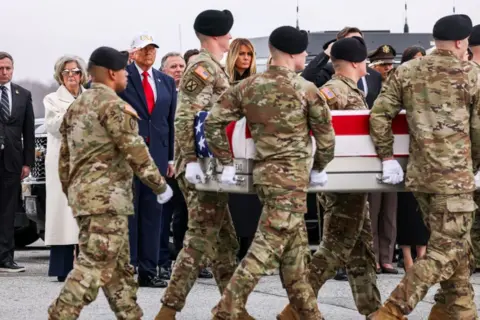
Thirteen US service members have been killed and hundreds more wounded. Munition supplies are said to have been expended at a rapid rate, including large numbers of tomahawk missiles, and an estimated price tag to the war of more than a billion dollars a day.
US officials, meanwhile, say unmatched military skill and technological prowess has completed an aerial campaign ahead of schedule that has forced a capitulation by Iran.
At home, meanwhile, there has been a political cost for Trump. Polling has consistently suggested a minority of Americans approve of the war. Trump's standing in Congress has largely been split along partisan lines with Republicans backing him. By early this week, however, some were openly opposing his social media threat to destroy a whole civilisation.
 Getty Images
Throughout the war, influential figures in his MAGA movement, like the podcast host and journalist Tucker Carlson, sharply split with him.
On Sunday, as Trump escalated his threats to destroy Iranian infrastructure, Marjorie Taylor Greene, once one of his biggest cheerleaders who has since broken with him, said: "This is not making America great again, this is evil." These fractures show few signs of healing within Trump's movement.
Democrats, meanwhile, were equally outraged at Trump's increasingly wild threats as well as his insults to America's allies. They urged the administration to answer questions about whether a US missile was behind the strike on a school in the town of Minab on day one of the war, killing at least 168 people including 110 children.
If confirmed this would be one of the worst cases of civilian casualties from a US strike in the Middle East in a generation. I pressed both Hegseth and Secretary of State Marco Rubio about it. The Pentagon has said it is investigating but nearly six weeks later has released no findings.
This week, several lawmakers called for his cabinet to invoke the 25th Amendment to seize power from a sitting president. The administration argues Trump's threats forced Iran to back down, and his Press Secretary Karoline Leavitt said: "Never underestimate President Trump's ability to successfully advance America's interests and broker peace".
A clearer verdict on that may come from Americans in November. The global economic fallout of the Strait of Hormuz closure has already sparked higher petrol and diesel prices for Americans. This is set to feed through to "sticker shock" at the grocery store, with anger at increasing costs already predicted to make this year's midterm elections uncomfortable for Trump's party.
This could become even worse due to the war, potentially costing the Republicans control of the House of Representatives and possibly the Senate. For the Republican Party, that would be a steep price to pay.
Trump had to respond to the looming economic crisis as Iran used the tactics of insurgency to respond to a conventional aerial war. His war aim became the need to reopen a strait that was open when he started the war.
Testing America's allies
As Iran took control of the Strait of Hormuz, Trump flip-flopped repeatedly on how to respond. He went from demanding allies help reopen the strait, to saying the US did not need their help, to calling for them to help, to calling longstanding allies "cowards" for not doing so.
Nato's already fraying cohesion, deepened by Trump's designs on Greenland, has been supercharged by the Iran war. Trump has renewed his attacks on the alliance which avoided formal involvement. After talks at the White House, Nato Secretary General Mark Rutte said the conversation was "very frank".
The president may believe that overwhelming American military superiority will safeguard America's role as a superpower in the long-term. But European nations are already looking at ways to "derisk" away from what they see as a now unpredictable, unreliable protector.
This is a potential economic and strategic gain for China, and one that has caused dismay among Trump's critics in Washington.
The true costs of this war are yet to be counted, and if this ceasefire or delicate negotiations fail they could become far steeper.