'Memory of a generation': China mourns the sudden death of a controversial education influencer

 stringer/ Feature China/Future Publishing via Getty Images
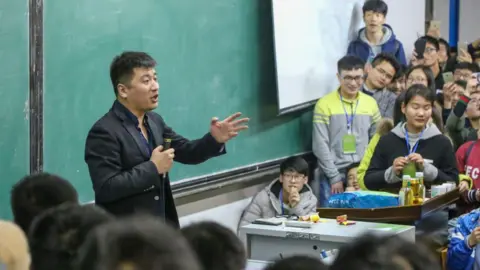
Within a decade, Zhang Xuefeng became one of the most recognisable names among China's youth.
With more than 26 million followers on Douyin, China's domestic version of TikTok, the 41-year-old was among the country's most prominent influencers - even while building his reputation in a niche field. By offering students and parents advice on university applications and choice of majors, he sought to help them achieve what many view as an all-important goal: better job prospects.
Issues of employability are complex in China, and Zhang was known for his extremely pragmatic approach. It also made him a highly controversial figure. Zhang once declared that "any major is better than journalism" and described liberal arts majors as a "service industry that caters to others".
Local media have often linked his rise to a pervasive anxiety in Chinese society, driven by a slowing economy and a sluggish youth employment rate. Yet Zhang remains a polarising figure.
Supporters say he changed the course of their lives by providing information that ordinary families without resources would otherwise struggle to access. Critics, meanwhile, argue his advice was narrowly utilitarian and ultimately unhelpful to society.
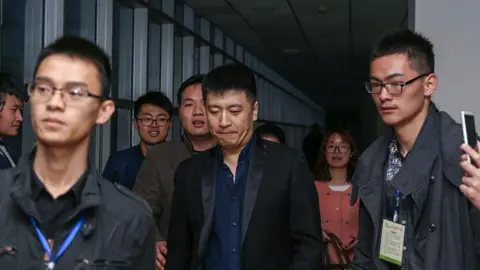
But such debates came to an abrupt pause on Tuesday. Zhang's name began trending in the afternoon amid rumours that he had collapsed while exercising. A few hours later, a statement appeared on his social media accounts announcing that he had died of cardiac arrest.
 stringer/ Feature China/Future Publishing via Getty Images
Tributes poured in almost immediately. Zhang's death was reported by major state media, including CCTV and People's Daily, and on social media the hashtag "Zhang Xuefeng dies" generated more than 600 million views in less than 24 hours.
"It's such a pity - he really changed many directionless families who had no background," read one comment on Weibo. It received more than 1,000 likes.
The making of Zhang Xuefeng
Zhang's rise embodied what millions of his followers aspire towards: someone from a small town who climbs the social ladder by forging their own path.
Zhang, whose original name was Zhang Zibiao, was born in May 1984 in a small county in Qiqihar, a city in north-eastern Heilongjiang province.
He studied water supply and sewerage engineering at Zhengzhou University in central China. After graduating in 2007, he joined a tutoring agency in Beijing that helps university students prepare for the national graduate entrance exam.
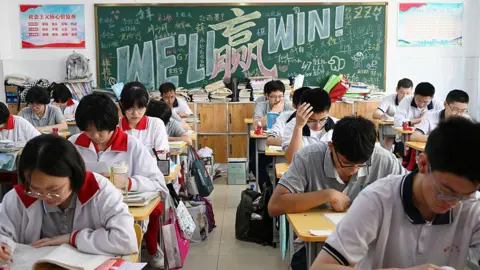
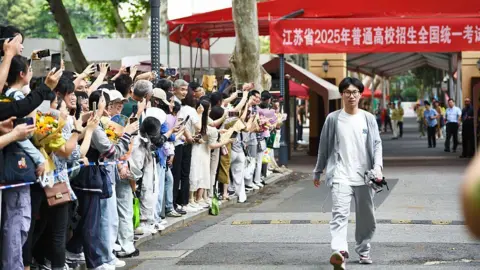
In a country where education has long been seen as a key to success, many Chinese people believe some of life's most important turning points could hinge on a handful of high-stakes exams: the university entrance exam, or gaokao; the graduate entrance exam, or kaoyan; and the civil service exam, or kaogong.
 HAO QY / Feature China/Future Publishing via Getty Images
Zhang entered the tutoring industry at a time of rapid expansion. China's economy was on the rise - it became the world's second-largest economy in 2010 - and university enrolment was also growing quickly. In 1998, there were only 1 million newly admitted college students in China; by 2008, that number had jumped to 5.99 million.
The expansion of college enrolment gave many low-income and rural families an opportunity to send their children to college for the first time. But experts have suggested that such rapid growth also led to lower teaching quality and an oversupply of graduates in the job market.
"The days when a college degree guaranteed a good job are gone, and graduates now face immense employment pressure," says Xiang Biao, director of Germany-based Max Planck Institute for Social Anthropology.
This, along with growing inequality in Chinese society, places a heavy burden on low-income families, he added, which has made people "increasingly view education as the last channel for families and individuals to achieve social mobility".
As university enrolment expanded, admissions systems also became more complex. Rules for university admissions can vary by province; in one model used in Shanghai, a student can apply for up to 96 majors. Meanwhile, for graduate school, applicants must choose a single major at a single university from nearly 1,000 institutions.
 Costfoto/NurPhoto via Getty Images
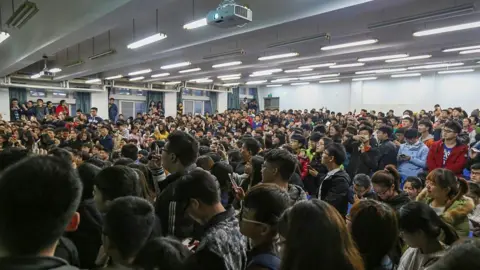
For students and parents overwhelmed by these complicated systems, Zhang offered clarity. In 2016, he went viral after delivering a lecture in which he summarised the 34 elite universities that set their own admission standards, rather than follow national cut-off scores.
Zhang had a charismatic and humorous style that made such complex information easy to digest - and his career took off from there.
A polarising figure
From then on, Zhang appeared on a range of TV programmes and entertainment shows, and eventually started his own company, building a strong social media presence and providing consultancy services for students and parents willing to pay a premium.
His most prominent platform became social media. On platforms like Douyin, Zhang would livestream for hours and post clips aimed at concerned parents seeking help to choose a major - as well as, ultimately, a career path that would lead to a secure life for their children.
He fielded questions such as "Should a girl major in electrical engineering?" and "How likely is a law graduate to find a job?" and responded with characteristic bluntness.
Zhang knew every major, university, and career path so thoroughly that he spoke with absolute certainty. In one livestream, when asked about the finance major, he almost shouted: "How good a job you'll find has nothing to do with your grades… It all comes down to whether you have the right resources."
To his followers, he provided a clear formula for future planning that universities could not offer. He would say things like: "If you are not from a top school and work somewhere different from where you study - you are doomed."
He advised students in liberal arts to major in law, accounting, or Chinese literature, reasoning that these fields most commonly led to recruitment after civil service exams. For biology, chemistry, or environmental science, he warned that finding a decent job often required studying all the way to a doctorate.
 stringer/ Feature China/Future Publishing via Getty Images
Zhang's advice, however, was not universally accepted.
"We can't recommend a major to any student just because it's a 'good' major. It's like a doctor making a diagnosis without examining the patient," says Xiong Bingqi, from the 21st Century Education Research Institute in Beijing. "He completely ignored students' academic ability and overall development."
But Zhang and his followers argued that ordinary families cannot afford to focus on personality or personal preferences. "All I do is to save children from ordinary families," Zhang once said in a livestream. "The experimentation cost is too high for our kids."
He was also no stranger to conflict over his fiery remarks. After saying he would "knock off kids who only want to study journalism" and claiming "you could pick any major from China's undergraduate catalogue with your eyes closed and it'd still be better than journalism," several journalism professors publicly criticised Zhang as "ridiculous" and "misguiding".
In September, he was banned from all social media platforms for nearly a month, after authorities cited "longtime use of vulgar and offensive language" during his livestreams. He apologised after later returning, saying he had "been too blunt and extreme in my remarks, which hurt many people and made me neglect the responsibilities of being a public figure".
Some of Zhang's supporters disagreed.
"All he did was tear away that fragile veil in advance, placing the reality outside the room plainly on the table," one Xiaohongshu post read after his death. "In an age shaped by an elite perspective, his words may have lacked grace, but they offered advice to ordinary people with very little margin for error."
After returning to the internet, Zhang had been more careful with his words, but he continued to work just as diligently. On 24 March, the day of his death, he livestreamed in the morning and asked people to join again in the evening.
No-one expected that these would be his last words to the public.
While Zhang's death has sent shockwaves across the internet, it has also prompted a wave of reflection: on whether he did more good or harm, the education anxiety that fuelled his rise, and the ultimate cost of achieving success in Chinese society.
In 2024, Zhang said he wanted to be remembered as "the memory of a generation of Chinese" in the future, where students influenced by him could have a good degree, a good job, and a good life.
"You have accomplished that goal," read a top-liked comment after his death on Douyin. "We will not forget you."