Digital art helps bring Britain's 'Pompeii' to life

 Guy Schofield
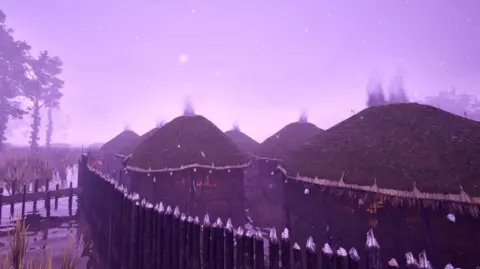
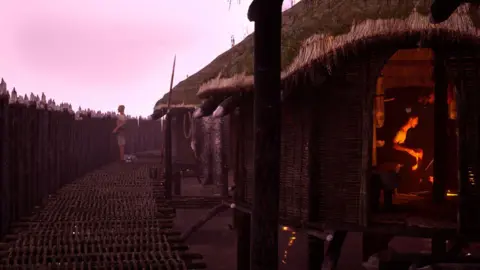
People will get an idea of what a Bronze Age settlement could have looked like through an immersive digital art installation.
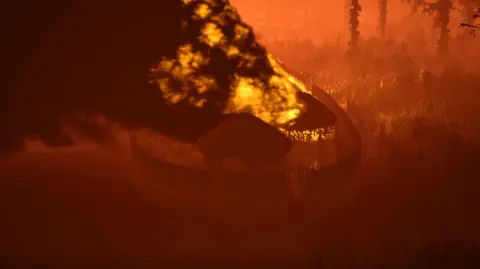
It is thought the 3,000-year-old settlement at Must Farm quarry in Whittlesey, Cambridgeshire, burnt down less than a year after it was built.
An exhibit called Fire to Fen is at March Library until 15 May. It follows the lifespan of the site, as depicted by archaeologists.
Dr Chris Wakefield, project producer and engagement officer at the Cambridge Archaeological Unit (CAU), said it had brought the settlement "to life in a way that is both immediate and engaging".
 Guy Schofield
Must Farm was excavated by the CAU between 2015 and 2016 and a wealth of well-preserved artefacts were discovered.
Also known as Britain's Pompeii, it had about 10 circular wooden houses.
The artist behind the project, Guy Schofield, used 3D modelling, motion capture and artificial intelligence (AI) to tell its story.
Pupils from Cromwell Community College, in Chatteris, also worked on the project, creating characters featured.
Schofield said it was "inspiring" working with the young people.
"Fen to Fire has been an amazing platform for combining cutting-edge technologies like AI-based motion capture with archaeology and storytelling," he added.
 Guy Schofield
As well as the CAU, the project's supporters included the Collusion's SHAPE Hub programme with the University of Cambridge and the McDonald Institute for Archaeological Research.
Speaking to BBC Radio Cambridgeshire, Wakefield said without Fire to Fen, non-archaeologists would find it hard to imagine what Must Farm was like.
He said the main installation was on a "huge TV" and there were more screens on either side of it.
Entry is free. The display can be viewed during library opening hours.
Do you have a story suggestion for Cambridgeshire? Contact us below.
Follow Cambridgeshire news on BBC Sounds, Facebook, Instagram and X.