Future of historic common ridings 'in jeopardy'

 PA
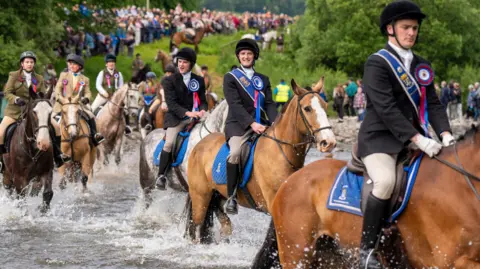
PAOrganisers have warned that the south of Scotland's historic common riding festivals could be at risk due to increasing financial pressures.
In the Scottish Borders, a working group has been established to safeguard the future of the ridings with organising committees citing unsustainable costs.
Meanwhile, in Dumfries and Galloway, several towns which host riding of the marches events are struggling to attract riders for principal roles due to the financial commitments required.
What does the future hold for these long-standing events?
 Getty Images
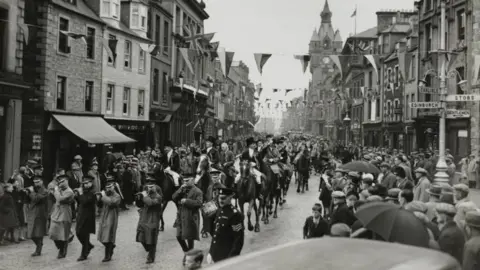
The history of each ride varies, with some laying claim to ceremonies dating back to the 13th and 14th Centuries.
Regardless of their inception, they represent their town's tempestuous past - when the boundaries were protected from encroachers.
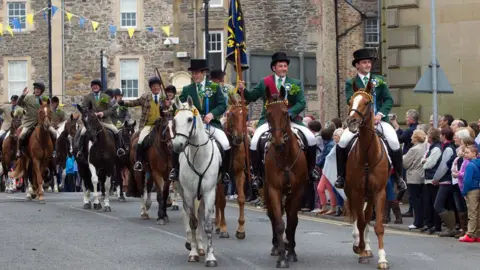
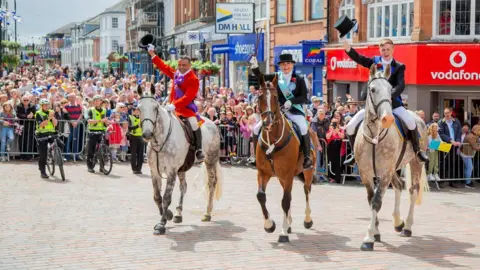
Nowadays, the riding of the marches, or the boundaries, is purely symbolic and is led by "principal" riders followed by a cavalcade of supporters on horseback.
Principal roles vary, but can include a cornet, cornet's lass and the standard bearer - who is tasked with carrying the burgh standard, or flag.
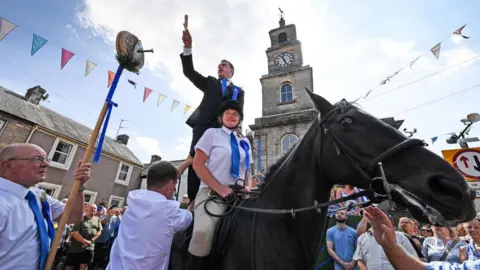
Each town is fiercely proud of its own unique traditions - whether that be the colour-bussing in Hawick or the nailing of a salted herring to a barley bannock in Langholm.
 Getty Images
The ridings are the highlight of the social calendar for communities, with ex-pats also being drawn back home.
In the Borders, there is a saying that the ridings are "better felt, than telt".
Book your wedding on common riding week and you will be scrambling for guests to witness you saying "I do".
However, the financial pressures are growing on organisers and participants, as health and safety regulations tighten and insurance costs rise.
The Borders ridings and festivals are larger than those in Dumfries and Galloway, and come with much higher running costs.
In 2025, the total expenditure for Hawick Common Riding was more than £125,000 - with portaloo hire alone topping £7,500.
The riding generated a £20,000 profit in 2007 - a figure that had dwindled to just over £1,000 last year.
 Dougie Johnston
Frank Scott is the chair of Hawick Common Riding (HCR), He believes more funding is needed.
''They're absolutely in jeopardy and we need to protect everybody, not just our own town," he said.
''They are the lifeblood of the Borders and are more important than Christmas for sure.
"I can't imagine Hawick without a common riding.''
A working group has now been established to represent the 29 Borders common ridings and festivals.
Scottish Borders Council (SBC) currently awards grants between £400 to more than £9,000 and allocated an additional £30,000 to support festivals in 2024/25 however communities have reported difficulties in accessing it.
Scott said he knew the local authority was "strapped for cash" but they could use more support.
In addition to financial backing, the council also gives a significant range of in-kind services for festivals and has committed to look at opportunities to improve long-term sustainability for the events.
 Findlater family
In Dumfries and Galloway, the cost of participating makes filling principal roles a problem.
In previous years, the cornet, lass and standard bearer would likely own their own horse, or could easily borrow one.
It was not uncommon to buy a horse for £1,000 and sell it at the end of the season.
Nowadays, those without a horse or one to borrow, are left with two costly options.
The first is forking out at least £8,000 to buy a horse that is experienced and fit enough to cope with the lengthy and challenging rideouts.
The second option is to use a horse-hire company where the bill could still top £3,000.
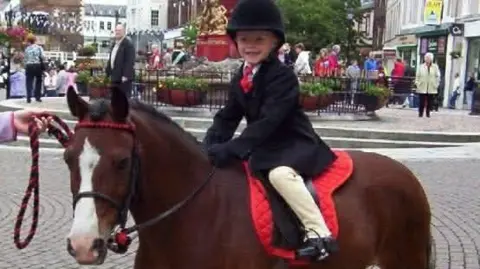
Ross Findlater's family has a long association with the Dumfries Riding of the Marches and Guid Nychburris' Day.
In 2022, he became the third generation to represent his family in a key role, when he was elected as cornet.
"I always looked up to the principals, especially when they came round the schools and I always wanted to be a cornet," he said.
"I was lucky I used my mum's horse.
"If I had to hire there's no way I could have afforded that with being an apprentice."
 Martin McNae Photography
Mary-Ann Boulton, convenor of Lockerbie Riding of the Marches, said in days gone by people had been "begging" for key roles, but that has changed.
"Over the last few years I've been phone bashing to try and get cornets and trying to find principals all across the region is getting very difficult," she said.
''It is a treasure and tradition and it will be a right loss if it goes down the tubes.''
For those who have grown up dreaming of being a cornet or cornet's lass, the thought of having to turn down the role due to a lack of finances could be heartbreaking.
For the hundreds of volunteers who organise the ridings, the pressure to balance the books is unrelenting.
And for the hundreds of thousands who cherish these ancient traditions, the uncertainty over their future is concerning.