First cases of mosquito-borne virus found in blackbirds in Scotland

 Getty Images
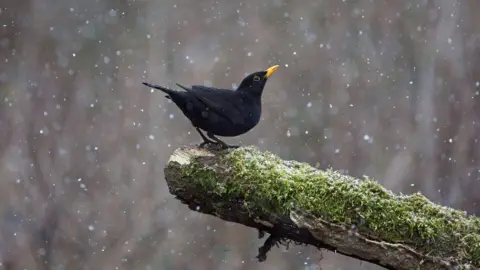
The first cases of a mosquito-borne virus have been identified in blackbirds in Scotland.
The birds are particularly susceptible to Usutu virus (USUV), and it has been circulating in south-east England for six years.
The UK government's Animal and Plant Health Agency (APHA) said analysis of blackbirds found dead in Arran, North Ayrshire, last summer had confirmed USUV.
It is regarded as generally of low risk to people and there have been no human cases reported in the UK to date.
The British Trust for Ornithology (BTO) said it was working with research project Mosquito Scotland to closely monitor the spread of the virus.
USUV has been found across Europe.. Wild birds are the main carrier of the virus, and the blackbird is one of the most common UK birds.
Andra-Maria Ionescu, of APHA, said: "The detection of Usutu virus in blackbirds in Scotland shows that countries further north are now facing an increased risk of mosquito-borne viruses.
"These findings highlight importance and need for improved, nationwide wild bird and mosquito surveillance to better assess the risks posed to animal and human health."
Islanders on Arran spotted a cluster of blackbirds displaying unusual neurological behaviour, and found dead birds, during the summer last year.
Prof Heather Ferguson, Mosquito Scotland project lead at the University of Glasgow, said: "Mosquito-borne diseases are increasingly likely to get a foothold in the UK, including in Scotland, as our environment continues to change."
She added: "When news of suspicious blackbird deaths consistent with Usutu came through, we were able to almost immediately deploy a team of experts to Arran for rapid follow up and investigation.
"This allowed us to confirm the presence of several different mosquito species near the locations where infected birds were found, including several known to be capable of spreading Usutu."
How to report suspected cases
BTO said it has been working closely with the Radar project in England and Wales, while its Scottish partner organisation Mosquito Scotland has been covering Scotland.
A BTO spokesperson told BBC Scotland News: "What we have seen is that the virus has been detected in a range of species and a range of places, though the main impacts in the UK so far have been on blackbirds, in and around Greater London.
"We will collectively be keeping an eye on things and continuing to monitor the situation as best we can, and as far as funding will allow."
APHA has urged the public to report any dead birds, particularly songbirds, owls or any other bird showing neurological signs of being unwell or in distress.
It added: "People are also encouraged to keep their gardens free of any stagnant water to minimise any mosquito breeding grounds particularly now that we are entering the mosquito active season which runs from April to October."