Why UK can block Isle of Man's assisted dying bill

 PA Media
In the chambers of Tynwald, the world's oldest continuous parliament, a bill is passed by members of the House of Keys and Legislative Council.
But before it can actually change the lives of the 84,000 people living on the Isle of Man, it must take a journey across the Irish Sea to London.
While the island is a self-governing Crown Dependency, it remains tied to the British monarchy through a process known as Royal Assent.
Without this final "seal of approval," no Manx Bill can become law.
Here is how the process works and why, in practice, it gives the UK government a significant say in Manx affairs.
How does a bill become law?
Once the two branches of Tynwald - the House of Keys and the Legislative Council - agree on a bill, it is sent to the UK Ministry of Justice (MoJ).
Officials spend several months scrutinising the legislation and then advise the Lord Chancellor on whether the bill should be recommended for Royal Assent.
If the UK ministers are satisfied, they notify the Lieutenant Governor, the King's representative on the island, who is usually granted delegated powers to give Assent on the King's behalf.
Once the green light is given, the bill is signed in a formal sitting of Tynwald and Royal Assent is typically announced later the same day.
The bill then becomes an Act of Tynwald.
The UK's 'veto' power
Because the Crown acts on the advice of UK ministers, the British government effectively holds a veto over Manx primary legislation.
If ministers have concerns, the process can hit a standstill, which is what happened recently with the Assisted Dying Bill 2023, which was sent away to receive Royal Assent in March 2025.
The process that usually takes between three and six months, has now taken more than a year.
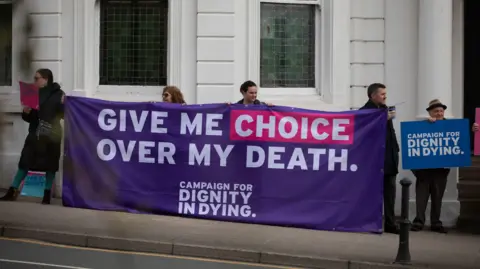
Last week the MoJ said it could not recommend the bill for Royal Assent unless more safeguards were written into the primary legislation.
 PA Media
What happens if the UK says 'no'?
If the MoJ cannot recommend a bill in its current form there are three different options.
The most common is the UK suggests changes, which can then be approved by Tynwald or the House of Keys.
Another option is withdrawing the original bill altogether, introducing a new revised bill and taking it through each legislative stage again.
This happened in 1929, 1951, and 1969.
The final option would be the MoJ witholding Royal Assent entirely, which, while rare, happened in 1962 over the Wireless Telegraphy (Isle of Man) Bill.
That was over a dispute rooted in the era of pirate radio.
While the UK's ability to block Manx law is a significant constitutional power, it is rarely used, and most legislation passes through the MoJ without friction.
However, the mechanism remains a reminder of the island's unique status - fully self-governing in name, but still operating under the ultimate gaze of the Crown in London.
Read more stories from the Isle of Man on the BBC, watch BBC North West Tonight on BBC iPlayer and follow BBC Isle of Man on Facebook and X.