The unusual ways Fijians predict when a cyclone is approaching

 Frankie Adkins
Creeping yams and bees behaving strangely – in Fiji, farmers read nature's warning signs to predict hurricane season.
It's July, a month when Fijian farmers begin watching wild yams closely. "If they see wild yam vines creeping along the ground, there's going to be a hurricane in between November and April – the hurricane season," says farmer Marika Radua. If the vines shoot upwards, it's unlikely a hurricane will hit, he says.
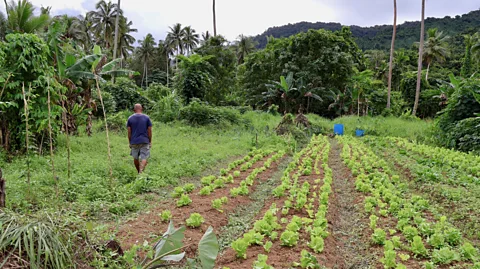
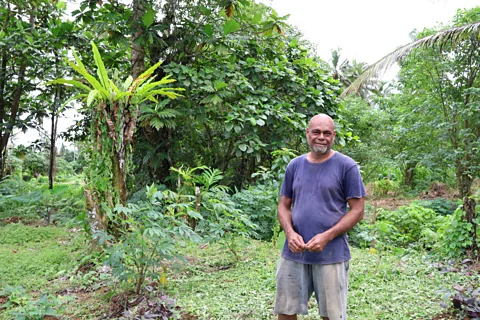
In the dense jungle on Vanua Levu, Fiji's second largest island, Radua's farm is a riot of green. Every plant has its place – from rows of delicate lettuce, to sturdy taro and cassava. For years, Radua has read the signs in nature to know when, and where, to plant his crops to ensure they thrive each season.
Yam vines are natural indicators of extreme weather, according to Fijian traditional ecological knowledge. This environmental knowledge comprises ancient traditions held and practiced by indigenous peoples. When the vines hug the ground, "they are already trying to protect themselves from the wind. It's nature," Radua says.
Many Fijians – especially those from older generations who are more likely to use traditional farming methods – believe other organisms act as natural weather forecasts, such as bananas, bees and breadfruit.
 Frankie Adkins
Before modern technology, environmental indicators like these were used across the world to predict natural disasters. But in the last century, data from satellites, weather radars and computers has provided increasingly precise monitoring and forecasting.
In the Pacific, communities are returning to ancient wisdom to anticipate extreme weather, to enhance modern methods. Scientific studies and Fiji's meteorological service are recording these local "early warning signs" of tropical cyclones and flooding. As climate-change-driven disasters pick up pace in the Pacific, traditional knowledge might buy communities more time to prepare.
A total package
In 2024, the Fijian Meteorological Service announced it would integrate traditional environmental knowledge into its scientific forecasting – describing the pair as "a total package".
Fiji follows in the footsteps of Vanuatu, Tonga, Samoa, Niue and the Solomon Islands – Pacific nations participating in an ongoing project to integrate traditional knowledge in their early-warning systems.
Siosinamele Lui, the climate traditional knowledge officer at Secretariat of the Pacific Regional Environment Programme (SPREP), an intergovernmental body, says natural indicators are key to helping remote communities can prepare for weather events.
"In most parts of the world, traditional knowledge and national services are not mentioned in the same sentence," says Lui. "But in the Pacific, it's now becoming the go to. It's normal practice."
Since 2016, the SPREP project has been researching natural indicators, with Pacific islanders reporting early warning signs directly to the Pacific Meteorological Desk via calls, messages, social media or local climate centres.
Vanuatu is "leading the way" with an app named ClimateWatch, says Lui. The app has a database of crowd-sourced natural indicators – for example, green turtles nesting further inland suggests a cyclone may be approaching.
However, using traditional knowledge to preempt weather events is not an instant process, says Lui.
"You cannot integrate a data set that's only five years old with a data set that's 100 years old. At the moment, most of our monitoring data is not old enough for us to build it into the climate forecast," she adds. Therefore, the government is studying the correlation of traditional indicators with weather events, before building this into their climate forecasting model.
 Getty Images
However Lui says that promoting traditional weather knowledge can help people in secluded areas.
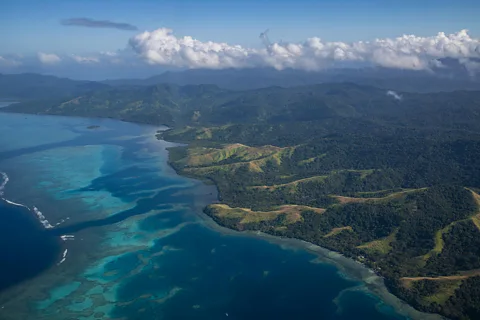
"To put it in context, you're looking at the biggest ocean in the world, and you have thousands of islands that are widespread. You don't have monitoring equipment on every island," says Lui. This technology is expensive and sparsely located, leading to gaps in meteorological data, she adds.
Not everyone will be able to get critical warning information on time, if at all. "That's where this programme comes in," says Lui. "Whether it's from the Meteorological Service or whether it's traditional warning systems. The goal is for people to respond and be prepared," she says.
Listening to the land
For Fijian people, traditional knowledge such as how the seasons change isn't "black and white", Radua says. "We don't write things down – they are translated from one generation to the next through stories, songs, dances and idioms," he says.
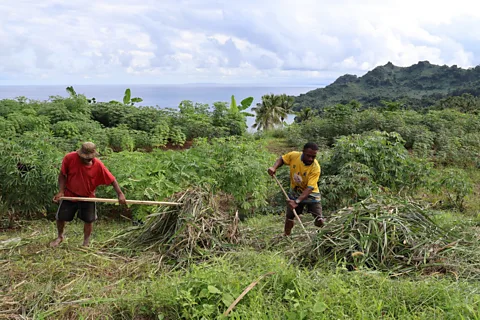
Radua, who is a climate resilience expert on Vanua Levu, began compiling this cultural wisdom into a seasonal calendar available for farmers on the island. Many farms, both commercial and family-run, in Fiji have converted to modern ways of farming – for example monoculture, planting and cultivating a singular crop. Radua teaches subsistence farmers how to return to traditional agricultural methods, such as planting multiple crops at different times of the year.
Not only is this better for nature, but it means farmers can listen to the land for early warning signs, says Radua. "The trees will tell them, when something flowers, it tells them," he says, explaining how farmers keep an eye on shifts beyond normal seasonal patterns. "That's preparedness and resilience," he adds.
For Pacific communities, the need to buffer against extreme weather is more urgent than ever. Radua recalls Cyclone Winston, which caused widespread damage, costing Fiji's agricultural sector over $2m (£1.5m). "Most of us lost all of our crops," he says.
According to a 2025 report that assessed the country's climate risk – ranking Fiji 103 out of 190 countries – tropical cyclones are predicted to increase in severity in Fiji. Pacific Island countries need around $1bn (£730m) for climate adaptation investments, according to the International Monetary Fund.
Although several ideas are being considered to increase the country's climate resilience – from seawalls to climate migration – integrating ancient wisdom is being proposed as a low-cost part of the solution in Fiji.
"Almost everything about mitigating climate change is pointing back to traditional knowledge," says Radua.
Buying time
Some Fijian communities reported that traditional signs were the first and most reliable way of being alerted that Cyclone Winston was approaching.
In a coastal village in the Province of Tailevu, on the southeastern fringe of Vitu Levu, Fiji's main island, villagers noticed nature reacting in uncharacteristic ways up to four months before the cyclone.
In a 2025 report, published by independent think tank the International Institute for Sustainable Development, 10 villagers in Tailevu recalled witnessing a spectrum of signs, that have been previously seen happening prior to cyclones.
Around three to four months prior to the cyclone, hornets nested close to the ground, five or more breadfruit grew on one stalk and the central shoots of plantain plants curled instead of growing straight. One month before the cyclone, fishers noticed the sea felt hotter, while small fish were found dead on the shorelines. One week before the cyclone, seabirds flew towards land, swooping lower than usual. (Read more about how seabirds predict tropical cyclones.)
 Frankie Adkins
The report suggests that tracking natural indicators gives communities more time to prepare prior to a disaster. With greater warning, villagers could stock up on food and fresh water, reinforce their houses and move farm animals to sheltered spaces.
"Faced with escalating climate risks and climate impacts, mounting costs and overstretched budgets, local and national governments are looking for ways to address the climate crisis in a cost-effective way," says Alec Crawford, the director of nature for resilience at the International Institute for Sustainable Development.
But nature-based solutions grounded in traditional ecological knowledge goes beyond their cost effectiveness. "They are the most well-suited adaptation actions to implement, because local communities are the ones who know best how to adapt to their changing environment," adds Crawford.
Coping mechanisms
Joeli Veityaki, a climate scientist from the University of the South Pacific, says traditional indicators were developed centuries ago as important "coping mechanisms". "There are examples that our technology is just as good as tech in other parts of the world that are so dominant," he says.
Patrick Nunn, a professor of geography from the University of the Sunshine Coast, Australia, says we have hardly "scratched the surface" of traditional ecological knowledge.
"In places like Fiji, all of its traditional knowledge is empirical based – people see something and they infer an association," he says. Nunn gives the example of when black birds fly over the land, and people deduce that a cyclone is on its way.
"This knowledge has already been validated simply by the fact that they've been shown to work over long periods of time. If the sighting of black birds over the land is not a reliable indicator of an approaching tropical cyclone, then people wouldn't have retained that knowledge for so long," he adds.
Nunn refers to oral stories from the Pacific that describe ant behaviour, which aligns with scientific observations. For example, leaf-cutter ants appear to detect subtle environmental changes that signal impending rain, prompting adaptive responses. While this does not constitute scientific proof that ants can predict tropical cyclones days in advance, it does suggest that their behaviour may be predictive in ways consistent with Pacific traditional ecological knowledge.
The idea that Pacific Islands are inherently "vulnerable" or "lack resilience" is misguided, says Nunn. "People arrived in the Western Pacific more than 3,000 years ago, and they've been there ever since. They didn't survive by luck – they survived by design."
This doesn't mean the region is without challenges, or that climate change isn't reshaping traditional ways of life. Between 1999 and 2018, Fiji ranked as the 13th country most affected by extreme weather events.
More like this:
• How indigenous conservation protects Canada's environment
• These Florida domed homes have survived category 5 hurricanes
"But there is a formidable body of traditional local knowledge in every Pacific Island community that is able to assist in developing strategies for coping with future climate change," says Nunn.
Back on his farm in Vanua Levu, Radua echoes a similar sentiment. "Knowledge evolves with time, but it's not just about traditional knowledge," he says. "It's about living in harmony with nature."
--
For essential climate news and hopeful developments to your inbox, sign up to the Future Earth newsletter, while The Essential List delivers a handpicked selection of features and insights twice a week.
For more science, technology, environment and health stories from the BBC, follow us on Facebook and Instagram.