The nerve centre running a new mission to the Moon


 Getty Images
Just like the Apollo missions, Artemis II will be run from a mission control monitoring every instrument from here on Earth. How has it changed since the days of the space race?
The rocket scientists get the acclaim, the astronauts the glory but – when it comes to flying to the Moon – the real heart of the action can be found in a 1960s concrete office block in Texas.
Nasa's Christopher C Kraft, Jr Mission Control Center on the outskirts of Houston is named after the man who came up with the concept at the dawn of the space age. Kraft's idea was to bring together, in a single room and under the direction of a flight director, all the people responsible for the spacecraft.
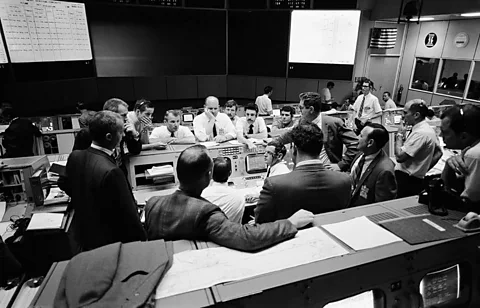
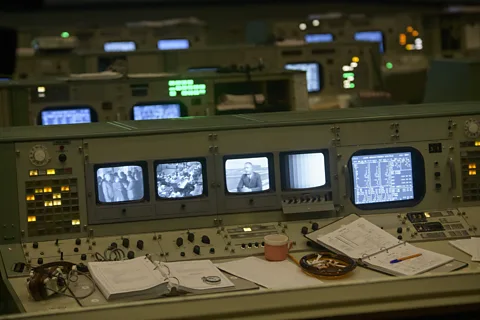
The original mission control that oversaw the first Moon landing and brought us the phrase "failure is not an option," after a section of the Apollo 13 spacecraft exploded on the way to the Moon, is now preserved as a US National Historic Landmark – ashtrays, coffee cups and all. (You can read more about the restoration here.)
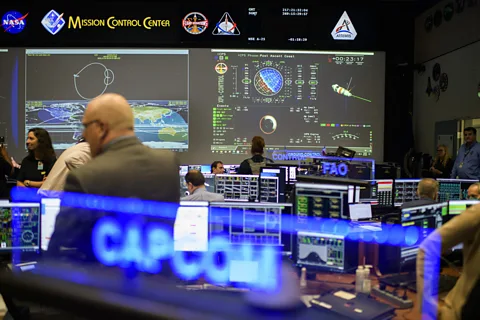
But across the hall is the modern equivalent for 21st-Century lunar missions: Artemis mission control and the purpose is essentially the same.
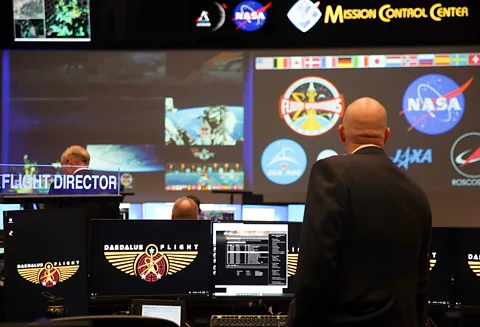
"The structure that Chris Kraft put together as the first flight director has really stood the test of time," says Fiona Antkowiak, one of nine flight directors assigned to Artemis II, Nasa's first crewed Moon mission since 1972.
 Getty Images
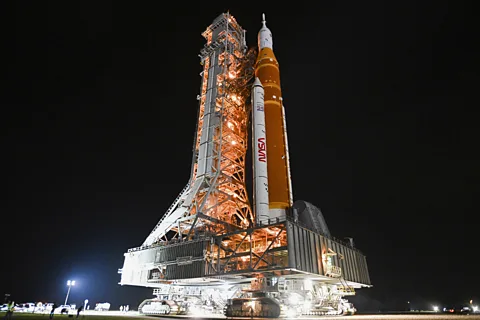
Currently due for launch in April 2026 (the latest launch opportunities are here), Artemis II will take four astronauts in a loop beyond the Moon, further than humans have ever gone before. They will become the first people to blast into space on the giant new SLS rocket and fly in the Orion capsule. There is a lot at stake.
It will be up to the team in Houston to keep the mission on track and bring the crew safely back to Earth 10 days later. Working in three shifts, 24 hours a day, mission control will communicate with the astronauts, send commands and monitor everything from trajectory and propulsion systems to the astronauts' heartbeats.
"The role of mission control is ultimately to keep the astronauts safe, keep the Orion spacecraft safe and to achieve the mission objectives," Antkowiak says. "We structure our work to do those items in priority order."
From the '80s-era Nasa 'worm' logo on the back wall, to the funky hexagonal LED lights suspended from the ceiling, today's mission control is a blend of the old and new. The bespoke grey consoles with the chunky buttons and black and white monitors of the Apollo era have been replaced by keyboards and touchscreens. But the names of the desks date back to the earliest missions – life support, for example, is still overseen by Eecom (Emergency, Environmental, and Consumables Officer) – crucial for keeping the astronauts alive during the Apollo 13 rescue.
The air is also a lot cleaner than it used to be now smoking is banned and the china cups have been superseded by plastic travel mugs. But beyond the technology, probably the biggest change has been in the appearance of the mission controllers themselves.
Look at any picture of Apollo mission control and the controllers were all young white men, wearing white shirts, their pockets filled with pens and slide rules. When Poppy Northcutt joined as the first female engineer in the mid-1960s it was very much seen as a boys' club. Today, not only is the attire much more informal but mission control is much more diverse – and frequently led by women.
The room where it happens
Every aspect of the flight will be overseen from this room. Mission controllers on the ground will work with the astronauts in space to keep Artemis II on track. To avoid confusion, all communication with the crew is through a capsule communicator or "capcom" (a name dating back to the earliest Mercury spaceflights) but it's the flight director that ultimately calls the shots.
"The key is that you have an on-console flight director and that person has ultimate authority to make any quick-turnaround decision," says Antkowiak.
Although many of the systems on this complex spacecraft are automated, keeping across everything and dealing with any problems is more than a small group of people in one room can do alone. That is where another team in the building's Orion Mission Evaluation Room (Mer) gets involved.
(See more on the history of Nasa's mission control in our picture gallery: Mercury to Artemis: the evolution of mission control)
 Getty Images
"The Mer has a unique and different perspective from the flight director and his or her operational team," says Orion Mer Lead, Trey Perryman. "We're not responsible for operating or the immediate response to issues, but for monitoring the spacecraft performance in significant detail and to lead resolution of problems – there's a difference between responding to a problem and resolving the problem."
The engineers working in the Orion Mer are the same ones who designed and built the spacecraft, so they are familiar with every bolt, component, circuit and valve. The Mer team includes a group from Europe responsible for the critically important service module attached to Orion. Provided by the European Space Agency (Esa), and built by Airbus in Germany, this half of the spacecraft contains the main engine and fuel to power the spacecraft, as well as the water and air to keep the astronauts alive.
"We know the most about the spacecraft," says Perryman. "So, we support all [the spacecraft operators] through the mission to help them understand what's happening, where they may need a little bit more engineering help and resolve any problems because it's crucially important we get that crew home."
It is possible – from launch to splashdown – that every single stage of Artemis II will go exactly to plan. The first, uncrewed, Artemis mission, Artemis I, made it to the Moon and back with only a few glitches. But the history of human spaceflight suggests that it's wise to be prepared for any eventuality.
Almost every Apollo Moon mission experienced some anomaly – from faulty thrusters to overloaded computers. But every problem was overcome, and every mission saved, thanks to the combined knowledge of the crew, mission control and the Mer.
Before any mission left the ground, most contingencies had been thought about, prepared for and simulated on the ground. The Apollo astronauts spent months of their lives shut in a spacecraft simulator learning how to fly and land. Apollo mission control and Mercury, meanwhile, experienced failure after failure during simulations to develop the expertise for the real thing.
 Nasa
NasaDuring the second mission to the Moon, for instance, just seconds after launch the rocket was struck by lightning. The discharge knocked out the power in the command module, leaving the astronauts hurtling into space on the top of a giant rocket with all the alarms going off and the spacecraft, seemingly, out of control. But Houston had experienced this before during a simulation, and suggested the crew select an obscure switch on the spacecraft control panel: SCE to Aux. SCE stands for Signal Conditioning Equipment, the system that processed sensor data for transmission to the ground.
Once selected, the power came back on, and the astronauts went on to walk on the Moon (you can read the full story here).
Predicting the problems
The technology in Artemis II is far more sophisticated than Apollo and – to make sure they know it inside out – mission controllers have similarly spent months pushing the spacecraft to breaking point.
"Our goal is that we run a simulation, and 10 things break in three hours," says Antkowiak. "On the real mission that number should be smaller, and we are prepared therefore to address it."
"We know walking in, there will be problems," Perryman adds. "You can imagine a scenario where perhaps a thruster has failed, and a navigational system in another part has also failed – it's important for us to understand not just whether we can recover those but, if we can't recover, what does that mean for the mission?"
What distinguishes Artemis II from any other mission in more than 50 years rests on a decision made two days into the flight. After launch, Artemis II will orbit the Earth to adjust its trajectory and enable the crew and flight controllers to check out spacecraft systems. This will include a period when the astronauts take manual control of the spacecraft – something the highly skilled pilots are almost certainly looking forward to. Then, on day two, the duty flight director will poll the room and make a call: are all systems "go" to send Orion to the Moon?
 Getty Images
"It's called translunar injection," says Antkowiak. "It's a huge decision – you need to make sure that the spacecraft is ready to support the crew for up to 10 days and once you make that choice, you don't have a lot of quick ways to get home."
Another unusual aspect of Artemis II is that the crew will be out of contact from the Earth for around 40 minutes when Orion disappears behind the Moon. The trajectory and laws of physics mean the spacecraft will definitely come back round, but that won't necessarily reduce the tension in the control room.
"We certainly like having communication with our spacecraft – it's a nice warm fuzzy feeling to be able to hear the crew and see that telemetry data coming down," admits Antkowiak. "I think as you get near that time that the com comes back, you have a whole room of people in mission control just staring at their screens, waiting for the data to come back on time."
More like this:
• Have you got what it takes to go to the Moon?
• Artemis I: A giant rocket to set new space records
• The astronaut school inside a Swiss mountain
For the crew, however, this period out of contact with mission control is likely to be another highlight. It will be just them and the Moon as they fly above areas of the lunar surface never directly seen before with human eyes. The astronauts are scheduled, in the official timeline, to spend the time looking out of the window taking photos, shooting video and recording their thoughts.
Once Orion has swung round the Moon, physics also dictates that it will be coming home fast. Approaching the Earth, the capsule will be travelling at some 25,000 mph (40,200km/h). As Orion passes into the atmosphere, it will experience temperatures of more than 2,000C (3,632F) – potentially the most dangerous few minutes of the mission. During Artemis I in 2022, the heatshield was damaged on re-entry, one of the reasons Artemis II has been so delayed.
The risks of returning to Earth are something Perryman appreciates only too well. He was on duty in mission control when Space Shuttle Columbia disintegrated during re-entry in January 2003, killing the seven astronauts on board.
"The Columbia accident has permanently left a mark on me," he says. "It is for sure in the back of my mind that what we do here in this building, in my room and with the flight director and their team, is immensely important."
--
If you liked this story, sign up for The Essential List newsletter – a handpicked selection of features, videos and can't-miss news, delivered to your inbox twice a week.
For more science, technology, environment and health stories from the BBC, follow us on Facebook and Instagram.