Summary

  1. We are going to see things we have never seen beforepublished at 10:35 BST

    Pallab Ghosh
    Science correspondent

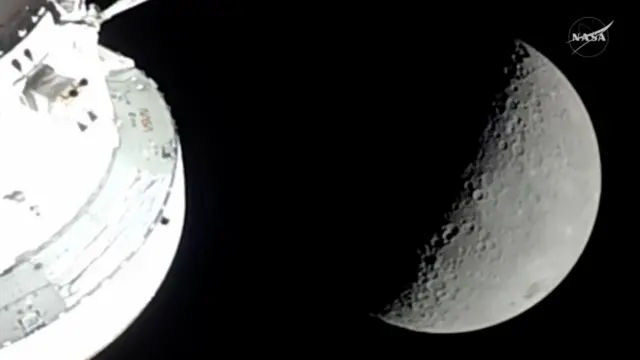
    A view of the Moon from the Artemis II mission's Orion spacecraft.Image source, NASA/Reuters

    It's a story of inspiration and a story of science. For me, it had echoes of the Apollo programme.

    At a time when this world does not have enough optimism, this was a moment in time when we could forget we're a planet that has a war. We can see that picture of the Earth and look at it as one planet.

    The most moving moments were the human ones. You could hear the crackle of emotion in the astronauts' voices when they named a crater after Reid Wiseman's wife.

    This is the difference between this mission and other recent robotic ones - you have four people out there being our eyes and our eyes and transferring their love of the Moon to us.

    What we haven't seen are the pictures from the crew. We are going to see things no human has seen before - the Moon has features and terrain we have never seen.

    That's important because it's a record of what happened to our own planet as it was forming. The images from the astronauts are going to be analysed, and we are going to be in for a treat over the coming days and weeks as we start seeing what the astronauts saw.

    This is not the end of the story by any means, this is just a test flight for an eventual landing on the Moon - not just one, but many more to come.

    Our coverage is now pausing as the spacecraft's journey back to Earth continues and the crew get some sleep. You can read more about the mission here.

    As things stand, the astronauts are expected to splashdown off the coast of San Diego at approximately 17:07 local time on Friday 10 April (20:07 eastern time and 01:07 BST on Saturday) - we'll be bringing you live coverage of that moment.

  2. History made - now what happens next?published at 10:30 BST

    Esme Stallard
    Science reporter

    The astronauts should be fast asleep now - and some say with weightlessness they have their best sleeps ever in space.

    In the mean time, pictures, audio and other data from the lunar flyby are being downlinked by Mission Control.

    We are waiting patiently (sort of) for those first pictures to appear on Nasa's website and will bring you them online and elsewhere across the BBC as soon as we have them.

    The rest of the day should unfold as follows:

    • Flight day 7 will begin this afternoon and the crew will be woken up
    • The spacecraft will depart the lunar sphere of influence and will begin to be pulled back to Earth by our planet's gravitational field
    • The Orion crew will speak to astronauts on the International Space Station
    • The lunar science team and the astronauts will discuss what was seen in the flyby, which we will be able to listen to
    • We're expecting a mission update at 21:30 BST
  3. 'Positive vibes' or 'sick of hearing about it'? Your views on the Moon missionpublished at 10:19 BST

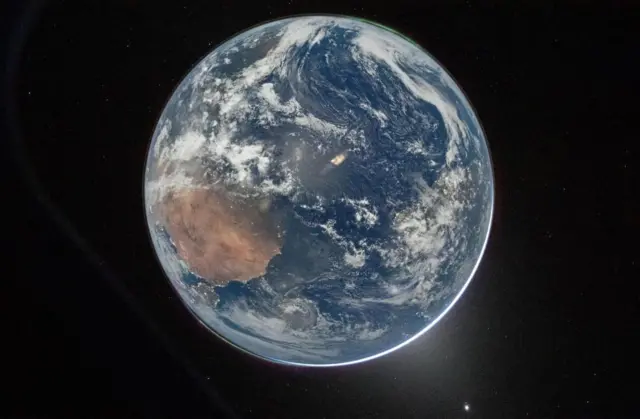
    A view of Earth taken by NASA astronaut and Artemis II Commander Reid Wiseman from one of the Orion spacecraft’s window after completing the translunar injection burn on 2 April, 2026/ The planet is seen against a dark space backdrop with the light from the sun visible in the bottom right cornerImage source, NASA

    BBC Radio 5 Live listeners have been sharing their opinions about the Artemis II mission, including Steve in Malton, who says it has shown how "fragile we are in space".

    He tells host Nicky Campbell: "I hope we use this mission as that launchpad to protect the planet more."

    Peter in Exeter says: "I can’t help thinking that the way we treated this planet, which isn’t with much respect, we will be treating all the other planetary bodies we go to in the same ways. Because we’re going to exploit them for what they’ve got to offer us."

    Karen in Northumberland says: "I’m sick of hearing everywhere that everybody loves this. They really don’t.

    "There’s all these narcissistic wars. So many people going hungry. We’re killing the planet. It’s not for all of humanity."

    But former Nasa space scientist Dr Hina Khan says: “We have to look beyond what we can do that is positive and good, and this does. This mission gives that positive vibe.

    "It’s been a bit of a release with all the other news we have to deal with. It gives us hope and yes, transcending where we are and off our planet."

  4. Where are the Artemis II crew now?published at 09:48 BST

    The Orion spacecraft has completed its lunar fly-by, reaching the furthest distance travelled by humans from Earth at 252,756 miles (406,771 km).

    The spacecraft is still about 244,200 miles (393,002 km) from Earth as of 09:30 BST, with the astronauts due to land in the Pacific Ocean at 20:07 eastern US time on 10 April (01:07 BST 11 April).

    Once the crew arrive home, they will have travelled over 695,000 miles (1,118,494km) in total.

  5. Why has it taken so long to return to the Moon?published at 09:16 BST

    Rebecca Morelle
    Science editor

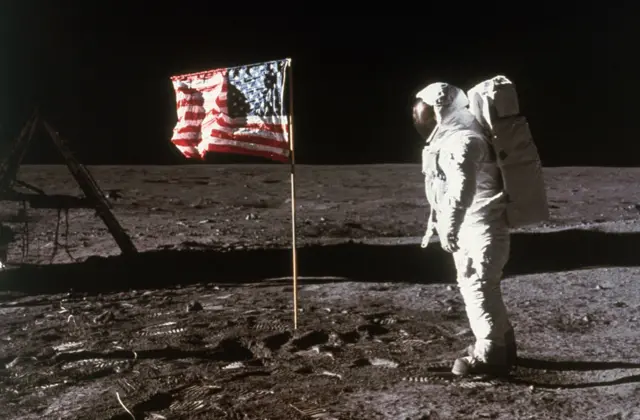
    Astronaut Buzz Aldrin in a white outfit and large helmet stands beside an American flag placed on the moon during Apollo 11Image source, Getty Images
    Image caption,

    Buzz Aldrin stood beside a US flag on the Moon in 1969

    After its history-making lunar landings, the Apollo programme was cancelled in 1972.

    Costs had spiralled, priorities had changed, so attention shifted to a more budget-friendly destination: low-Earth orbit.

    And that’s been the focus for Nasa the last 50 years, starting with Skylab, then the Space Shuttle programme, and more recently the International Space Station.

    A return to the Moon was mooted in 2005 under Nasa’s Constellation programme, but it was cancelled in 2010 because of delays and cost over-runs.

    However, the technology developed for Constellation - namely the Orion spacecraft and parts of the Constellation rockets - became incorporated into the Artemis programme, which formally began in 2017.

    A Moon landing was originally planned for 2024, but with delays to both Artemis I and II, Nasa says the Artemis lunar landing will now happen by 2028.

  6. What did the Artemis II crew see on the far side of the Moon?published at 08:52 BST

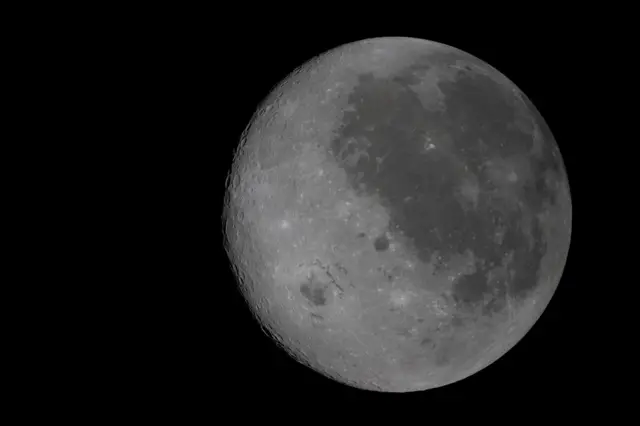
    The MoonImage source, NASA
    Image caption,

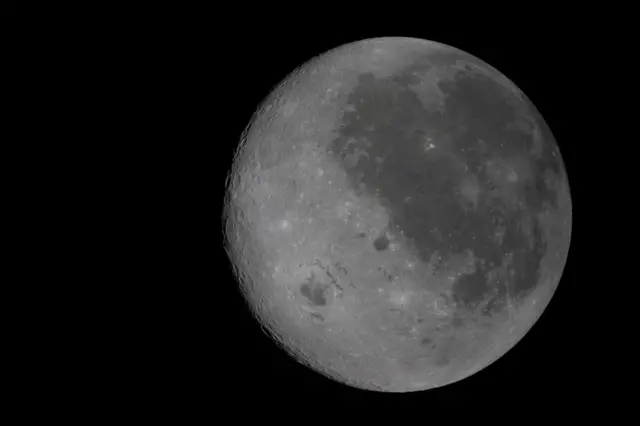
    We're still waiting for pics of the far side of the moon to be beamed back from the spacecraft - this one of the near side was taken yesterday

    Alongside witnessing a total solar eclipse, Nasa's head of science Dr Nicola Fox says the Artemis II crew saw several “new, small craters” while observing the far side of the Moon.

    Fox tells BBC Radio 4’s Today programme the craters appeared as “bright patches” and were visible to the naked eyes of the crew as a series of colours, including shades of brown and blue.

    The astronauts also described the line dividing the sunlit and dark side of the Moon as a “jagged edge” due to the celestial body’s craters.

  7. Crew were well-prepared for testing mission, says astronautpublished at 08:21 BST

    Meganne ChristianImage source, European Space Agency

    It is hoped the Artemis II mission will help to usher in a new era of space travel - and one of those hoping to be part of it is Dr Meganne Christian, a reserve astronaut with the European Space Agency.

    The dual British national began training in January 2025 after being selected from thousands of applicants, getting a taste of the rigorous preparations the Artemis crew will have gone through for moments like losing contact with Earth.

    She tells BBC Radio 4's Today programme the astronauts will have performed "simulation after simulation, knowing what's going to happen in any given moment - they were ready for it".

    Asked about the importance of this mission, she says: "This is a test flight, preparing us for the future of exploration, preparing us for future landing sites... We are not just going to the moon, we are going there to stay."

  8. Moon crater to be named after astronaut's late wifepublished at 07:56 BST

    There was a poignant moment onboard the capsule yesterday when conversation turned to proposing names for craters on the Moon to memorialise this record-breaking voyage.

    One of the craters should be named Integrity after their Orion spacecraft, the crew agreed - while another should be named after astronaut Reid Wiseman's late wife Carroll who died in 2020.

    The name proposals will need to be formally submitted to the International Astronomical Union, which governs the naming of features in space - but we suspect they'll be open to the suggestion.

  9. Astronauts clock off for the night after record-breaking daypublished at 07:30 BST

    Esme Stallard
    Science reporter

    We've just heard from the crew onboard the Orion spacecraft, who have bid goodnight to the teams on Earth after a day which saw them surpass a space-travel record.

    Mission control tells the astronauts: "We got a sneak peek at your imagery. It is absolutely stunning, we are all completely in awe of the work you did today.

    "Thank you so much for bringing us on this journey with you. We hope you have sweet dreams of Moon joy."

    The crew replies: "We're glad they're appreciated. We certainly appreciate it up here."

  10. Artemis II is 'kick-off for the next generation of space exploration'published at 07:10 BST

    Dr Nicola Fox, a white lady with brown hair, sat in a room with curtains drawn and a lamp on, smiling at the camera.

    Nasa's head of science Dr Nicola Fox says the Artemis II Moon mission is all about "doing the work to set up that sustained presence on the Moon".

    Artemis IV, which is expected to launch in early 2028, will land humans on the Moon for the first time since 1972, Fox tells BBC Breakfast.

    She says Nasa's ultimate goal is to have astronauts living and working there continuously, which will pave the way for the "next giant leap in exploration, to send crews to Mars".

  11. Gravity in control and instant death awaits outside spacecraft, says ex-astronautpublished at 06:50 BST

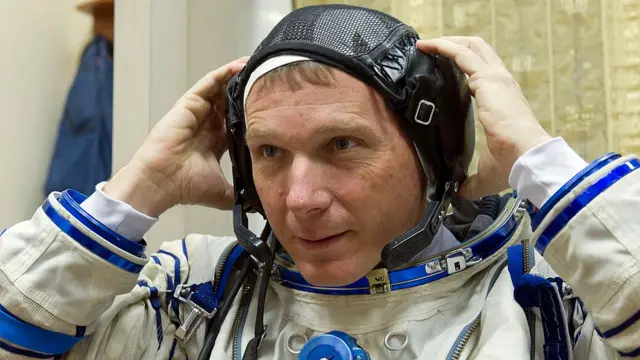
    Terry Virts in an astronaut suitImage source, Getty Images

    Retired Nasa astronaut Terry Virts, who was formerly commander of the International Space Station, says the crew of the shuttle had to allow gravity to take over in order to slingshot the moon.

    He says: "They are in deep space with no way to be rescued, getting the harshest radiation that doesn't even exist on Earth, surrounded by instant death just a few millimetres outside of that thin aluminium shell.

    "The entire 10-day mission is not exactly super safe but basically nothing happened today. The only thing that happened today was the moon flew by the capsule.

    "They didn't do a manoeuvre - they allowed the moon's gravity to kind of bend the shape of their trajectory 180 degrees and bring them back to Earth.

    "So it wasn't like they had to do a big complicated manoeuvre or docking or landing or anything like that.

    "Sir Isaac Newton is in charge - gravity is what's manoeuvring the capsule now."

  12. Satellites have been here before - but human eyes have notpublished at 06:31 BST

    Esme Stallard
    Science reporter

    The MoonImage source, NASA

    Now contact has successfully been remade with the Artemis II crew I am frantically refreshing the Nasa's photos stream, which will bring us all the images they took while observing the far side of the Moon.

    Both the record distance, illumination levels and particular orbit means that the crew have seen sights that no human has ever laid their eyes on.

    They have digital cameras with them which they are using to capture the sights - but it is what they saw from the spacecraft that has many scientists back on Earth most excited.

    Both China and India have sent probes over this side in the last few years to capture images - so is having humans see it for themselves exciting from a scientific point of view, or purely in terms of human exploration?

    Chris Lintott, professor of astrophysics at the University of Oxford and co-host of BBC's series The Sky at Night, told my colleague Georgina Rannard: "The value of the images coming back from Artemis and its crew is artistic, not scientific."

    And yet, ask any former geology student like me and you are still trained to make observations and sketches with the human eye. Science puts great store by our own inbuilt cameras.

    Abbie MacKinnon, curator of the Science Museum's space gallery, says: "I know we have... satellite imagery and everything like that. It's just not the same as humans there deciding what images to take and what looks good."

  13. Key moments from the Artemis II lunar fly-bypublished at 05:56 BST

    Media caption,

    Watch: Artemis II mission loses contact with Earth for 40 minutes

    It has been a historic day for the Artemis II crew, who are now bound for Earth after completing a fly-by of the Moon. Here's what has happened over the past few hours:

  14. Amazing and busy day for Nasa's scientistspublished at 05:37 BST

    Rebecca Morelle
    Science editor

    We spoke to Nasa's head of science Dr Nicola Fox after the fly-by.

    She said it had been an amazing - and very busy - day for the science team here at mission control.

    The astronauts have spent years preparing for this part of the mission, studying lunar science with the team here - and Fox said the crew had aced their test, providing fantastic lunar observations.

    As a solar scientist, she was particularly excited about the eclipse.

    She's gazed at many of these celestial events, but said this one, with such an unusual vantage point, looked very different from any she'd seen on Earth.

  15. What the Artemis astronauts said after regaining communication with Earthpublished at 05:23 BST

    There was much anticipation during the 40 minutes when Orion was not able to contact Earth.

    After the Artemis crew returned from the far side of the moon, mission specialist Christina Koch broke the silence.

    Here is what Koch said:

    "Houston, Integrity, comm check.

    It is so great to hear from Earth again...

    To Asia, Africa and Oceana, we are looking back at you, we hear you can look up and see the moon right now. We see you too.

    When we burned this bird towards the moon, I said that we do not leave Earth, but we choose it and that is true.

    We will explore, we will build, we will build ships, we will visit again.

    We will construct science outposts. We will drive rovers, we will do radio astronomy, we will found companies, we will bolster industry.

    We will inspire but ultimately we will always choose Earth.

    We will always choose each other."

  16. The long journey homepublished at 04:55 BST

    After travelling a record-breaking 252,756 miles (406,771km) from Earth and circling past the moon, the Artemis II astronauts are on their way home.

    It will take them about four days to journey back, with a splashdown in the Pacific Ocean off the west coast of the US expected at 20:07 eastern US time 10 April (01:07 BST 11 April).

    Teams will collect the astronauts from the water in helicopters and take them to the a nearby US Navy ship.

    They will have medical checks aboard the ship as they head back towards land, Nasa says.

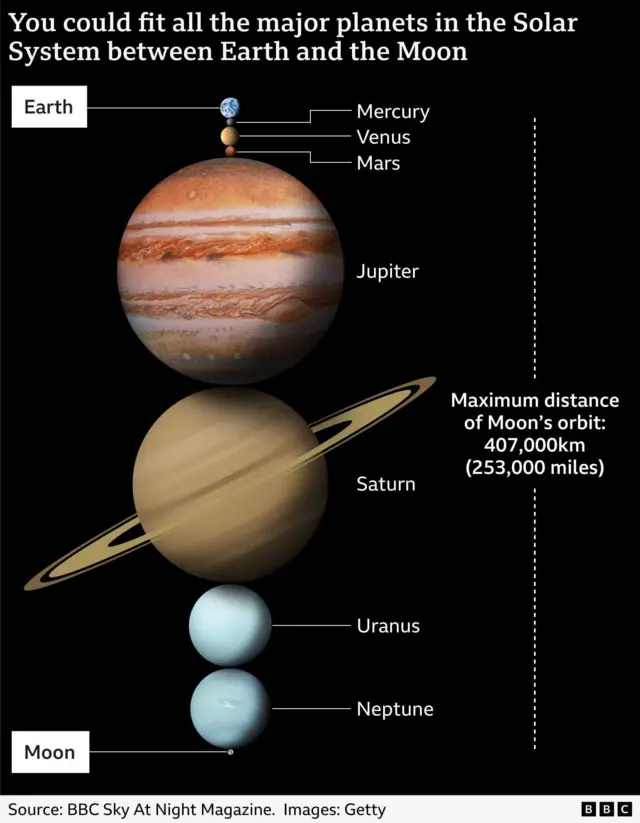
    Infographic titled “You could fit all the major planets in the Solar System between Earth and the Moon.” The graphic shows Earth at the top and the Moon at the bottom, with all the other planets stacked vertically between them to illustrate their combined width. From top to bottom, the planets shown are Mercury, Venus, Mars, Jupiter, Saturn with its rings, Uranus, and Neptune. A dotted vertical line on the right marks the maximum distance of the Moon’s orbit: 407,000 km (253,000 miles). Labels identify each planet and the Earth–Moon endpoints.
    Return to the latest post
  17. Trump tells astronauts 'you've made history' - a recap of his call to spacepublished at 04:16 BST

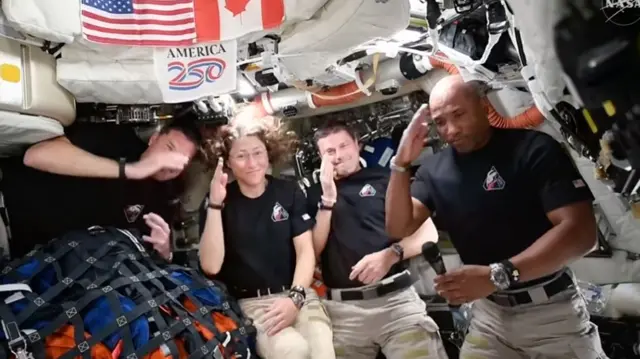
    Four astronauts saluting to the camera while in the Artemis II spacecraft.Image source, NASA

    US President Donald Trump had a short conversation with the four astronauts aboard the Orion spacecraft. As a microphone floated in front of the astronauts on their journey back to Earth, Trump praised the crew for their achievements.

    • He told the Artemis II crew that they had "made history" by breaking the record for the furthest distance travelled from planet Earth
    • Astronaut Victor Glover told the US president that he said "a little prayer" when the spacecraft briefly lost contact with Nasa, while Commander Reid Wiseman said they had seen sights "that no human has ever seen"
    • There were also several references to Mars throughout the call; Commander Reid Wiseman told the president that all of the crew had commented "how excited we are to watch this nation and this planet become a two planet species"
    • Canadian Space Agency astronaut Jeremy Hansen also gave a special thanks to Trump on behalf of Canada; Trump responded by saying he had spoken to Canadian Prime Minister Mark Carney and former Canadian ice hockey player Wayne Gretzky, who had both expressed how proud they were of Hansen and the Artemis II crew
    • The president invited the four astronauts to the White House once they return to Earth - he said he rarely asks for autographs, but he wanted to get theirs
  18. Trump invites crew to White Housepublished at 03:44 BST

    Before the call ended, Trump said he will be seeing the Artemis crew at the White House once the mission is complete.

    "I've been pretty busy also, as you know, but I will absolutely find the time," Trump said, before adding he would like to give "a big salute on behalf of the American people and beyond that".

    "Thank you for that, Mr President," pilot Victor Glover replied.

  19. 'Saw sights that no human has ever seen'published at 03:39 BST

    Trump continues with questions, asking the crew: "What is the most unforgettable part of this really historic day?"

    Commander Reid Wiseman was the first to respond, and starts by saying that the call from the president was "certainly very special to all of us".

    "We saw sights that no human has ever seen, not even Apollo, and that was amazing for us," said Wiseman.

    He went on to explain the crew's observations of the solar eclipse, and said all four of the crew had commented on how "excited we are to watch this nation and this planet become a two-planet species" in reference to goals of future ventures to Mars.

  20. Trump asks crew what it was like to lose contact with Earthpublished at 03:36 BST

    Trump asks the Artemis crew: "What was your feeling when you had no communication all of a sudden?"

    Astronaut Victor Glover answers by saying he said "a little prayer" but then had to keep working to record scientific observations of the far side of the moon.

    "We were busy up here and working really hard, and I must say it was actually quite nice," Glover adds.