Summary

  1. The last glimpse of the Earthpublished at 00:06 BST

    Rebecca Morelle
    Science editor

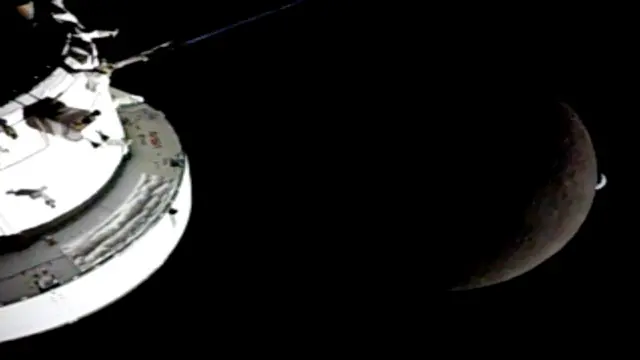
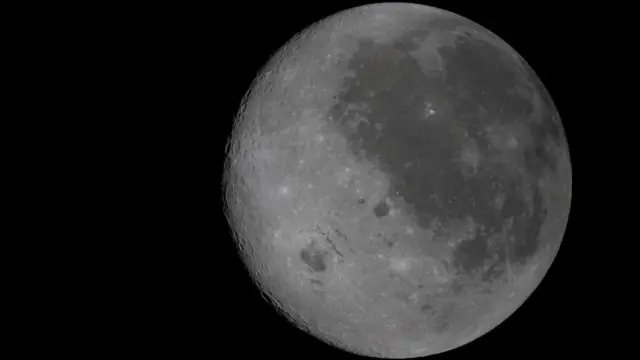
    Black background as part of the moon can be seenImage source, NASA

    This is the last view from the Artemis II spacecraft in the moments before connection was lost with the Earth.

    That silence is expected to last 40 minutes.

    Throughout their epic journey, the astronauts' contact with mission control has been a constant link with home.

    But now that link is lost, as the signal from the spacecraft is blocked by the Moon itself.

    The 40 minutes without contact will be tense here at mission control. But for the four astronauts - so very far away from home - it will be just them and the Moon.


  2. Astronauts busy during loss of communicationpublished at 00:00 BST

    Pallab Ghosh
    Science correspondent

    Orion should be at its closest pass to the Moon – a sweeping fly by that brought the spacecraft to within a few thousand miles of the surface. At that distance, the Moon fills the screen, with craters and mountain chains sliding past in slow, stately motion.

    As well as taking vital scientific imagery, this part of the mission is also about grabbing gravity and using its force to hurl the astronauts back home, as if using the Moon like a slingshot.

    The crew will be busy. Their cameras will be picking out features that lunar geologists back on Earth are desperate to scrutinise – fresh craters, ancient lava plains and scarps where the Moon’s crust has buckled.

    The crew has also been asked to make quick pencil sketches and voice notes, capturing details that even the sharpest images can miss. It’s the kind of observational work that is normally done by astronomers on a mountaintop observatory.

    Tonight, it is happening from a capsule sweeping round another world.

  3. Artemis II pilot echoes message from Apollo 8 crewpublished at 23:56 BST

    Pallab Ghosh
    Science correspondent

    Pilot Victor Glover's message just before loss of signal has echoes of the reading from the Book of Genesis from the Apollo 8 crew on Christmas Eve in 1968.

    "In the beginning God created the heaven and the Earth. And the Earth was without form, and void; and darkness was upon the face of the deep."

    Words that were all the more profound for those able to watch on TV, seeing live black-and-white images of the Moon and of the distant Earth as seen from their spacecraft

    Command module pilot James (Jim) Lovell then took up the next verse followed by the commander, Frank Borman who signed off, with another iconic moment.

    "And from the crew of Apollo 8, we close with good night, good luck, a Merry Christmas – and God bless all of you, all of you on the good Earth," followed by a crackle and long bleep, to punctuate this historic moment in human history.

  4. Astronaut Jeremy Hansen shouts out to family back on Earthpublished at 23:49 BST

    Canadian astronaut Jeremy Hansen sent a message to family members in the Nasa viewing gallery, including his wife Catherine and his son Devon.

    "I just wanted to let them know how much fun we're having out here," he says.

    "It's extraordinary to be on the far side of the moon right now. Just see it hanging out there looking back at the Earth.

    "Just wanted to say hi to all you guys, love you guys and we'll be heading back your way shortly."

  5. Astronauts out of contact with Nasa for estimated 40 minutespublished at 23:44 BST
    Breaking

    Pallab Ghosh
    Science correspondent

    Orion has just slipped behind the bulk of the Moon and out of radio contact with Earth.

    Engineers have always known this moment was coming – part of the flight plan – but when the signal drops, it's still a tense moment.

    Right now, four astronauts are arcing round the far side of the Moon, further from home and more cut off than any humans have been for more than 50 years. There will be no comforting murmur for them from Mission Control, just the faint hum of fans and electronics as Orion follows its pre‑programmed path.

    Outside the window, they are seeing landscapes we have only ever mapped with robots – steep‑walled craters, mountains thrown up by ancient impacts, and highlands pummelled by billions of years of debris.

    For the next several minutes or so there is nothing anyone on Earth can do but wait. The spacecraft’s computers will handle the crucial engine burn that bends Orion onto its long loop home.

    If everything goes to plan, the first sign that all is well will be a simple one: the signal returning followed by a cheery voice of one of the astronauts.

  6. 'We will see you on the other side' - last words before loss of contactpublished at 23:44 BST

    Houston begins speaking again and says it is a privilege to watch the astronauts.

    Thank you to all of you for allowing us to be on this immense journey together pilot Victor Glover says.

    "To all of you down there, we love you from the Moon," Glover speaks briefly about what he calls the most important mystery on earth "love".

    Glover and the other astronauts will be out of communication for 40 minutes.

    "Houston copies, we'll see you on the other side," Leah Cheshier Mustachio from NASA communications tells the astronauts.

    Glover replies: "We will see you on the other side." Then there's just silence, as we all eagerly await to hear from the astronauts again.

  7. The 40 minutes of silence during the flybypublished at 23:27 BST

    Alison Francis
    Senior science journalist

    As the astronauts pass behind our celestial neighbour, the radio and laser signals that allow communication between the spacecraft and Earth, will be blocked by the Moon itself.

    For about 40 minutes, the four astronauts will be totally alone.

    They’ll spend the blackout dedicated to lunar observation – taking images, studying the Moon’s geology and simply gazing at its bleak beauty.

    When they emerge and the signal is re-established, the world is expected to breathe a collective sigh of relief.

    And the history-making astronauts will be able to share their incredible views with everyone back home.

  8. What's the latest on the Artemis II mission?published at 23:11 BST

    Tara Mewawalla
    Live reporter

    When the crew woke up today, they listened to a special message recorded by Apollo 13 Commander Jim Lovell shortly before his death last year. "I'm proud to pass [this] torch on to you," he told them.

    The Integrity spacecraft had already entered the lunar sphere of influence, meaning the pull of the Moon's gravity is stronger than that of the Earth.

    The Artemis II astronauts set a new record for the furthest distance humans have ever travelled away from the Earth.

    The record was previously held by the Apollo 13 crew, who travelled 248,655 miles from Earth in 1970. Artemis II will beat this record by about 4,102 miles, reaching a maximum distance of 252,757 miles at around 18:07 central time (22:07 GMT).

    The crew named one of the Moon's craters after Commander Reid Wiseman's late wife Carroll, who died of cancer in 2020. They name another crater Integrity - after the Orion spacecraft which has carried them to the far side of the Moon.

    The lunar observation period has begun and will last for around seven hours. Wiseman described his view of the earth as a "small crescent", while mission specialist Christina Koch told mission control she had an "overwhelming sense of being moved by the Moon".

    In the coming hours, mission control is expecting Artemis II to temporarily lose communication with the crew as the Orion spacecraft passes behind the Moon.

  9. 'Hey babe, I love you from the Moon', Artemis II pilot tells wifepublished at 22:54 BST

    Artemis II pilot and Nasa astronaut Victor Glover hears that his family is in the viewing gallery, listening to him give his "sit-rep" (situational report) to mission control.

    When he is told Dionna Glover, his wife, is "all smiles", he replies: "Hey babe, I love you from the Moon... I'm glad you get to be there."

  10. 'I had an overwhelming sense of being moved by the Moon' - astronautpublished at 22:38 BST

    Mission specialist Christina Koch describes to mission control her lunar observation as an "incredible experience".

    "At one point... I just had an overwhelming sense of being moved by looking at the Moon", she says.

    She says this lasted "just a second or two" as something "drew me in suddenly into the landscape and it became real".

    "The moon really is its own body in the Universe. It's not just a poster in the sky that goes by. It is a real place and when we have that perspective and we compare it to our home of the Earth it just reminds us how much we have in common.

    "Everything we need the Earth provides and that is in and of itself truly a miracle."

  11. Thought the Moon was grey? Think againpublished at 22:30 BST

    Alison Francis
    Senior science journalist

    As we've just been reporting, the astronauts have been describing the colours they can see on the surface of the Moon.

    The astronaut Harrison Schmitt was chosen for Apollo 17 because of his background as a geologist.

    As he and Gene Cernan were collecting rock samples from the grey and bleakly beautiful lunar surface they were in for a surprise.

    Schmitt suddenly said: “Hey wait a minute - it’s orange… there is orange soil… it’s all over.” A sample was brought back to Earth, and scientists think it’s microscopic glass beads that formed from lava "fire fountains" that rapidly cooled in the lunar vacuum.

    The Artemis astronauts have a key objective to look for those nuances of colour on the surface of the Moon from the Orion spacecraft.

    The eye of a well-trained person is one of the best scientific instruments for detecting those colours, as well as texture and geological features on the far side of the Moon.

    Kelsey Young, Lunar Science Lead, told us: “When you really start to spend time and let your eyes get attuned to what you're seeing, you do see subtle shades of colour pop out, especially when you're close to the Moon, like our Artemis II astronauts will be.”

  12. Crew expecting to see crescent Earth and Moon at the same timepublished at 22:23 BST

    One of the astronauts tells mission control it's "truly awesome" the crew "now have the Moon and the Earth in window three simultaneously".

    They say the Moon is a gibbous - when the illuminated part is greater than a semicircle and less than a circle - and the Earth is a crescent - the curved sickle shape.

    "I'm guessing in about 45 minutes we'll have two identical crescents as we change our position in the universe," he adds.

  13. Greys, greens and browns - the colours the astronauts are seeing on the Moon's surfacepublished at 22:04 BST

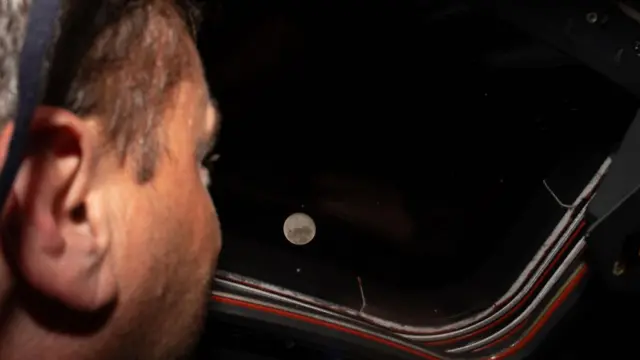
    Artemis II commander and Nasa astronaut Reid Wiseman looking out the window of the spacecraft to look at the Moon which is light and dark grey surrounded by pitch-black skyImage source, NASA
    Image caption,

    Artemis II commander Reid Wiseman looks out the window of the Orion spacecraft at the Moon

    In a "sit-rep" (situational report), astronaut Jeremy Hansen describes what it's like looking at the Moon.

    "My eyes just now readjusted - the Moon is so bright when you come back to the window. I was in the interior of the cabin, I've come back to [the] window now."

    He describes the colours he can see on the Moon's surface - including the darker and lighter greys that we are used to seeing.

    He adds: "Right now, Aristarchus (a crater)... is hard for me to see from this window but that had greenish hues to me. It was very unique, I didn't see anything else like that anywhere else on this side of the Moon.

    "And then I saw a lot of what i would call brownish hues."

  14. Astronauts reporting on their observations - watch livepublished at 21:46 BST

    The Artemis II crew are now calling down to mission control describing their observations of the Moon.

    Astronaut Jeremy Hansen is speaking now - you can watch live at the top of the page.

  15. How the Moon could unlock our own planet’s pastpublished at 21:43 BST

    Rebecca Morelle
    Science editor

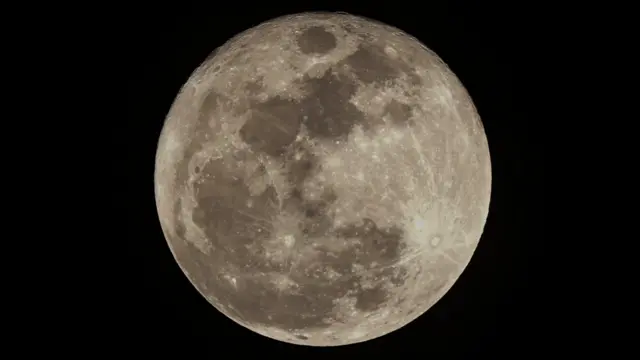
    The MoonImage source, EPA

    The Moon was born from the Earth.

    About 4.5bn years ago, a huge Mars-sized body smashed into our planet, blasting off debris that then coalesced to form our celestial neighbour.

    This means the Moon’s history is also our own - but this ancient archive is much better preserved in the lunar rocks.

    With no plate tectonics, wind and rain, and oceans and vegetation to wipe this archive away, the Moon is a perfect time capsule.

    Scientists are eagerly awaiting the images and observations that will be beamed back, but they’re even more excited about a future lunar landing, when rocks can be collected and brought home to their labs.

  16. Nasa releases images of the Moon taken by crew - including part of the far sidepublished at 21:15 BST

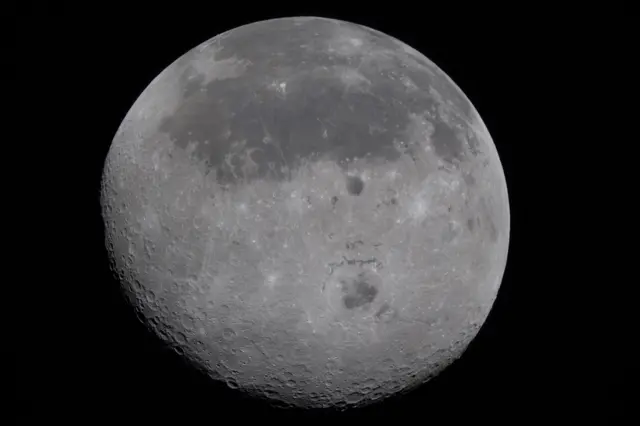
    The MoonImage source, NASA

    The crew of the Artemis II mission have been sharing photographs of the Moon taken from on board the spacecraft.

    Nasa says the below picture shows part of the far side of the moon.

    The near side - the hemisphere we see from Earth - is visible on the right-hand-side in the photograph and is "identifiable by the dark splotches that cover its surface", Nasa says.

    It adds: "These are ancient lava flows from a time early in the Moon’s history when it was volcanically active.

    "The large crater west of the lava flows is Orientale basin, a nearly 600-mile-wide crater that straddles the Moon’s near and far sides. Orientale's left half is not visible from Earth, but in this image we have a full view of the crater.

    "Everything to the left of the crater is the far side, the hemisphere we don’t get to see from Earth,"

    A fully illuminated view of the Moon where the near side can be seen on the right by the dark splotches. The background is pitch black and there are craters visible on the surface of the moonImage source, NASA
  17. What cameras do the Artemis II astronauts have?published at 21:06 BST

    Kevin Church
    Videographer, BBC News

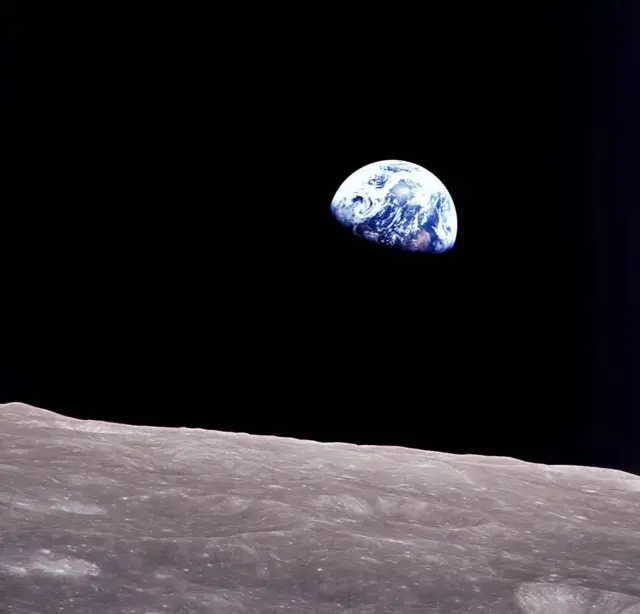
    Earth peeking out from beyond the Moon's surfaceImage source, NASA
    Image caption,

    The iconic Earth-rise picture was taken aboard Apollo 8

    The astronauts have just been talking to mission control about photographs they are taking of the Moon - BBC videographer Kevin Church gives a run down of the camera kit they have at their disposal.

    Compared to their Apollo predecessors, the Artemis crew have an array of digital cameras at their disposal.

    They’ve brought three Nikon cameras: two D5s, one with a 14-24mm wide lens to capture the whole Moon and the other with an 80-400mm zoom lens that can pick out the finer details. They’ve also packed a Z9 with a 35mm lens, which takes images that are close to what the human eye can see.

    There are GoPros mounted to the solar panels outside the spacecraft and each crew member has an iPhone to document the mission inside.

    During the fly-by, the capsule’s lights will be dimmed to get the best possible pictures. However even these modern cameras will struggle to match the quality of the 70mm Hasselblad cameras used by the Apollo astronauts.

    But packing one of these would mean bringing along multiple rolls of film, while a digital camera can store thousands of photos on a memory card the size of a postage stamp.

  18. Astronauts Wiseman and Hansen taking photos of Moonpublished at 20:50 BST

    We've just been hearing from the Nasa Mission Control Center, which has been sharing insight into what the astronauts are currently observing on the Moon.

    Mission control says commander Reid Wiseman and astronaut Jeremy Hansen have been at windows two and three on the Orion spacecraft. One has been taking photos and the other has been making observations and making annotations.

    "At this time, we also anticipate they are looking at a crater duo," mission control says.

  19. Tim Peake: 'Hugely special' to name crater after Wiseman's late wifepublished at 20:34 BST

    As we've been reporting, the Artemis II crew has named one of two Moon craters "Carroll" - in memory of mission commander Reid Wiseman's late wife.

    Anne Carroll Taylor, a school nurse, died of cancer in 2020, aged 46.

    "That was a hugely special moment," former British European Space Agency astronaut Tim Peake tells the BBC.

    "You know, they've just been announced as the furthest human beings from Earth and they got to name those craters and to have that bright spot on the moon named after Carroll.

    "That would have been an incredibly emotional experience for them, very, very special.

    "We are a very close knit community, a very small family in the astronaut world," he says. "We all know each other, we all know each other's families, so I just know how touched they will be, everybody back in mission control will be by that moment."

    Commander Wiseman, 50, has been raising his two daughters as a single dad since his wife passed away.

    He has stated that he sees this as his greatest challenge and the most rewarding phase of his life.

    And just before the start Moon mission, he wrote: "I love these two ladies, and I’m boarding that rocket a very proud father."

  20. Artemis mission will inspire future generations - Tim Peakepublished at 20:25 BST

    Tim PeakeImage source, EPA

    We've just been hearing from former British European Space Agency astronaut Tim Peake.

    He tells the BBC that the Artemis mission will have an "absolutely huge" impact on future generations and on space travel.

    "In one short, seven-hour window they're going to be seeing so much," he says of the lunar flyby.

    He adds that the astronauts will be able to observe things never seen before, detecting structure, colour and the texture of the lunar surface - a "wealth of scientific information".

    "This will inspire this generation, future generations, to make sure the records they're setting today are not held for very long," he says.