Summary

  • The US Supreme Court has heard oral arguments on whether some children born in the US have a constitutional right to citizenship

  • Donald Trump attended for part of the hearing - the first sitting US president to attend oral arguments in the chamber

  • Some Supreme Court justices seem to be signalling scepticism of the administration's argument - writes our Washington correspondent

  • It is the most significant case of the court term, stemming from an executive order signed by Trump on his first day back in office

  • The order sought to end automatic US citizenship for babies born in the United States to parents who are in the country illegally or temporarily

  • Opponents say Trump's order violates the US Constitution's 14th Amendment - ratified in 1868 - which says that "all persons born or naturalised in the United States, and subject to the jurisdiction thereof, are citizens of the United States"

  • Proponents argue Trump's new interpretation of the clause will allow the government to combat "significant threats to national security and public safety"

Media caption,

Protesters rally as birthright citizenship arguments get underway

  1. What does the 14th Amendment say?published at 15:19 BST 1 April

    The first sentence of the 14th Amendment to the US Constitution establishes the principle of birthright citizenship:

    Quote Message

    All persons born or naturalized in the United States, and subject to the jurisdiction thereof, are citizens of the United States and of the state wherein they reside.”

    The Trump administration says the phrase "subject to the jurisdiction thereof" means the amendment excludes children of people not in the country permanently or lawfully.


    Return to the latest post
  2. Justices question Trump administration attorneypublished at 15:18 BST 1 April

    The Supreme Court justices have now started to question the lawyer arguing for the state, US Solicitor General John Sauer.

    Sauer is first asked about the Dred Scott v. Sandford, an 1857 Supreme Court case that determined African Americans had no right to citizenship.

    The 14th Amendment, passed in 1866, overturned that decision.

    Sauer says "the newly freed slaves had the relationship of domicile" to the US and didn't have an allegiance to a foreign power, which he argues temporary visa holders and undocumented immigrants can't claim.

    The crux of his response is that "allegiance" to the US is the true focus of who should benefit from birthright citizenship during the 14th Amendment.

  3. Analysis

    Trump's presence underscores how much at stake in landmark casepublished at 15:12 BST 1 April

    Daniel Bush
    Washington correspondent

    President Donald Trump’s unusual visit to the Supreme Court today underscores just how much is at stake in this landmark case over birthright citizenship.

    This will be the first immigration-related case the Supreme Court will decide on its merits since Trump started his second term. The Court has heard other cases regarding Trump’s immigration agenda, but it has not yet issued a final ruling upholding or striking down any of his policies.

    Trump’s executive order seeking to end birthright citizenship isn’t a central element of his broader push to deport millions of undocumented immigrants. But it is a popular idea on the right and has long been part of Trump’s immigration platform.

    If the court upholds the executive order Trump could claim a victory and use it to rally Maga voters ahead of the midterms.

    But a loss would hand Trump his second major setback at the court in recent months. Earlier this year the court rejected Trump’s global tariffs.

    Trump may be hoping that his attendance will sway the justices, in particular the three justices he appointed to the court. How they rule will help shape one of Trump’s signature domestic policy issues.

  4. How would the law change if Trump wins?published at 15:09 BST 1 April

    Sakshi Venkatraman
    US reporter

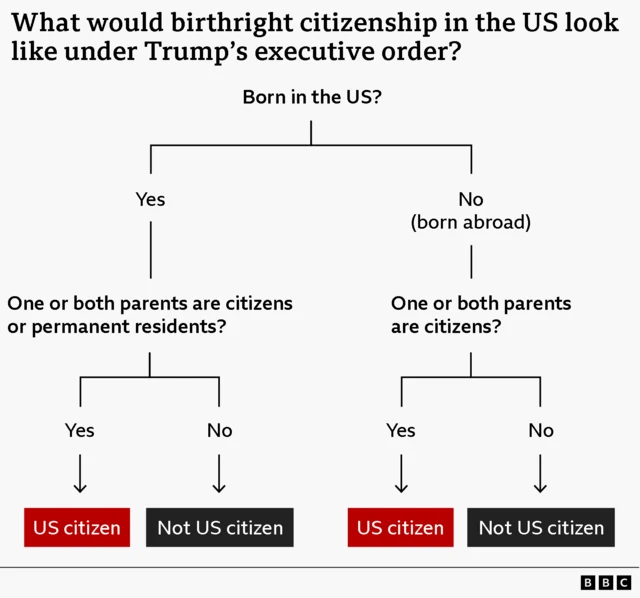
    A flowchart titled “What would birthright citizenship in the US look like under Trump’s executive order?” It begins with the question “Born in the US?” If “Yes,” the next question asks whether one or both parents are citizens or permanent residents. If yes, the outcome is “US citizen” in a red box; if no, the outcome is “Not US citizen” in a dark grey box. If “No (born abroad),” the chart asks whether one or both parents are citizens. If yes, the outcome is “US citizen”; if no, “Not US citizen.”

    For nearly 160 years, the 14th Amendment of the US Constitution has established the principle that anyone born in the country is a US citizen, with very few exceptions.

    Though the language of the Constitution will stay the same, the principle of birthright citizenship will entirely change if Trump’s executive order is allowed to take effect.

    One month after it becomes law, two large cohorts of people will no longer be considered citizens at birth:

    1. Children of undocumented immigrants
    2. Children of temporary visa holders

    Constitutional law experts tell me it will cause a legal upheaval, and thousands of children will effectively be born “stateless”.

    In 2022, the latest year that data is publicly available, there were 1.2 million US citizens born to unauthorised immigrant parents.

    A study published in May suggested that repealing birthright citizenship could increase the size of the undocumented population in the US by an additional 2.7 million by 2045 and by 5.4 million by 2075.

  5. Arguments begin as crowd gets larger outsidepublished at 15:06 BST 1 April

    Ana Faguy
    Reporting from the Supreme Court

    Arguments have begun inside the Supreme Court.

    Outside, the crowd size has nearly tripled since the president arrived and there's a much heavier police presence.

    While arguments happen inside, outside a series of advocates and activists are expected to speak to the crowd. We will keep bringing you the latest. Stay with us.

  6. Supreme Court is now in sessionpublished at 15:05 BST 1 April
    Breaking

    The highest court in the country is now in session.

    We're expecting to hear arguments over Trump's executive order on birthright citizenship in just a few moments.

    You can listen live at the top of this page.

  7. Americans outside the court share their own immigrant historiespublished at 14:59 BST 1 April

    Ione Wells
    Reporting from the US Supreme Court

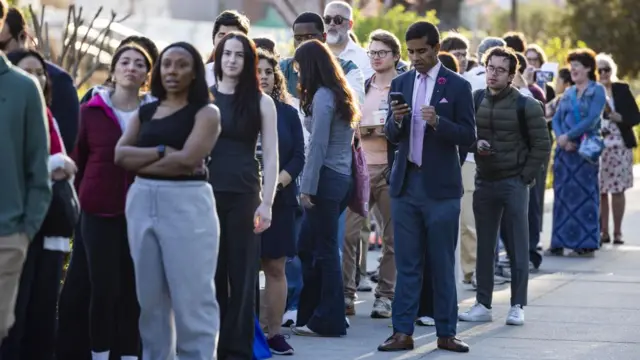
    People line up outside the Supreme CourtImage source, EPA

    I’ve spoken to people queuing to get in to hear the arguments at the Supreme Court today, some told me they had been here since Monday night.

    Many of those queuing to get in were opposed to Trump's executive order to end birthright citizenship for some people. They were concerned about how far this could go back - making the point that many of them were first, second or third generation immigrants themselves.

    Others made the point that challenging the Constitution would undermine a fundamental cornerstone of American society and democracy, that many came to America based on the "American dream" and now some families might have their citizenship questioned. Some feared that Trump turning up in court today is an attempt to put pressure on the judges to rule in his favour.

    A protest is gathering outside the court itself.

    While the majority are opposed to the change, there are some signs here arguing that birthright citizenship was not designed to apply to people who were in the country temporarily or illegally.

  8. Trump's visit to the court unusual, but not surprisingpublished at 14:57 BST 1 April

    Bernd Debusmann Jr
    White House reporter

    Donald Trump's visit to the US Supreme Court is highly unusual, but not entirely surprising.

    It's an idea he has floated in the past. Last year, for example, Trump said he wanted to attend a hearing that dealt with his controversial tariffs, but later backtracked, saying it would have become a distraction.

    Today's visit, however, marks the first known example of a sitting president taking the opportunity to attend arguments at the Supreme Court.

    There is no rule or legislation against him doing so.

    But his detractors are likely to characterise his presence at the court as both a distraction and attempt to influence the court's decision.

    The president and his backers will no doubt dismiss any suggestion that the visit is innappropriate and note that the case is one that Trump has taken substantial interest in and framed as his executive order to end birthright citizenship as a key accomplishment - and one that is broadly popular among his supporters across the country.

  9. Dozens of people queuing to hear today's argumentspublished at 14:53 BST 1 April

    Ana Faguy
    Reporting from the Supreme Court

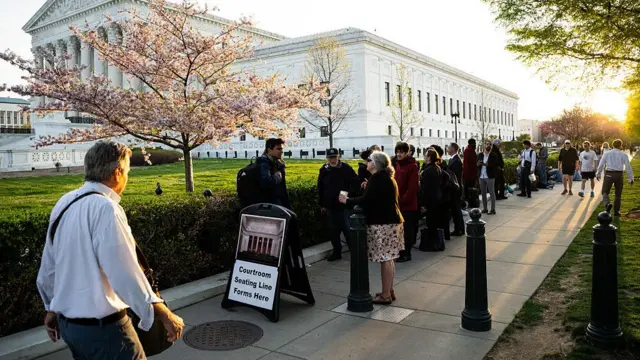
    People queue behind a sign that reads "Courtroom seating line forms here"Image source, Getty Images

    There's a queue of more than 100 or so people standing behind a sign that reads "courtroom seating line forms here".

    They're waiting to see if a seat opens inside America's top court and they can witness a historic moment.

    Some of them have been following the case closely and others are just hoping for a front row seat to history.

    Towards the back of the line is Amanda Michalski, who along with her husband, who is a lawyer, is trying to get in to hear today's arguments.

    "If it doesn't work out, we'll come back another day," she says.

  10. Trump arrives at the Supreme Courtpublished at 14:50 BST 1 April
    Breaking

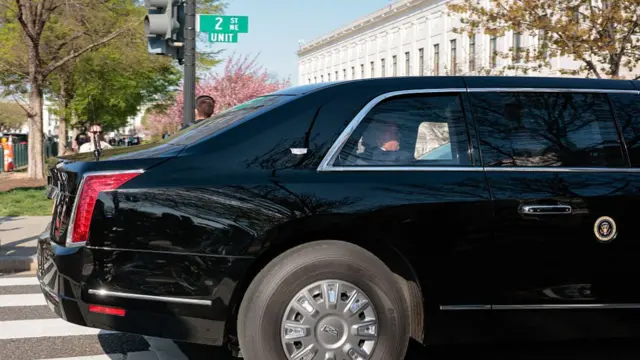
    Trump sitting in the backseat of the presidential vehicleImage source, Getty Images

    Trump has now arrived at the Supreme Court.

    Photos show him pulling up in the presidential vehicle.

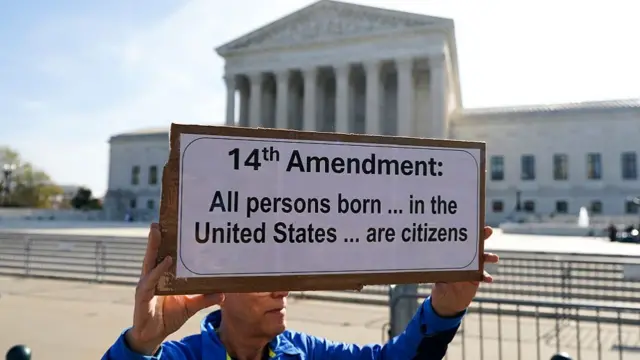
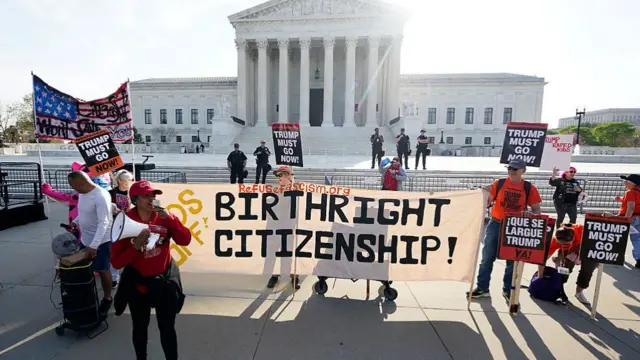
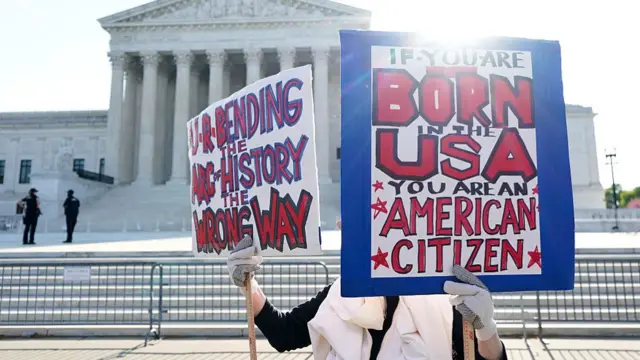
  11. Photos: Demonstrators urge Supreme Court to do away with Trump's executive orderpublished at 14:48 BST 1 April

    A man holds a sign outside of the US Supreme Court.Image source, Getty Images
    A group of protesters hold a large sign that says "Hands off Birthright Citizenship"Image source, Getty Images
    A woman stands outside the Supreme Court holding two signs protesting Trump's executive orderImage source, Getty Images
  12. Trump leaves the White House and heads to Supreme Courtpublished at 14:43 BST 1 April

    A far-away photo of Trump and Pam Bondi departing the White HouseImage source, Reuters

    President Donald Trump has just left the White House in the presidential state car, also known as Cadillac One.

    Also with him is Attorney General Pam Bondi, who walked out of the White House and boarded the vehicle alongside him.

    They're now headed to the Supreme Court.

  13. Protesters gather outside the Supreme Courtpublished at 14:35 BST 1 April

    Ana Faguy
    Reporting from the Supreme Court

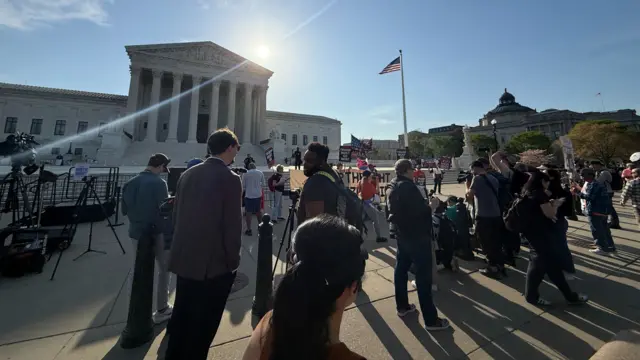
    People gather outside the Supreme Court. Some hold signs, others have cameras set up. The building can be seen in the backgroundImage source, Getty Images

    The atmosphere outside the Supreme Court resembles a festive atmosphere.

    There are bright lights glaring from the dozens of television cameras. Children, who are presumably joining their parents to protest, shouting, and screaming. There’s blaring music.

    There’s more of a joyful presence than I personally expected. Protesters here say they’re focused on protecting an enshrined right.

    We’re expecting arguments to take anywhere between 60 and 90 minutes. Protesters say they'll stay for the entirety.

  14. Trump expected to be in attendance at the argumentspublished at 14:22 BST 1 April

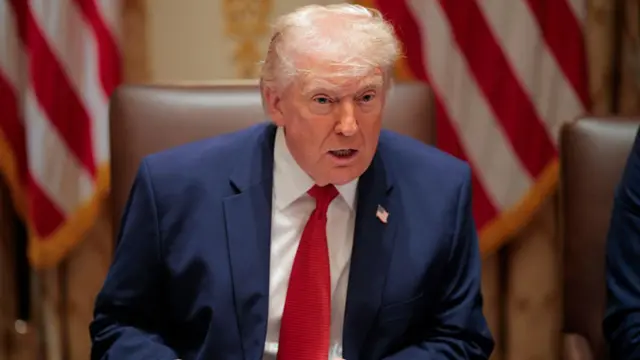
    Trump sits at a cabinet meeting. He wears a navy jacket and red tieImage source, Getty Images

    President Donald Trump plans to be at the Supreme Court today for the hearing over his executive order.

    "I'm going," he told reporters yesterday at the White House. "I have listened to this argument for so long."

    Trump's public schedule also shows that he will attend at 10:00 local time (1500 BST), when arguments start. Then at 12:30 local time he attends an Easter lunch.

    This will make him the first sitting president to attend oral arguments at the nation's highest court.

  15. What is Trump arguing about birthright citizenship?published at 14:12 BST 1 April

    Sakshi Venkatraman
    US reporter

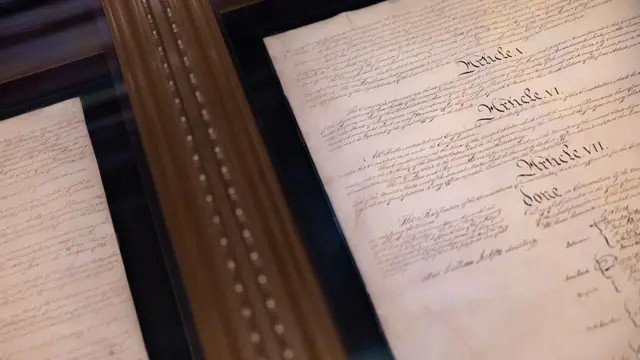
    US Constitution is seen at the National Archives in WashingtonImage source, Getty Images

    This is the section of the 14th Amendment of the US Constitution that will be argued over today:

    • All persons born or naturalized in the United States, and subject to the jurisdiction thereof, are citizens of the United States and of the State wherein they reside.

    To try and strip birthright citizenship from undocumented and temporary immigrants, the Trump administration is honing in one one particular phrase: subject to the jurisdiction thereof.

    That phrase has previously been believed to only exclude children of foreign diplomats or occupying armies from having birthright citizenship.

    But Trump says it should exclude children of people who are not in the country permanently or lawfully.

    The president argues that it should exclude immigrants who do not have a "permanent domicile" here.

    People "who are domiciled elsewhere, and are only temporarily present in the United States, owe primary allegiance to their parents' home countries, not the United States", the administration argues.

    Many constitutional and civil rights law experts take issue with this.

    "People who are here out of status, that doesn't change that they are residents here," says Margo Schlanger, a law professor at the University of Michigan.

  16. Supreme Court to hear birthright citizenship arguments on this historic day in Washingtonpublished at 14:09 BST 1 April

    Ana Faguy
    Reporting from the Supreme Court

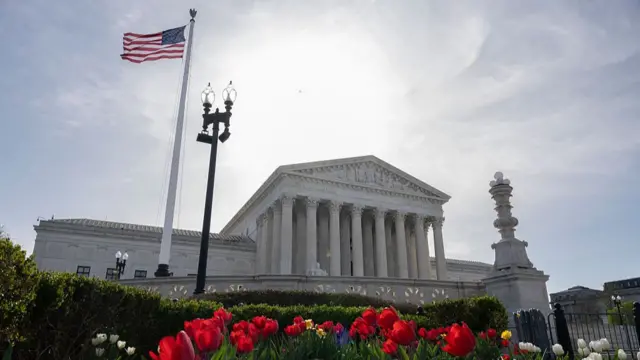
    Supreme Court in the background with red, pink and purple flowers in the foregroundImage source, Getty Images

    Good morning from a sunny and warm Washington, where I am reporting from outside the US Supreme Court.

    All eyes are turned here this morning as the court's nine justices consider whether or not President Donald Trump can end America's longstanding right to citizenship for anyone born in the country.

    On his first day back in office last January, Trump ordered an end to automatic - or birthright - citizenship in the United States. The executive order would prevent babies born to parents who are in the country illegally or temporarily from getting US citizenship at birth - a reversal of more than 150 years of precedent.

    Today, we'll hear the justices question the Trump administration's lawyers, as well as the American Civil Liberties Union (ACLU) - the organisation that brought the challenge against the executive order.

    We're also watching to see whether Trump will attend court, as he said yesterday that he planned to.

    "I'm going," the president told reporters in the Oval Office on Tuesday. "Because I have listened to this argument for so long."

    Trump previously said he would attend oral arguments for another case earlier in his second administration, but skipped the session in the end.

    Should he show up this time, it is believed it would be the first time a sitting president attends Supreme Court oral arguments.

    Court is in session from 10 am (1500BST), when you'll be able to listen live to the arguments in a stream above.

    Stick with us and we'll bring you the latest from inside and outside the court.