Summary

  • The US Supreme Court has heard oral arguments on whether some children born in the US have a constitutional right to citizenship

  • Donald Trump attended for part of the hearing - the first sitting US president to attend oral arguments in the chamber

  • Some Supreme Court justices seem to be signalling scepticism of the administration's argument - writes our Washington correspondent

  • It is the most significant case of the court term, stemming from an executive order signed by Trump on his first day back in office

  • The order sought to end automatic US citizenship for babies born in the United States to parents who are in the country illegally or temporarily

  • Opponents say Trump's order violates the US Constitution's 14th Amendment - ratified in 1868 - which says that "all persons born or naturalised in the United States, and subject to the jurisdiction thereof, are citizens of the United States"

  • Proponents argue Trump's new interpretation of the clause will allow the government to combat "significant threats to national security and public safety"

Media caption,

Protesters rally as birthright citizenship arguments get underway

  1. Trump wants to pick who gets to be an American and who doesn't - California senatorpublished at 16:32 BST 1 April

    Ana Faguy
    Reporting from the Supreme Court
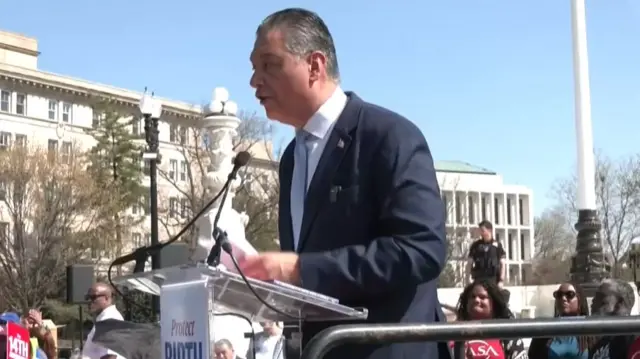
    California Senator Alex PadillaImage source, Reuters

    As arguments are ongoing inside, Democratic California Senator Alex Padilla is speaking to protesters outside the court.

    "It's almost unbelievable that we have to be here today," he tells the crowd.

    Padilla says the 14th amendment shouldn't be up for debate, but if it must be debated "we will win".

    "If you're born here, you are a citizen, it couldn't be more clear," he says.

    Padilla says Trump wants to pick who gets to be an American and who doesn't.

    "It's wrong."

  2. 14th amendment protects birthright citizenship, says ACLUpublished at 16:31 BST 1 April

    ACLU lawyer Cecillia Wang argues that the citizenship rules in the US are widely interpreted as "anyone born here is a citizen alike".

    "That rule was enshrined in the 14th amendment to put it out of reach of any government official to destroy," she says.

    She adds that the Supreme Court has already ruled in previous cases that the 14th amendment means "virtually everyone born on US soil is subject to its jurisdiction and is a citizen".

    Wang says that birthright citizenship has contributed to the growth and thriving of the US. Ruling against it, she says, would invalidate dozens of other US laws and would lead to thousands of babies losing their citizenship.

    "The citizenship of millions of Americans past, present and future could be called into question," she concludes.

  3. Here are the existing exceptions to birthright citizenship in the USpublished at 16:27 BST 1 April

    Sakshi Venkatraman
    US reporter

    Justice Clarence Thomas asks ACLU attorney Cecillia Wang how she sees the current exceptions to birthright citizenship in the US.

    She echoes what we’ve mentioned earlier on this page, that there are five words in the 14th Amendment that lay the groundwork for exceptions.

    "All persons born or naturalized in the United States, and subject to the jurisdiction thereof, are citizens of the United States."

    Those words create a caveat, but one that has been used very sparingly.

    Currently, the main groups of people who wouldn’t be citizens if born in the US are

    • The children of foreign diplomats
    • The children of hostile invading armies

    Some children of Native Americans born on sovereign tribal land were also excluded from citizenship under this definition - but that ended in 1924 with the Indian Citizenship Act.

    The right to US citizenship has only expanded throughout the country’s history. Trump wants to reel it back in.

  4. Sauer's questioning ends, ACLU's Cecillia Wang up nextpublished at 16:25 BST 1 April

    The Supreme Court has now finished questioning Solicitor General John Sauer, next up is Cecillia Wang, the national legal director of the American Civil Liberties Union (ACLU).

    The ACLU is the body that brought this case to the Supreme Court.

  5. 'What if you don't know who the parents are?' - Justice Barrett asks attorneypublished at 16:23 BST 1 April

    Justice Amy Coney Barrett has asked US attorney Sauer to weigh in on some practical examples of how Trump's birthright citizenship would be applied.

    "What if you don't know who the parents are?" she asks him.

    She also questions the Trump administrations argument that being subject to the jurisdiction of the US means you have an intent to stay in the country lawfully.

    "You're not going to know at the time of birth for some people whether they have the intent to stay or not," Justice Barrett says, giving the example of a US citizen living in Norway who comes back to the country to have their child - but they have no intent to stay.

    Sauer says "there may be situations where facts are determined" and that guidance exists to make those determinations when they arise.

    Barrett brings up the concepts of jus soli and jus sanguinis, the concept of allowing citizenship based on birth in the country and allowing citizenship based on the status of the parents, respectively. She says the Trump administration is trying to make both modes of citizenship more narrow.

    She asks if the framers of the Constitution intended to create a whole new brand of American-style citizenship. Sauer says the framers were not talking about the English-version of allegiance to the country.

  6. US law an 'outlier' among modern nations - Trump attorneypublished at 16:16 BST 1 April

    Sauer argues that the US law granting "almost unrestricted" birthright citizenship is "outlier" among modern nations, adding that "every nation" in Europe has a different rule.

    Justice Sonia Sotomayor puts it to Sauer that "England was always different" to other European nations. "English rule was always by birth and other nations were not by birth."

    The concept of birthright citizenship in the US, also known by the legal term "jus soli", is based in English common law and was initially generally accepted to apply to white men throughout early American history.

    However, Sotomayor references a 1898 US Supreme Court case that ruled in favour of the child of legal Chinese immigrants and outlined the few limited exceptions to birthright citizenship, such as for children of diplomats.

    "Are you asking us to overrule our cases?" Sotomayor asks Sauer.

    Sauer replies that this is not what it being asked.

  7. Justices challenge Trump administration over 130-year-old precedentpublished at 16:12 BST 1 April

    In 1898, the US Supreme Court ruled that birthright citizenship applies to the children of immigrants in the case of US v Wong Kim Ark.

    Wong successfully argued that because he was born in the US, his parents' immigration status did not affect the application of the 14th Amendment. The court ruled in Wong's favour, setting a precedent that's nearly 130 years old.

    Justice Sonia Sotomayor asks Sauer if the Trump administration is asking the court to overturn that precedent.

    He says no, it wouldn't be overruled.

    Justice Sotomayor expresses scepticism about how that position could be sustained.

    She also notes that the ruling would apply only prospectively, but questions how it could prevent a future Congress or president from using it to denaturalise people born in the US - pointing to the government’s past treatment of Native Americans as an example.

    "We're not asking for any retroactive relief," Sauer says.

  8. Court asks if Native Americans born in the US are birthright citizenspublished at 16:03 BST 1 April

    Justice Gorusch asks Solicitor General Sauer whether he believes that Native Americans born in the US today are birthright citizens.

    Sauer responds that there is widespread agreement that the children of Native Americans are not birthright citizens.

    Justice Gorsuch then presses him on the relevance of the parents’ “domicile” under that test, asking whether, on that basis, such individuals would be considered birthright citizens.

    Sauer responds: "I think so," before later adding "I have to think that through."

  9. What's it like inside the Supreme Court?published at 15:57 BST 1 April

    Ana Faguy
    Reporting from the Supreme Court

    The Supreme Court is DC's hottest ticket today. There were more than 100 people in line to get a handful of public seats inside.

    I saw dozens of them walk away from the court just before arguments began, looking disappointed.

    It can be difficult to get a glimpse at America's judicial branch with limited seating and no cameras inside. All of us are currently listening to an audio-only stream of the arguments.

    Lawyers and journalists who regularly cover the court, are some of the only ones who know what it's truly like inside.

    "The United States Supreme Court is a lot smaller than most people think, it's a fairly intimate space," 
Janai Nelson, who heads the Legal Defense Fund and has argued before the court, says.

    Nelson says lawyers are physically close to the justices.

    "And there's a lovely, quiet, and intensity to being there and to arguing," she adds.

  10. Analysis

    Justices starting to signal some scepticismpublished at 15:54 BST 1 April

    Daniel Bush
    Washington correspondent

    Some Supreme Court justices are starting to signal scepticism of the administration’s argument in the opening moments of this hearing.

    Chief Justice John Roberts seemed to reject Solicitor General John Sauer’s principal argument that the few groups that have historically been excluded from receiving birthright citizenship - such as the children of foreign diplomats - should be expanded to include the children of undocumented immigrants.

    “I’m not quite sure how you can get to that big group from such tiny and sort of idiosyncratic examples,” Roberts said.

    Justice Elena Kagan said the 14th Amendment does not support the administration’s argument that undocumented immigrants don’t have “allegiance” to the US and therefore don’t qualify for birthright citizenship. Kagan suggested undocumented immigrants qualified because they are subject to US law, and said that matters more than less concrete concepts of general allegiance or “domicile".

    “Where does this principle come from, allegiance, domicile?” Kagan asked Sauer. “The text of the clause does not support you.”

    It’s too early still to say which way the court may be leaning. But in the first hour of this hearing, Sauer appears to be struggling to convince the court that the administration’s argument is supported by the 14th Amendment and past court rulings.

    Return to the latest post
  11. Decision on today's arguments expected later this yearpublished at 15:51 BST 1 April

    Today the Supreme Court is hearing arguments over the legality of stripping automatic citizenship away from babies born in the US to parents in the country illegally or temporarily.

    It is because Trump signed an executive order on the first day of his second term ordering just that, putting an end to a right enshrined in the US Constitution.

    However, after a case brought forward by the American Civil Liberties Union (ACLU), it is now down to the Supreme Court to decide on the legality of the move.

    A final decision is expect from the court in June.

  12. State puts forward arguments about anchor babies and birth tourismpublished at 15:50 BST 1 April

    A familiar argument we have heard today from the Trump administration's lawyer is that unrestricted birthright citizenship will create a "pull factor" for undocumented immigrants to come and have their babies in this country.

    Terms like "birth tourism" and "anchor babies" have long come up in these conversations, with conservatives decrying those as a way for new immigrants to find a way to stay in the country.

    Here's what they mean:

    Birth tourism is a term coined to describe people travelling to the US to have babies and then returning home once their children's citizenship is established.

    Anchor baby is meant to mean a child born in the US to undocumented immigrant parents who are seeking to live in America.

    Millions of people are "a plane ride away" from having a baby in the US, Sauer says, adding that "it's a different world" now.

    "It's a different world but the same Constitution," one of the justices responds.

  13. Justice Barrett questions Trump administration's interpretation of the lawpublished at 15:45 BST 1 April

    We have just heard from Justice Amy Coney Barrett who asks Solictor General John Sauer about his argument that birthright citizenship - or the 14th amendment - was enacted to put all newly-freed slaves on equal footing so they would be citizens.

    She notes that this interpretation is not in the text of the amendment. "So how do you get there?" she asks.

    Justice Barrett also notes that slaves and their children were brought illegally under US laws that forbade the slave trade at the time.

    She asks how does that square with the Trump administration's argument that illegal immigrants in modern US are not entitled to citizenship because they entered the country unlawfully.

    Sauer responds that even if slaves were brought in illegally, once they were in the US they did not have allegiance to any foreign entity and were lawfully domicile.

  14. Justices grill US attorney on concept of 'domicile'published at 15:42 BST 1 April

    Back to the hearing inside the court, the justices are now digging into one of the linchpins of the Trump administration's arguments in this case - the concept of people only being under the jurisdiction of the US if they have a "permanent domicile" in the country.

    Sauer, the Trump administration's lawyer, argues that a domicile is necessary in order to have an "allegiance" to the country.

    But the justices press back, saying "that's not what we think of" when it comes to the "jurisdiction" mentioned in the 14th Amendment.

    "The text of the clause does not support you," one justice says. "You're looking for some technical or esoteric meaning."

    Justice Neil Gorsuch also chimes in, pressing Sauer on his sources which he describes as obscure, including references to Roman Law and a speech from former President Abraham Lincoln.

    Gorsuch also presses on how this will be regulated and if domicile will need to be checked for every single baby born.

    "Whose domicile matters? It's not the child obviously," he says, questioning if it would be the mother or father.

    Sauer says it is the mother's domicile that matters.

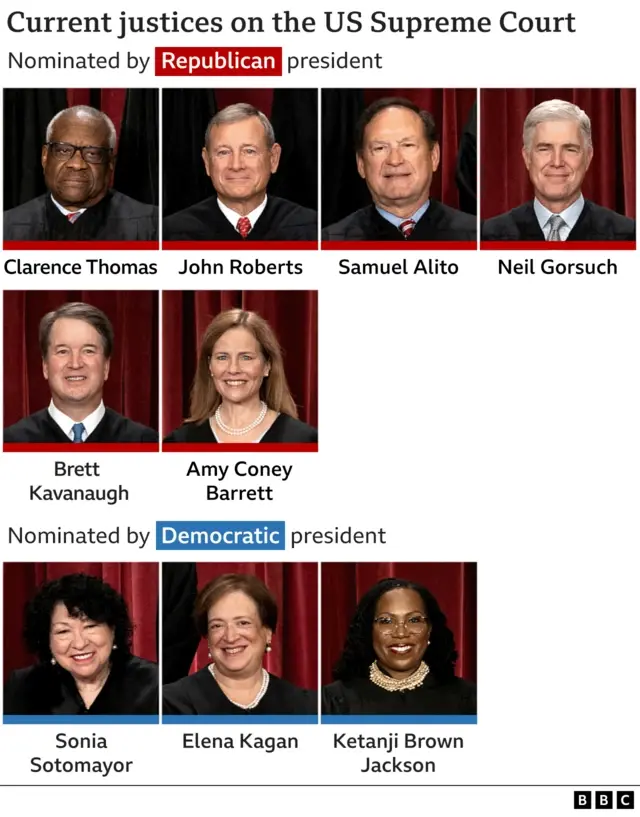
  15. Who is on the Supreme Court?published at 15:37 BST 1 April

    Six of the nine justices on the court were appointed by Republican presidents, including three when Donald Trump was in the White House. The other three were picked by Democratic presidents.

    The current court has been called the most conservative-leaning in modern US history.

    You can read more about each of the justices here.

    A photo showing the nine justices of the US Supreme Court, and which were nominated by a Republican or a Democratic president
  16. Son of immigrants tells of concerns over casepublished at 15:35 BST 1 April

    Ana Faguy
    Reporting from the Supreme Court

    For Luis Villaguzman, today's SCOTUS arguments are personal.

    The Californian is the son of immigrants. He says he's one of the lucky ones, born at the right time in the right circumstances.

    Now, he worries about what could happen to children born into the same circumstances as him, in a world where the justices affirm Trump's request to end birthright citizenship.

    A fate he says he fears is more likely because Trump is sitting in the courtroom.

    "I can't shake off that feeling, that dreadful feeling of the judges will just rule in his favour in this case," he says. "[Trump] is making history, sitting in an oral argument."

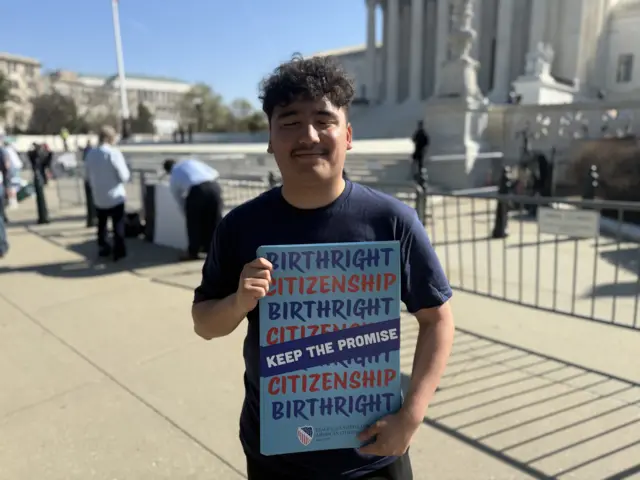
    A protester holds a sign
  17. What’s been the legal back and forth on this case so far?published at 15:29 BST 1 April

    On his first day back in office last year, President Donald Trump signed an executive order aimed at ending automatic citizenship rights, which are enshrined in the US Constitution for nearly anyone born on US territory. It's what is known as "birthright citizenship".

    The move was instantly met by lawsuits, including from five pregnant women, 22 states, two cities, the Maryland immigrant advocacy group CASA and the Asylum Seeker Advocacy Project.

    Judges in district courts in Maryland, Massachusetts and Washington state blocked Trump's order.

    Trump's Department of Justice responded by saying the case did not warrant the "extraordinary measure" of a temporary restraining order and appealed against the case to the Supreme Court.

    After taking up the case, the high court ruled in June that federal judges cannot issue injunctions that block orders from going into effect nationwide.

    But, the justices did not do away with injunctions entirely - judges can still block orders from taking effect for the people who sue against them while their lawsuits proceed.

    Though it stemmed from a case about birthright citizenship, the Supreme Court’s June ruling was about injunctions specifically, not about the underlying issue of birthright citizenship.

    That core issue of whether or not people born in the US are automatically considered citizens is what the high court is now considering, beginning with arguments at today’s hearing. A decision is expected by late June or July this year.

  18. How did birthright citizenship start in the US?published at 15:26 BST 1 April

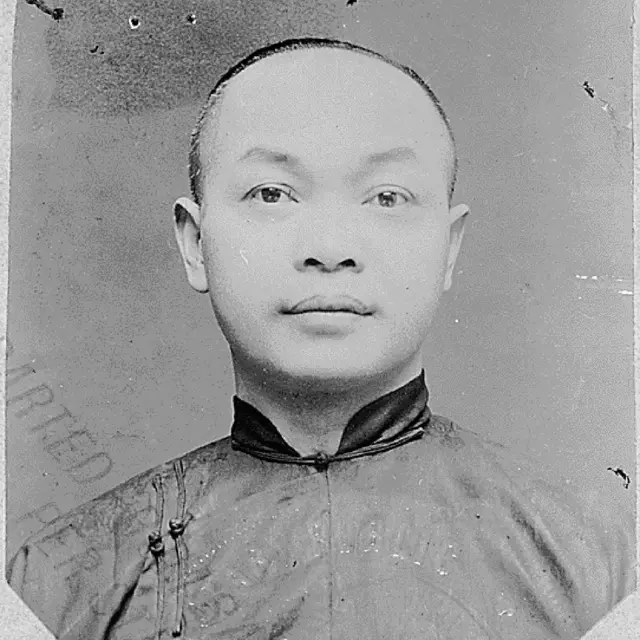
    , who took his case to the Supreme Court who ruled in 1898 in Wong's favor, establishing firmly that the U.S. Constitution's 14th Amendment recognizes birthright citizenship. Wong is seen in this photo housed in the National Archives from a federal immigration investigation case conducted under the Chinese Exclusion Acts.Image source, National Archives/Handout via
    Image caption,

    A photo of Wong Kim Ark, which is housed in the National Archives from a federal immigration investigation case conducted under the Chinese Exclusion Acts

    The concept of birthright citizenship, also known by the legal term "jus soli", is based in English common law and was generally accepted to apply to white men throughout early American history.

    However, it did not become part of the Constitution until 1868, when the 14th Amendment was passed in the wake of the US Civil War in order to settle the question of the citizenship of freed, American-born former slaves.

    Previous Supreme Court cases, like Dred Scott v Sandford in 1857, had determined that African Americans could never be US citizens. The 14th Amendment overrode that.

    In 1898, the US Supreme Court ruled that birthright citizenship applies to the children of immigrants in the case of US v Wong Kim Ark.

    Wong was a 24-year-old child of legal Chinese immigrants who was born in the US, but denied re-entry when he returned from a visit to China.

    Wong successfully argued that because he was born in the US, his parents' immigration status did not affect the application of the 14th Amendment.

    The court ruled in Wong's favour and outlined a few limited exceptions to birthright citizenship, such as for children of diplomats.

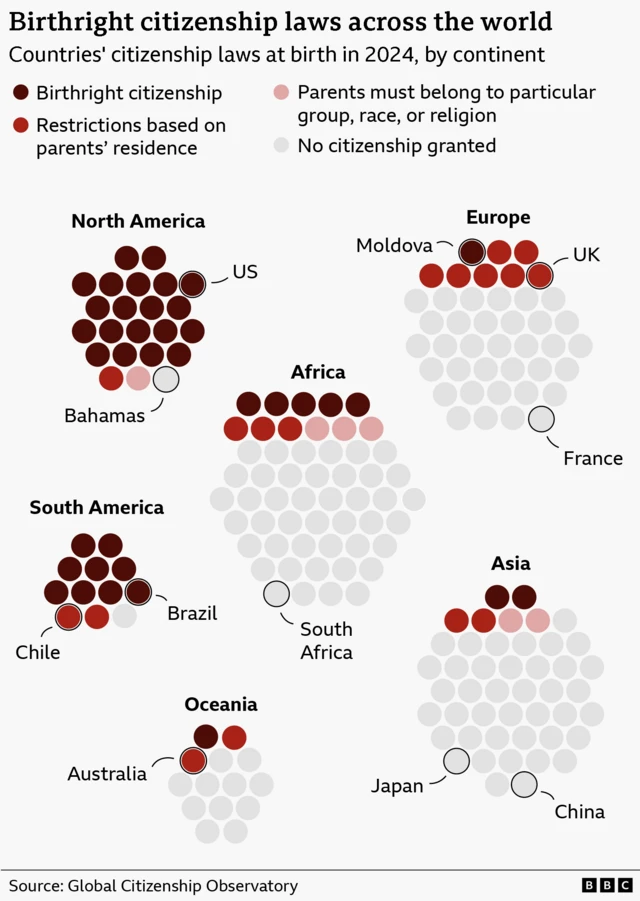
  19. What does birthright citizenship look like around the world?published at 15:21 BST 1 April

    A graphic with the countries in each continent represented by color-coded bubbles. The bubbles are filled in brown, red, pink, or white depending on whether or not they offer birthright citizenship, restrictions based on parents' residence, if the parents must belong to a particular group, or if no citizenship is grantedImage source, Getty Images
  20. Trump administration argues that current law 'demeans' US citizenshippublished at 15:20 BST 1 April

    Solicitor General John Sauer, who is outlining the Trump administration's arguments, lays out the history of birthright citizenship in the US as granting citizenship for newly freed slaves and their children in the 19th Century.

    Sauer says that "unrestricted birthright citizenship" is counter to how other nations approach their citizenship laws.

    The way the law is currently intrepreted, he adds, "demeans the priceless and profound gift of American citizenship" and attracts and rewards illegal immigration.