Summary

  • The US Supreme Court has heard oral arguments on whether some children born in the US have a constitutional right to citizenship

  • Donald Trump attended for part of the hearing - the first sitting US president to attend oral arguments in the chamber

  • Some Supreme Court justices seem to be signalling scepticism of the administration's argument - writes our Washington correspondent

  • It is the most significant case of the court term, stemming from an executive order signed by Trump on his first day back in office

  • The order sought to end automatic US citizenship for babies born in the United States to parents who are in the country illegally or temporarily

  • Opponents say Trump's order violates the US Constitution's 14th Amendment - ratified in 1868 - which says that "all persons born or naturalised in the United States, and subject to the jurisdiction thereof, are citizens of the United States"

  • Proponents argue Trump's new interpretation of the clause will allow the government to combat "significant threats to national security and public safety"

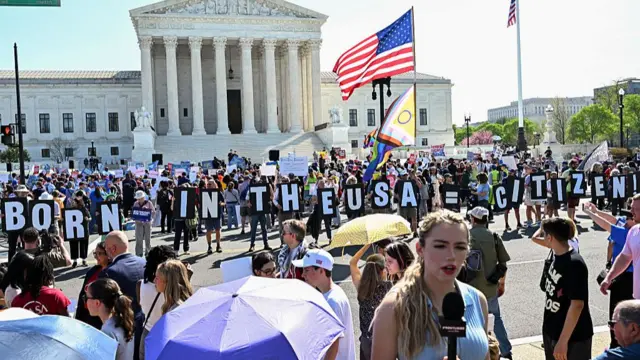
Media caption,

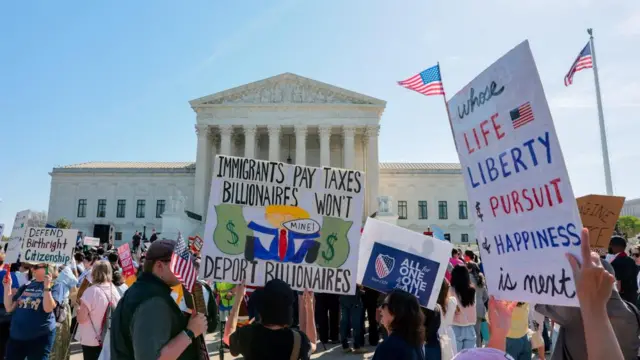
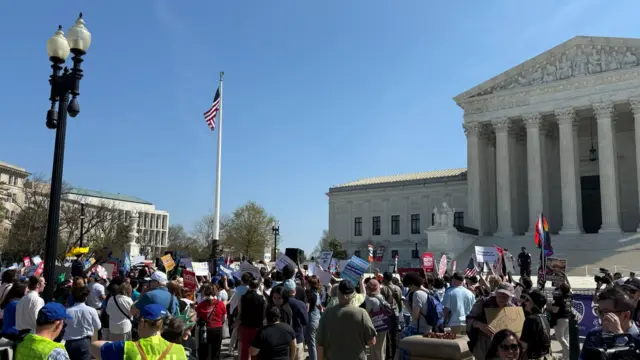
Protesters rally as birthright citizenship arguments get underway

  1. Analysis

    Trump admin's birthright citizenship arguments appear on thin ice after Supreme Court hearingpublished at 20:20 BST 1 April

    Daniel Bush
    Washington correspondent

    Protesters outside the Supreme CourtImage source, Reuters

    The Trump administration's case for ending birthright citizenship appears to be on thin ice after oral arguments concluded today at the Supreme Court.

    In over two hours of questioning, several justices repeatedly expressed scepticism at Solicitor General John Sauer’s argument that the court should fundamentally reshape US laws around birthright citizenship.

    Sauer said the court should upend the 14th Amendment, a key 1898 decision and more recent legislation passed by Congress granting birthright citizenship to most people born in the US.

    Chief Justice John Roberts and several other justices signalled they were unconvinced. Justice Brett Kavanaugh said if the court sides with the plaintiffs' interpretation of the landmark 1898 decision that upheld birthright citizenship, "then you win".

    "That could be just a short opinion," rejecting the Trump administration's case, Kavanaugh said.

    The court is expected to hand down its decision in June. It would be the first major immigration case decided on its merits since President Donald Trump started his second term.

    Trump attended the oral arguments in person. It was an unusual move by a sitting president that signalled just how much he has invested in this case. A win would help Trump make the case that he’s delivering on his campaign promises around immigration. A loss would be a second straight setback at the Supreme Court, after it ruled earlier this year to overturn his global tariff programme.

    We are ending our live coverage here shortly, thank you for joining us.

  2. American-ness isn't defined by legal citizenship, protesters saypublished at 20:00 BST 1 April

    Ana Faguy
    Reporting from the Supreme Court

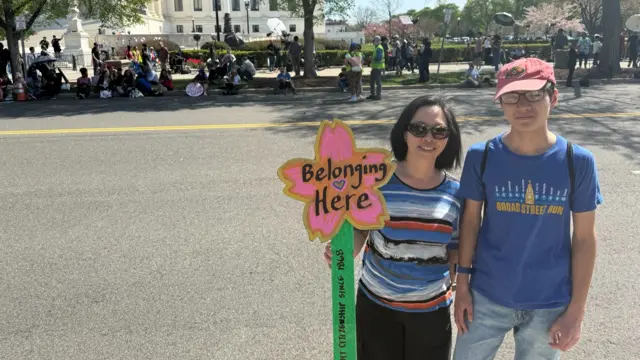
    Hannah Kim and Daniel Oshoa stand outside of the Supreme Court. Kim holds a sign shaped like a flower
    Image caption,

    Hannah Kim and Daniel Oshoa

    A question at the heart of the day seems to be: what makes someone an American?

    I asked some folks outside the court to weigh in on that question.

    Hannah Kim, who was protesting Trump's executive order today, told me there isn't one definition.

    "There are people who are here, who are American, but were denied citizenship," she said. "That didn't make them any less American."

    Still, the legal status of citizenship is important, she added.

    "It stands for something," she said. "It's something that people hope for and want for their children and have assumed as a right for over 100 years. I don't think it's something that can be taken away arbitrarily. It shouldn't be taken."

    Today's arguments had Kim thinking about the Chinese Exclusion Act of 1882 and Japanese internment during World War II, she told me.

    "Many of those people were denied the ability to become naturalised citizens,” she said. “I still call them American because they lived here, they were American.”

    For Daniel Oshoa, a tourist from North Carolina, the debate over who is an American and the role of the 14th Amendment has already been settled, regardless of the arguments happening at the Supreme Court.

    He doesn't agree with Trump's executive order, he said.

    "It goes against a lot of the sentiments this country was founded on," he said.

  3. Two years of monumental SCOTUS decisionspublished at 19:54 BST 1 April

    Bernd Debusmann Jr
    Reporting from Washington DC

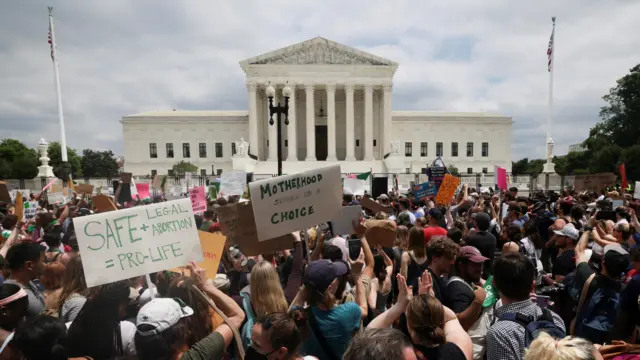
    Abortion rights demonstrators protest outside the United States Supreme Court as the court rules in the Dobbs v Women’s Health Organization abortion case, overturning the landmark Roe v Wade abortion decision in WashingtonImage source, Reuters
    Image caption,

    Abortion rights demonstrators protest outside the United States Supreme Court in 2022

    The court has only had its current make-up, with conservatives dominating the bench, since 2022.

    But in that short stretch, it has created a massive shift in the US, starting with ending the constitutional right to abortion in June of that year.

    As the grand finale of its 2023-2024 term, the court issued a decision to settle what Chief Justice John Roberts wrote was a "question of lasting significance", by ruling that Donald Trump and other ex-presidents have a wide (but not absolute) immunity from criminal prosecution for their actions in office.

    The court also ruled that federal prosecutors overreached when they used an obstruction law against 6 January rioters, it struck down a ban on federal "bump stock" devices for guns, and rejected an effort to restrict access to the abortion pill mifepristone.

    The justices also struck down former president Joe Biden's proposal to wipe out billions in student debt, and that race-based university admissions policies at Harvard and the University of North Carolina could no longer be used.

  4. Trump's order could render people stateless, expert sayspublished at 19:44 BST 1 April

    Sakshi Venkatraman
    US reporter

    If Trump’s birthright citizenship order goes into effect, it could create a "permanent racialised underclass" in the US, according to some experts.

    "If you’re the child of somebody undocumented and you’re not a citizen, then that’s your children too, that goes on forever," Margo Schlanger, a law professor at the University of Michigan, tells me.

    "So there’s no path to citizenship, not just for the folks who are here out of status, but for their children, and their grandchildren, and their great grandchildren."

    Schlanger says that others in the Trump administration, like Stephen Miller, are also trying to limit what benefits undocumented children would have access to, like public schools, for example.

    "It would also render quite a few people stateless," she says. "Because under the rules of their parents country, they are not citizens, and then they wouldn’t be citizens here either…Statelessness is its own disaster."

  5. Republicans back Trump's birthright citizenship order after court hearingpublished at 19:27 BST 1 April

    Trump's allies in the Republican party have praised the government's arguments at the Supreme Court hearing.

    Posting on X during the hearing, Missouri Senator Eric Schmidt said Trump's Solicitor General John Sauer "put on a masterclass" while answering the justices' questions.

    He also called birthright citizenship a "scam" and predicted that the final vote by the Supreme Court "is going to be close".

    Texas Senator Ted Cruz also weighed in.

    "We need to end this policy using whatever vehicle we can, whether that be a constitutional amendment, legislation, executive order, or the courts," he wrote on social media.

    He noted that he has put forth legislation that would end birthright citizenship, and says: "I hope the Supreme Court will affirm that American citizenship is reserved for those who abide by and uphold our laws."

    The X account of the Senate Republicans adds: "Birthright citizenship for illegal aliens is a national security risk."

  6. How does the US Supreme Court work?published at 18:59 BST 1 April

    Bernd Debusmann Jr
    Reporting from Washington DC

    Put simply, the Supreme Court is the keeper of US laws.

    The nine justices decide whether laws and government actions follow the US constitution. They also interpret laws passed by congress to decide if they are being correctly carried out.

    Most cases reach the Supreme Court by climbing up a ladder of appeals through lower federal courts or the state courts. Even though the Supreme Court receives more than 7,000 petitions a year, it only hears about 100 or so cases each term. The justices follow the "Rule of Four", where they review a case if four of them believe it has merit.

    By design, the court is supposed to be insulated from political change and the justices from political pressure in making their decisions.

    Americans do not vote for who can serve on the court. Justices are appointed by the president and then approved by the Senate.

    They serve for life or until they voluntarily retire, and they can only be removed by impeachment. Congress has only attempted an impeachment once, more than 200 years ago, and it failed.

  7. In pictures: Outside the Supreme Courtpublished at 18:48 BST 1 April

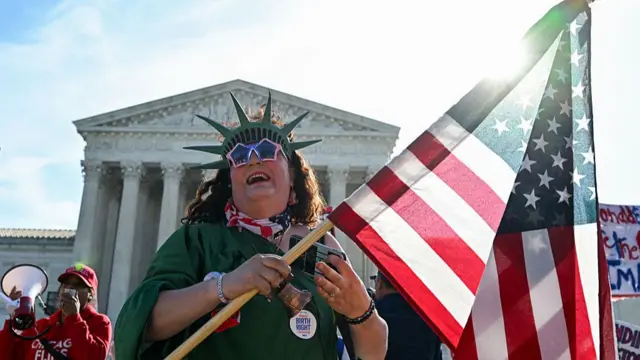
    Protesters overwhelmingly opposed to Trump's attempt to change US law continue to gather outside the court.

    It comes after Trump became the first sitting US president to attend a case at the highest court in the US.

    A protester dressed as Lady Liberty holds a US flagImage source, Getty Images
    Crowds of protesters holding a sign saying "born in the US = citizen"Image source, Getty Images
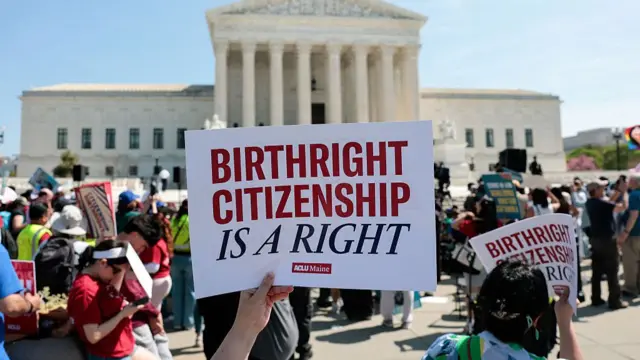
    A protester with a sign saying "Birthright citizenship is a right"Image source, Getty Images
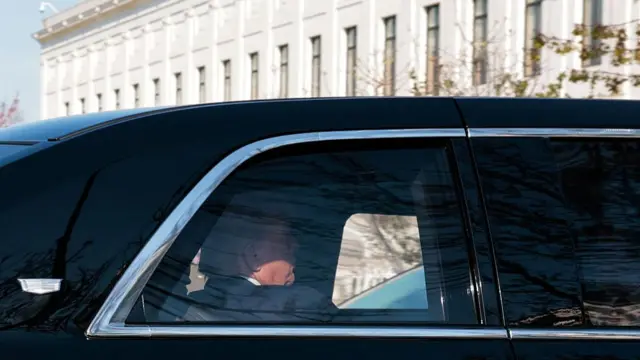
    Trump in a limoImage source, Getty Images
  8. What we heard from each side of the birthright citizenship argumentspublished at 18:31 BST 1 April

    Supreme Court justices just spent nearly two and half hours grilling lawyers about the past, present and future of birthright citizenship in the US.

    Here's a recap of how it went down:

    In the Trump administration's arguments:

    • US Solicitor General John Sauer, arguing for the Trump administration, presented the White House's argument that birthright citizenship should not apply to the children of people temporarily or illegally in the country
    • The justices focused their questioning on Sauer's underpinning concept that having a "permanent domicile" is what makes someone truly under the jurisdiction of the US - the key 14th Amendment phrase under review
    • Justices pressed him on how a baby's domicile - and therefore citizenship - status would be determined at birth
    • Sauer also told the justices that he was not asking them to overturn the precedent set by 1898 court case United States v. Wong Kim Ark, which first established that children of immigrants born in the US are citizens

    In the arguments against Trump's executive order:

    • Cecillia Wang from the American Civil Liberties Union (ACLU) was arguing on behalf of the challengers of Trump's order
    • Her argument was based on the claim that the 14th Amendmen to the US Constitution states clearly that those born on US soil are granted citizenship, she said
    • She gave historical examples to prove that children of non-citizens born in the United States - including those from Native American tribes and residents in Japanese internment camps - were considered citizens
    • The justices grilled Wang on explaining the existing exceptions to US birthright citizenship, which she said mostly encompassed the children of visiting foreign diplomats and children of invading powers
  9. Trump calls the US 'stupid' for allowing birthright citizenshippublished at 17:41 BST 1 April

    Trump has just taken to social media to claim: "We are the only Country in the World STUPID enough to allow 'Birthright' Citizenship!"

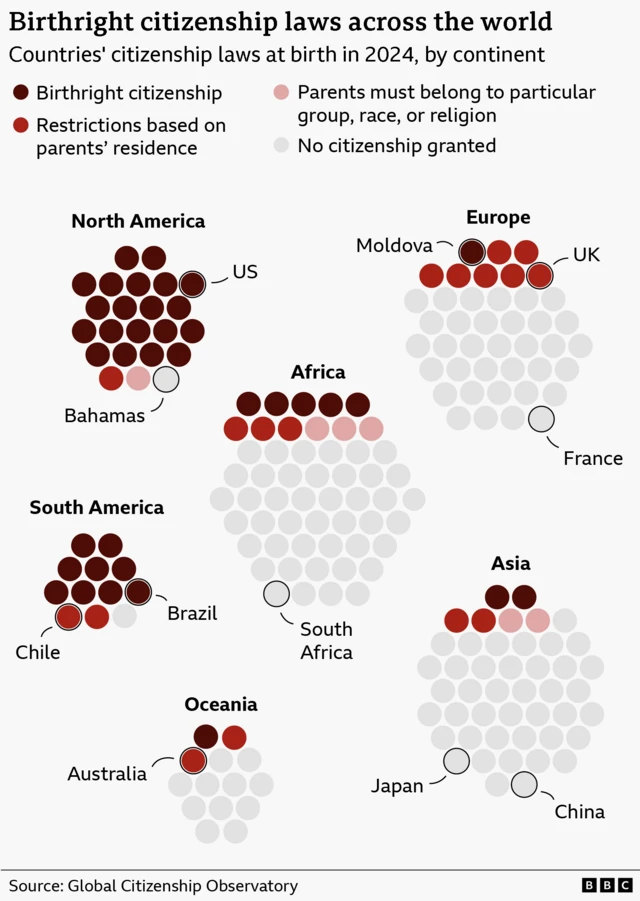
    The US is one of about 30 countries - mostly in the Americas - that grant automatic citizenship to anyone born within their borders.

    In contrast, many countries in Asia, Europe, and parts of Africa adhere to the jus sanguinis (right of blood) principle, where children inherit their nationality from their parents, regardless of their birthplace.

    To remind you, Trump made history today by becoming the first sitting president to attend oral arguments at the Supreme Court. He left after listening to the White House lawyer present his case, choosing not to hear from the lawyer arguing against his attempt to change US law.

    Read more about which countries have birthright citizenship here

    A graphic with the countries in each continent represented by color-coded bubbles. The bubbles are filled in brown, red, pink, or white depending on whether or not they offer birthright citizenship, restrictions based on parents' residence, if the parents must belong to a particular group, or if no citizenship is granted
  10. White House says 'temporary sojourners' are 'clearly not citizens'published at 17:34 BST 1 April

    The oral arguments have ended, but here's what the White House attorney said in his closing statement.

    Sauer, arguing for the Trump administration, said that prior courts had found that people travelling abroad did not owe the country they were visiting their allegiance.

    He said that early courts debated what it meant to be a "citizen" - before the 14th amendment granted citizenship to anyone born in the US. The law was intended to grant citizenship to the descendants of slaves taken from Africa, he said.

    Sauer said that the children of freed slaves were clearly found by Congress to have had an allegiance to the US, but the same could not be said of the "temporary sojourners" who were currently in the US without legal status, and were "clearly not citizens".

    "Congress has clearly departed from the British common law conception of allegiance," he said.

  11. Oral arguments endpublished at 17:21 BST 1 April

    Lawyers for the Trump administration and the ACLU have finished answering the justices' questions and the hearing has ended.

    We will continue to bring you updates from inside and outside court, so stick with us.

  12. Justice Jackson says everyone present in the US meets the bar for 'allegiance'published at 17:20 BST 1 April

    Justice Ketanji Brown Jackson has the last question for Wang before the government's rebuttal begins.

    Jackson argues that people have "local allegiance" even to countries they are just visiting temporarily.

    "I, a US citizen, am visiting Japan. If I steal someone's wallet in Japan, the Japanese authorities can arrest me and prosecute me...I can also rely on them if my wallet is stolen," she says.

    Wang agrees that, just by virtue of being in the US, people are under the country's jurisdiction and owe it allegiance.

  13. 14th amendment was not meant to be relitigated, says Wangpublished at 17:19 BST 1 April

    Justice Kavanaugh asks if the framers of the US constitution ever intended for this question on birthright citizenship to be ever reconsidered, and whether there can be additional exceptions made to the law based on "modern circumstances".

    ACLU lawyer Cecillia Wang says no, and that the framers intended to put "any further exceptions to birthright citizenship outside the reach of any future Congress."

    She adds that Congress has the power to expand citizenship, but they "can't go below that floor that the Constitution sets".

    This is a point that was asked about previously in questioning between Justice Amy Coney Barret and Wang.

  14. What happens to a child born to undocumented Iranian parents, Justice Alito askspublished at 17:14 BST 1 April

    Back in the court, Justice Samuel Alito brings up the hypothetical example for Wang to answer.

    "A boy is born in the US to an Iranian father who has entered the country illegally. That boy is automatically an Iranian national at birth and he has a duty to provide military service to the Iranian government," Alito says. "Is it not subject to any foreign power?"

    Wang says, no.

    She says this view would create exceptions even for lawful permanent residents, dual citizens, and essentially anyone from abroad. "That would have meant that the children of Irish, Italian and other immigrants...would not have been citizens either," she says.

    Justice Sotomayor also pushes back against Alito's point - saying even if the parents of the Iranian child were lawful permanent residents here, the child would still have a duty to serve.

    Wang says she's not sure about that, but contends that it doesn't matter.

    "We don't look to other countries' law in construing our 14th amendment," she says.

  15. It’s extremely rare for a president to challenge the Constitutionpublished at 17:04 BST 1 April

    Sakshi Venkatraman
    US reporter

    Some legal experts see Trump’s executive order as a direct challenge to the US Constitution - and to an amendment that has existed for more than 150 years.

    "It’s not at all common for a president to just out of the blue launch an attack on an old precedent," University of Michigan law professor Margo Schlanger says.

    Michele Goodwin, a professor of Constitutional law at Georgetown University, says it is "unprecedented", and that it’s not within the reach of the president’s powers to do so.

    Other presidents have signed executive orders limiting the rights of certain groups of people, Goodwin said, citing Franklin D Roosevelt’s executive order mandating Japanese internment.

    But it has never happened that a president has gone after a particular amendment itself.

    "The president least of all attempts to challenge what’s in the Constitution," she said.

    "It is incredibly rare. It is extraordinary what we have seen from Donald Trump… Presidents may not essentially backdoor draft constitutional amendments or dismantle them."

  16. Analysis

    A key question for the court: to rule based on Constitution, or on statutory grounds?published at 17:00 BST 1 April

    Daniel Bush
    Washington correspondent

    The Supreme Court will have to decide whether to base its final ruling around the Constitution or legislation passed by Congress addressing birthright citizenship.

    That issue -- whether the Court rules on constitutional or statutory grounds -- is a key question among court watchers following today’s hearing. The question is critical because it’ll help shape the scope of the ruling.

    If the court rules on constitutional grounds, it would represent a major reinterpretation of US law and upend more than a century of precedent dating all the way back to the 14th Amendment. A narrower ruling would likely focus on a 1952 immigration law passed by Congress that codified birthright citizenship status.

    The challenge, for the administration, stems from the fact that Congress relied on the language in the 14th Amendment for its law giving birthright citizenship to most people born in the US. On this matter there is very little difference between the more recent law, and the constitution.

    Solicitor General John Sauer argued that both were wrong. But under questioning from Justice Neil Gorsuch he acknowledged that the administration was seeking the broadest possible ruling.

    "This is a straight-up constitutional ruling you want from this court, win, lose, or draw?" Gorsuch asked. “Yes,” Sauer replied.

    That may be too big of an ask for the court. Already today, several justices signaled they don’t agree with Sauer’s argument that the 14th Amendment, later court rulings, and the 1950s-era law all got it wrong. The court may be reluctant in the end to issue a major constitutional ruling that fundamentally redefines the birthright citizenship process.

    Justice Brett Kavanaugh also raised the issue just a few minutes ago. “Our usual practice is to resolve things on statutory grounds and not to do constitutional grounds,” he said.

    Cecillia Wang, an ACLU attorney, replied that the plaintiffs have “two paths to a win here,” but urged the court to issue a broad ruling affirming the 14th Amendment and past court precedent.

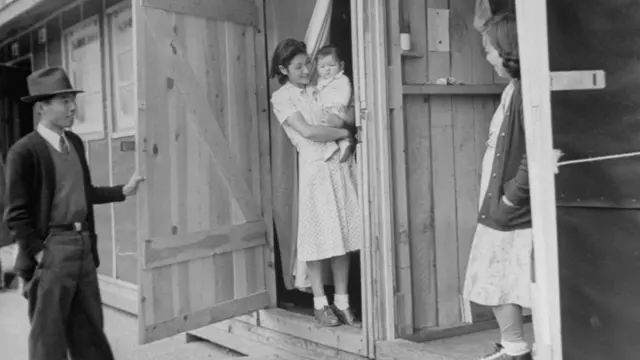
  17. Babies born in Japanese detention camps got US citizenship, argues Wangpublished at 16:55 BST 1 April

    A Japanese family stands outside their living quarters in a US internment camp in 1942Image source, Getty Images
    Image caption,

    A Japanese family in a US internment camp in 1942

    Taking a question from Justice Amy Coney Barrett, ACLU's Wang makes a point about babies born during the 1940s internment in US camps of Japanese Americans and Japanese nationals living in the US.

    "Even in World War II, when the United States was detaining Japanese nationals that were deemed enemy aliens of the United States, when those enemy aliens had babies in the detention camps, everyone agreed those babies were US citizens," she says.

    She added some of those babies went on to a lifetime of government service.

    She also speaks to the status of babies born to sovereign Native American tribes, who were not considered citizens at the time of the passing of the 14th Amendment. Wang describes them as a "constitutionally unique status".

    "Tribes are treated as quasi-foreign nations," she says.

    Remember: Babies born on Native American reservations were given full US citizenship in 1924 when Congress passed the Indian Citizenship Act.

  18. Debate over who has 'domicile' continuespublished at 16:51 BST 1 April

    Inside the court the arguments continue, as Justice Alito asks the ACLU lawyer about the term domicile, and how it appears in the Wong Kim Ark ruling.

    Lawyers for the White House have argued that citizenship should only be given to the children of mothers who have a "permanent domicile" in the US.

    Alito begins by noting that Chinese immigrants - unlike Europeans - could not become naturalised citizens at the time, due to "racist laws".

    Justice Jackson jumps in to say that the Wong Kim Ark ruling clarified that even migrant workers are considered to be domiciled in the US.

    Cecillia Wong, the ACLU lawyer arguing against the White House, says that at the time of the ruling "there was a common view that Chinese people were inherently temporary sojourners in the country".

    That ruling, she says "was trying to dispel that notion" being pushed by anti-Chinese campaigners at the time.

  19. Outside, some protest loudly while others listen quietly to argumentspublished at 16:48 BST 1 April

    Ana Faguy
    Reporting from the Supreme Court

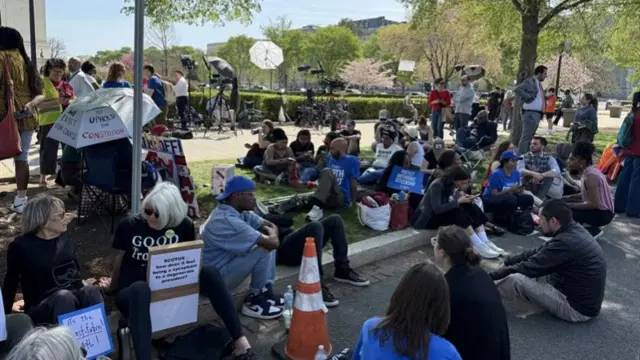
    Protesters outside Supreme Court

    There's a large group of people listening to speakers give impassioned speeches, banging drums and voicing their opposition to the Trump administration's proposed law.

    On the other side, there's a growing group of people sitting in the shade, listening to the arguments on a massive speaker.

    There's occasional commentary or claps in support from that group but otherwise, they are largely quiet and listening attentively to the justices' questions.

    People listen to arguments outside supreme court
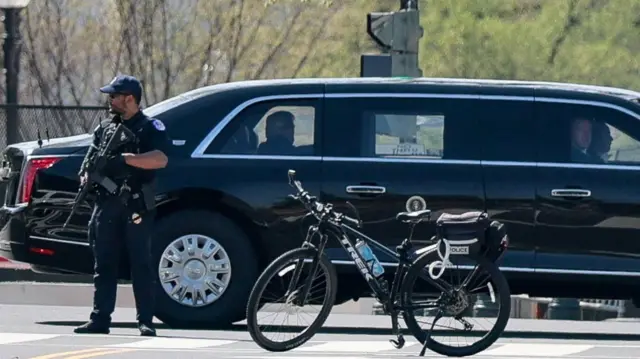
  20. Trump leaves Supreme Court as arguments continuepublished at 16:38 BST 1 April

    U.S. President Donald Trump sits in a car as he departs the U.S. Supreme Court after attending oral arguments on the legality of his administration's effort to limit birthright citizenship for the children of immigrants, in Washington, D.C., U.S., April 1, 2026.Image source, Reuters

    US President Donald Trump has left the Supreme Court, where he was listening to oral arguments on whether some children born in the US have a constitutional right to citizenship.

    In doing so, he became the first sitting US president to attend oral arguments in the chamber.

    He is now back at the White House.