Summary

  1. Next mission 'right around the corner'published at 04:09 BST 11 April

    There's lots of questions about the next Artemis flight, which Nasa hopes will take off next year.

    "The next mission is right around the corner," Henfling says.

    "We'll take the lessons learned... [and] when the time is right we'll get back into flight specific training."

    The crew has not been announced, including flight directors like Henfling, but he says everyone in the pool is "extremely capable".
  2. Today is 'thousands of times' better than Star Wars, says Hupublished at 04:05 BST 11 April

    Howard Hu says today is "thousands of times" better than Star Wars, adding he has fond memories of seeing the film with his late father.

    "That little kid who saw and was inspired by the stars... now we are able to send our crew out to the stars, the farthest any humans have been."

    He says he cannot express the "goosebumps" he has and tells the kids listening to pursue their dreams.

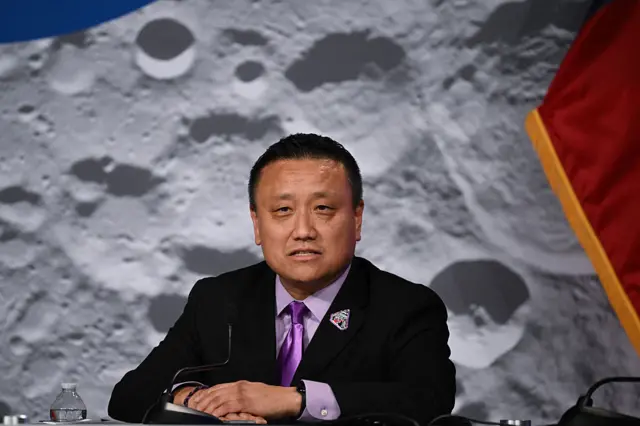
    Howard Hu in a black suit and purple tie speaks in front of a backdrop of the moonImage source, Getty Images
  3. Crew has already 'gathered a lot of data'published at 04:03 BST 11 April

    Another question has come up on the heatshield performance and how it will be assessed.

    Lori Glaze says the team has already "gathered a lot of data" which will be analysed in the coming days and weeks.

    She adds that divers have also taken pictures of the heatshield.

    Howard Hu says the crew has captured "a lot of great imagery" and the team is "very excited" to digest the data and "see it live in person".

  4. Kshatriya says Nasa has achieved objectives Apollo teams never got topublished at 04:02 BST 11 April

    Nasa originally wanted to learn to live and work in space for a long time, before reaching for the Moon - but as we know, the geopolitical environment five decades ago meant that objective changed.

    Kshatriya says the space agency has now been able to build that foundation, pointing to 25 years of occupation on the International Space Station, and, with the Artemis missions, are turning their focus back to the Moon.

    "The irony of history is that it took that long for us to do that," he says.

  5. Priority is getting crew back to their familiespublished at 04:01 BST 11 April

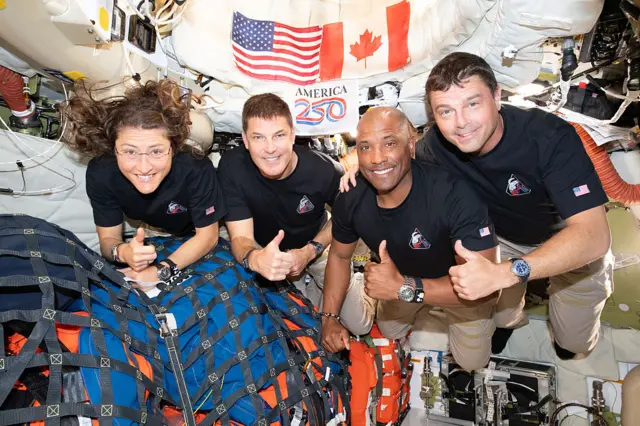
    The Artemis II crew, Mission Specialist Christina Koch, Mission Specialist Jeremy Hansen, Pilot Victor Glover, and Commander Reid Wiseman pause for a group photo inside the Orion spacecraft on their way homeImage source, Getty Images
    Image caption,

    Christina Koch, Jeremy Hansen, Victor Glover and Reid Wiseman all appear healthy after early medical checks, Nasa says

    The panel is asked what the astronauts will be doing for their first day back on Earth

    Rick Henfling says the top priority for Nasa is to get the astronauts back to their families.

    The crew are expected to arrive back in Houston tomorrow at some point between 07:00 and 19:00 local time.

  6. Controllers breathed a 'sigh of relief' when hatch opened up, says Henflingpublished at 03:58 BST 11 April

    Rick Henfling says there was a lot of anxiety but also a lot of confidence in the room while bringing the Orion crew home.

    He adds he has a lot of trust in his team and that flight controllers went through a "rigorous" training process.

    "We all breathed a sigh of relief once the side hatch opened up."

  7. Iteration 'the key' to reliability, says Kshatriyapublished at 03:55 BST 11 April

    Amit Kshatriya says iteration is "the key" to reliability and safety during the Artemis missions.

    He adds Nasa has been waiting to fly the Artemis II mission for several years.

  8. Artemis crew is 'happy and healthy'published at 03:55 BST 11 April

    One question from the press is on how the astronauts are doing, to which Rick Henfling, entry flight director, says everyone is "happy and healthy".

    "I saw Victor was smiling and in good spirits, everyone is happy and healthy and ready to come back to Houston."

    When asked when the crew for Artemis III is expected to be announced, he replies: "Soon."

  9. Plenty of praise for the astronautspublished at 03:53 BST 11 April

    Lori Glaze - an acting associate administrator at Nasa - is full of praise for the astronauts who helmed the Artemis II mission.

    She says the four were all individually impressive, but that she was proud of their "teamwork" and "camaraderie"

    "I think they really brought an amazing sense of what we were trying to achieve," she says.

    "It was a mission for all of humanity."

  10. Panel quizzed on feelings during communication blackoutpublished at 03:52 BST 11 April

    The panel is asked what the communication blackout felt like for them during re-entry.

    Flight director Rick Henfling says the team was aware of when the blackout would start, adding that it began and ended as expected.

    He says this reassured the team that the spaceship was flying itself correctly.

  11. 'A lot of lessons learned', says Hupublished at 03:50 BST 11 April

    The panel is then asked what issue they were most grateful to learn of during the mission.

    Howard Hu says Nasa are taking "a lot of lessons learned" from the mission, adding a leak being found in the system of the pressure control assembly was a new finding.

    He says changes will be made if necessary, and the team will move forward after assessing the relevant data.

  12. Some mission stats for youpublished at 03:48 BST 11 April

    Entry flight director Rick Henfling just rattled off some impressive stats.

    He says the Artemis II mission crew travelled 700,237 miles reaching a peak velocity of 24,664 mph.

    Their team's re-entry angle was only 0.4% off their target, and they splashed down within less than a mile of where they hoped.

    "What a tremendous day."

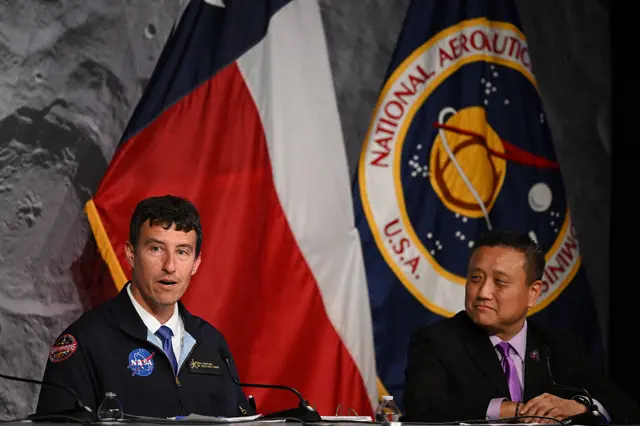
    Nasa officials speak at a press conferenceImage source, Getty Images
  13. Today is 'start of a new era of human space exploration', program manager sayspublished at 03:47 BST 11 April

    Howard Hu, Nasa Orion program manager, today has been "a fantastic day".

    He adds that the team at Nasa has "dreamed" of reaching this day.

    "This is the start of a new era of human space exploration."

    Return to the latest post
  14. 'The work ahead is greater than the work behind us', says Nasa associate administratorpublished at 03:44 BST 11 April

    Kshatriya goes on to say "the work ahead is greater than the work behind us".

    He adds: "Let us finish what they started... let us not go to plant flags and leave, but stay."

  15. Conference begins as Kshatriya praises work of teampublished at 03:42 BST 11 April

    Amit Kshatriya has begun speaking at the post-splashdown press conference.

    The associate administrator for Nasa says the families of the crew have had happiness and anxiety while awaiting the astronauts' return.

    Regarding the success of the mission, he says it is "not luck, that is 1,000 people doing their jobs".

  16. Press conference to be held after splashdownpublished at 03:37 BST 11 April

    We will shortly be receiving an update from Nasa following the successful return of the Artemis II crew.

    The press conference will be held at the Nasa Johnson Space Center.

    Participants include:

    • NASA Associate Administrator Amit Kshatriya
    • Lori Glaze, acting associate administrator, Exploration Systems Development Mission Directorate
    • Rick Henfling, entry flight director, Artemis II
    • Howard Hu, manager, Orion Program
    • Shawn Quinn, manager, Exploration Ground Systems Program
  17. Learning to walk again after landingpublished at 03:34 BST 11 April

    Helen Sharman
    The UK’s first astronaut

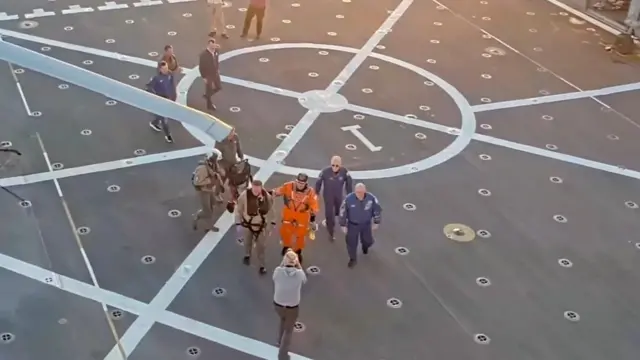
    A crew member walks across the deckImage source, Reuters

    The strangest part for me came after landing, when I tried to stand. Inside the capsule I already felt incredibly heavy – as if someone had quietly tripled my bodyweight.

    When I finally took my first steps, my legs felt like lead. Years of instinct took over: every time I lifted one foot, my body leaned the other way to “balance” the imaginary load, so I staggered sideways. It took 20 or 30 paces before my brain relearned how to walk in a straight line.

    I also felt slightly light headed, because gravity was pulling blood away from my head again.

    The Artemis II crew have pressure garments to help with that, squeezing fluid back up into the body, so they may feel better than I did.

    But I’d still expect them to be a bit wobbly and cautious at first, reaching for handrails, before feeling pretty normal again within a couple of hours.

  18. Koch and Glover pose for photospublished at 03:18 BST 11 April

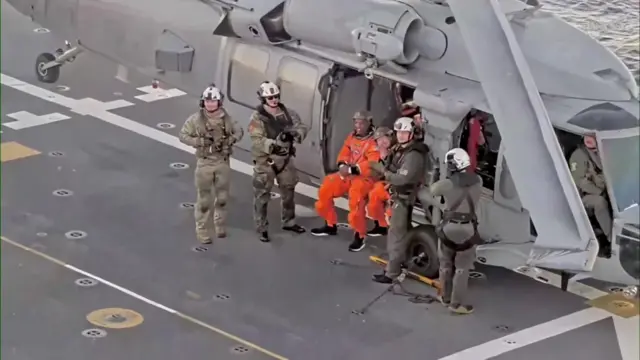
    Christina Koch and Victor Glover sitting on the flight deck of the USS John P MurthaImage source, NASA
    Image caption,

    Koch and Glover seen sitting on their helicopter

    The astronauts have just been escorted across the flight deck to the medical bay.

    Shortly before that, Christina Koch and Victor Glover could be seen sitting on their helicopter on the flight deck of the USS John P Murtha.

    The astronauts had taken off their helmets and could be seen smiling to each other while posing for photos.

  19. Artemis II was a 'gift to the world', Nasa administrator sayspublished at 03:07 BST 11 April

    Artemis II crew members walking across the flight deck of the USS John P Murtha. A helicopter can be seen on the edge of the flight deckImage source, NASA
    Image caption,

    Artemis II crew members walking across the flight deck of the USS John P Murtha

    Houston's control room is "overrun" with jubilant individuals, says Nasa's associate administrator.

    Amit Kshatriya says the mission exceeded expectations, describing it as a "gift to the world".

    He adds there is still some work to do to get the crew to the designated medical bay, but says the astronauts look "great".

    "See what we can do when we work together... it doesn't matter how hard the problems are, we can solve them."

  20. Crew safely aboard USS John P Murthapublished at 03:02 BST 11 April

    Pallab Ghosh
    Science correspondent

    Helicopters aboard the USS John P Murtha shortly after escorting the Orion crew from the moduleImage source, NASA
    Image caption,

    Helicopters aboard the USS John P Murtha

    All four Artemis II crew members are now aboard the USS John P Murtha — a San Diego-based warship with a floodable cargo bay large enough to take the Orion capsule on board directly from the ocean.

    It also has a helicopter pad, and onboard medical facilities. Reid Wiseman, Victor Glover, Christina Koch and Jeremy Hansen were extracted from the Orion capsule one by one, hoisted by helicopter and transferred to the recovery ship.

    Each astronaut will be checked by flight surgeons for pulse, blood pressure, brain and nerve responses, and balance.

    The balance system in the inner ear get used to weightlessness, so when astronauts come home they often feel dizzy and unsteady until they readjust.

    Britain's first astronaut Helen Sharman, who went through this herself, told me it took about 20 or 30 paces before she could walk in a straight line — her brain had to relearn that picking up one leg required the rest of her body to balance.

    Even lifting a finger, she said, felt surprisingly heavy. In the days ahead, the crew fly back to Houston, where the physiological and operational data from the mission will be scrutinised.

    How the human body responds to the deep-space radiation environment beyond Earth's magnetic shield is one of the key questions Artemis II was designed to help answer.