Main chutes open behind crewpublished at 01:07 BST 11 April
 Rebecca Morelle
Science editor
What a sight for the astronauts seeing those three main chutes open above them.
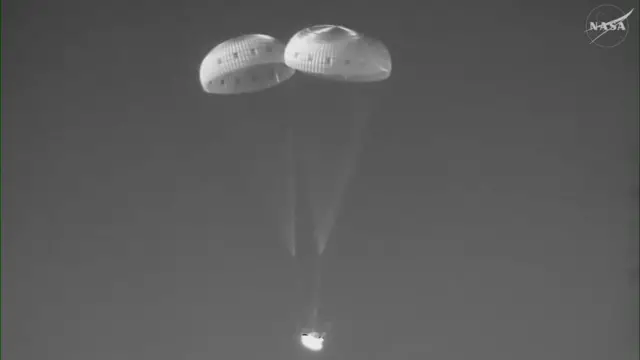 Image source, NASA
Orion with the three main parachutes deployed
The Artemis II astronauts have safely returned to Earth after a "textbook touchdown", bringing their historic 10-day mission to a close
The crew splashed down in the Pacific Ocean at 00:07 GMT (20:07 EDT), with commander Reid Wiseman confirming his team is healthy - here's what happens next
"This is the start of a new era of human space exploration," Nasa says, after the crew's return
The four astronauts are "happy and healthy", an official for the space agency says at a news conference
The Artemis II crew successfully re-entered the atmosphere after a routine but nerve-wracking six-minute communications blackout
On 6 April, the spacecraft reached its maximum distance from Earth - 406,771km (252,756 miles) - during the lunar flyby, breaking the previous record for the furthest humans have ever travelled into space
Rebecca Morelle
Science editor
What a sight for the astronauts seeing those three main chutes open above them.
Image source, NASAOrion with the three main parachutes deployed
 Pallab Ghosh
Science correspondent
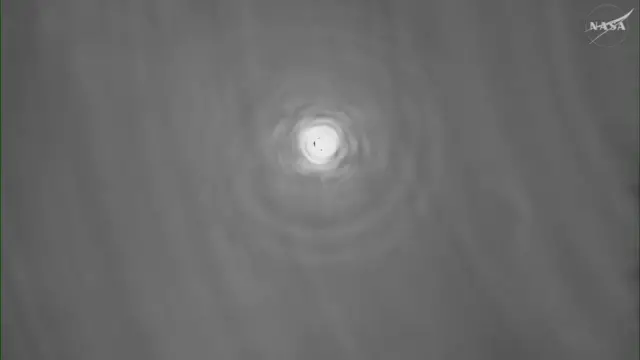 Image source, NASA
View of the Orion spacecraft as communications return
Signal restored. Orion is back. Phew!
For six minutes, Nasa's mission controllers had no contact with the crew — no voice, no data, no way of knowing whether the modified re-entry trajectory had protected the heat shield as the engineers predicted.
Then, on schedule, the plasma dissipated and telemetry flooded back into Johnson Space Centre. When the parachutes deploy, they are not pulled out gently — they are fired from a cannon using pyrotechnics, a controlled explosive charge that blasts each chute into the airstream.
The forward bay cover has been jettisoned. Drogue parachutes — two of them, seven metres across — have deployed at 22,000 feet, slowing and stabilising the capsule from around 300mph to 200mph.
The three main parachutes deploy at 6,000 feet — each one the footprint of a large house. It is, even knowing it is coming, a sudden brutal deceleration.
Britain's first astronaut Helen Sharman described the main chute opening as one of the most physically shocking moments of the entire mission. Even braced for it, she said, it still felt violent.
The capsule is descending gently toward the Pacific. The heatshield has done its job.
Pallab Ghosh
Science correspondent
Orion has hit the entry interface — 400,000 feet above the Earth's surface, southeast of Hawaii — and the blackout has begun.
The capsule is now travelling at close to 24,000mph. The air, thin as it is at that altitude, cannot move out of the way fast enough. It compresses, heats, and ionises — its molecules stripped of electrons to form a plasma glowing orange and yellow around the heat shield.
The temperature across that shield is now climbing toward 5,000°F — the oft quoted phrase “roughly half the surface temperature of the sun” illustrates perfectly how risky and otherworldly this experience is.
It is the most violent thing that happens to any returning spacecraft. And it is happening right now. The plasma bubble does not just generate heat. It blocks every radio frequency in and out. There is no signal from Orion. No voice. No telemetry. Mission controllers in Houston can see nothing; they can only calculate from physics and prior planning what is happening to the four people inside that fireball.
Here is what is happening: the crew are pressing back into their seats under a deceleration of up to 3.9G — nearly four times the pull of gravity. The atmosphere comes in layers, and pockets of denser gas are making the capsule shudder and lurch. For six minutes, there is nothing to be done from the ground.
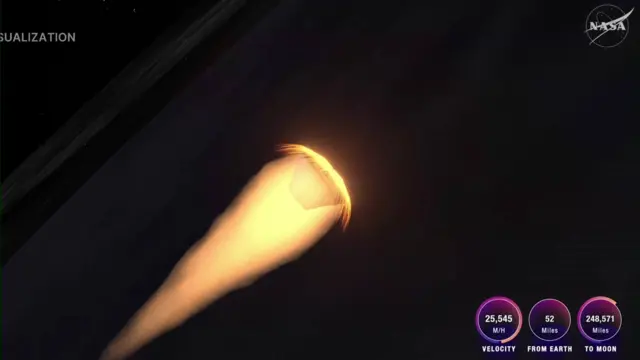 Image source, NASA
Visualisation of Orion as it re-enters the Earth's atmosphere during the communication blackout period
Rebecca Morelle
Science editor
As the Orion capsule hurtles through the Earth’s atmosphere it will experience temperatures of around 2,700C. That’s half as hot as the surface of the Sun.
All that stands between the astronauts and these scorching temperatures is the heatshield.
But during the Artemis I mission, which had no crew on board, the heatshield was badly damaged.
The material it was covered in - called Avcoat - was supposed to melt and vaporize, absorbing and dissipating the fierce heat.
But large chunks of this material broke off, leaving the heatshield pockmarked with char holes.
After an investigation, Nasa engineers said they had identified the problem. The profile of the re-entry left the capsule exposed to the high temperatures for too long, causing heat and pressure to build up underneath the Avcoat causing it to crack and shed unevenly.
For Artemis II, the engineers haven’t changed the heatshield. But they have adjusted the spacecraft’s angle of re-entry, so it’s not exposed to the high temperatures for so long.
The Artemis team say they’re confident this will work and the crew will come home safely.
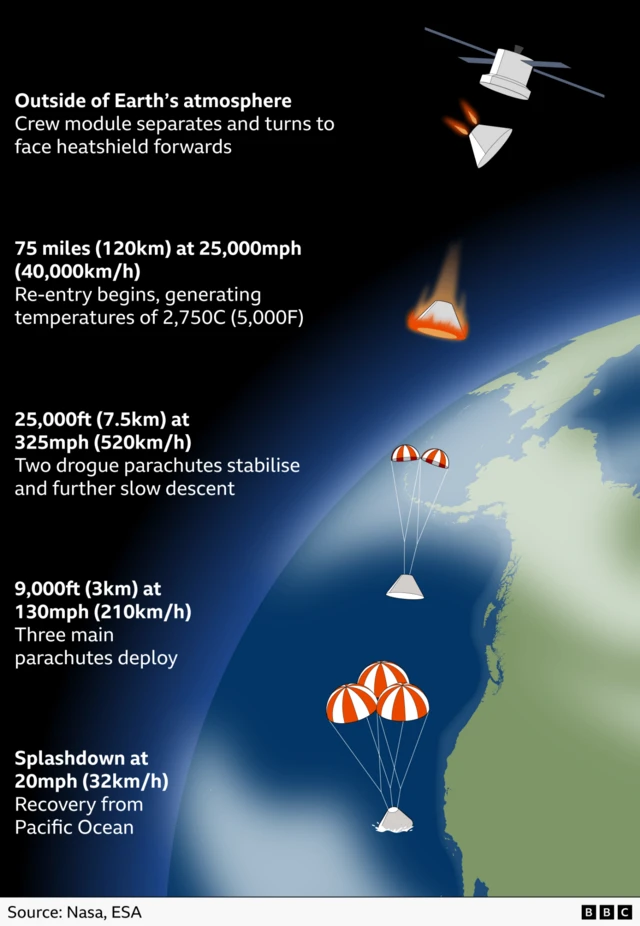
The re-entry path for Orion
Rebecca Morelle
Science editor, at mission control
As the spacecraft plunges into the dense atmosphere, plasma - superheated charged particles - will build up around it.
This will block the spacecraft’s signals for about six minutes during the riskiest part of the re-entry.
We visited the Orion capsule’s Mission Evaluation Room yesterday where the spacecraft is continuously monitored and spoke to Orion’s programme manager Howard Hu. He told us that six minutes of silence would be very intense.
“I don’t know if I can hold my breath for six minutes, but I’m going to be holding my breath. I’m going to be staring at the screen, watching the clock count, and waiting for Reid’s voice to come in on the loop.”
Pallab Ghosh
Science correspondent
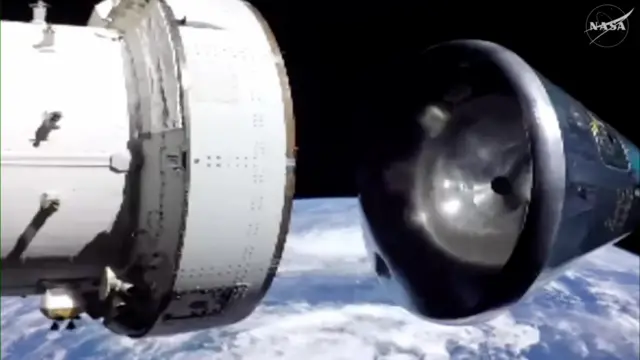 Image source, NASA
The service module shown separating from the Orion capsule
The service module has separated from the Orion capsule. This is the moment the crew are, in one practical sense, truly on their own.
For the past 10 days, the cylindrical service module — built by the European Space Agency — has been the workhorse of the mission.
Its engines performed the burns that sent Orion looping around the Moon. Its solar arrays generated the power that kept the crew alive. Its propulsion system nudged the vehicle onto a homeward trajectory across 230,000 miles of empty space.
Now it has been jettisoned and will burn up in the atmosphere, its job complete. It will never be recovered.
What remains is the crew module: the blunt-nosed cone in which Wiseman, Glover, Koch and Hansen have eaten, slept, and marvelled for the past week and a half. It is roughly the size of a large car. It must now survive a plunge through the atmosphere at 24,661mph (39,688km/h).
The final trajectory correction burn is underway, locking the capsule into its precise angle of approach for re-entry into the Earth’s atmosphere. Nasa's engineers have less than a degree of margin. Too shallow, and Orion skips off the atmosphere and cannot return. Too steep, and the heating is unsurvivable.
The riskiest part is about to begin.
Astronauts routinely take medication to mitigate the effects of returning to the Earth’s gravity and feelings of nausea from re-entry, according to a Nasa flight surgeon.
Dr Rick Scheuring says the medicine is similar to that of anti-nausea medication, with the astronauts also taking electrolytes and fluids to replace any they may have lost.
He says: "The human system is very dynamic, it has to readapt very quickly and one of the most common responses they get is just some stomach awareness, to some nausea, to some vomiting."
Scheuring adds that anti-inflammatory medicine is taken to mitigate the effects of feeling gravity again following weightlessness while in space.
Pallab Ghosh
Science correspondent
Orion is targeting splashdown in the Pacific Ocean off the coast of California, where US Navy ships, helicopters and divers are waiting to recover the capsule.
Nasa keeps several alternative splashdown zones along the ground track and watches the forecast closely; high seas, strong winds or nearby storms can force a shift to a different patch of ocean or even an extra orbit while the team reassesses.
Officials have also spoken about wider contingency arrangements – including agreements with partner nations so that, in a true emergency, ships or aircraft from other countries could help locate and recover the capsule if it came down far from the planned zone.
For the crew, the landing itself will be brief but punchy: a hard jolt as the capsule hits the water, then a lively bobbing while recovery teams move in to stabilise and secure the spacecraft.
Rebecca Morelle
Science editor
The European Service Module is the European Space Agency’s contribution to the mission and was built by Airbus in Bremen in Germany.
It sits at the back of the spacecraft, behind the crew capsule, but it’s had a vital job, providing the propulsion for the journey to the Moon, as well as the electrical power and life support systems that have kept the crew alive.
Its work is now almost done and the crew capsule will take over these systems for the re-entry. After it separates in less than 10 minutes time, it will eventually burn up in the Earth’s atmosphere.
 Helen Sharman
The UK’s first astronaut
I know what the Artemis II crew are about to experience.
After days of drifting weightless, re-entry was for me a brutal return to normality.
As our capsule hit the upper atmosphere, the gentle silence of orbit gave way to a rising roar and fierce vibration. The spacecraft began to shake, the G-forces built and I felt squashed into my seat.
I remember trying to lift our re-entry manual and being shocked by how heavy it felt – even my little finger was hard work.
Every small movement suddenly took effort as gravity “switched back on”.
Yet I was too focused to be frightened: eyes on the displays, waiting for each milestone to tick by, trusting the heatshield I couldn’t see.
I knew it was going to be rough, but I also knew it would only last minutes before the parachutes opened and the ride gentled.
Rebecca Morelle
Science editor
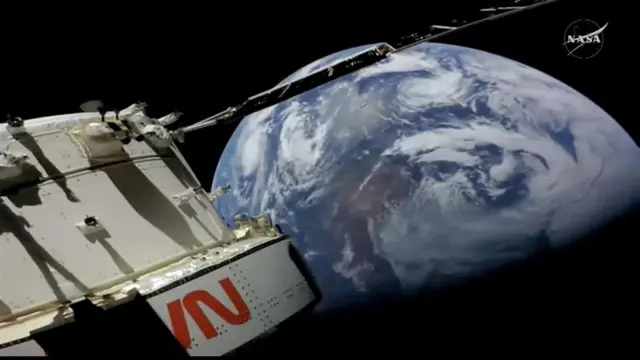 Image source, NASA
At mission control we're watching the live views from the spacecraft.
The Earth looks sublime, growing larger and larger as the crew hurtles towards it. Home is very much in sight now for the Artemis astronauts.
Commander Reid Wiseman just commented on the beautiful sunrise over the coast of Australia.
Pallab Ghosh
Science correspondent
During re-entry there is usually a short “communications blackout”, but this isn’t a glitch – it’s a well understood piece of physics that actually helps engineers design safer missions.
As Orion ploughs into thicker air at several kilometres a second, the gas around it is heated so fiercely that it turns into plasma: a cloud of charged particles that wraps around the heatshield.
Radio waves from the capsule’s antennas have to pass through this plasma sheath to reach Earth. In certain frequency ranges, the dense, ionised gas behaves a bit like a high pass filter, absorbing or reflecting signals below a critical “plasma frequency”, so they can’t get out and the spacecraft appears to fall silent for a few minutes.
Understanding that process lets engineers shorten the blackout by adjusting antenna positions, using higher frequency links or experimenting with ways to thin or tweak the plasma around the vehicle.
 Shaimaa Khalil
LA Correspondent
 Image source, Shaimaa Khalil
Sara Gomez brought her two daughters to the watch party
The seats and the big screen are all set as space enthusiasts start gathering at the Columbia Memorial Space Centre in Downey, southeast LA for the watch party of the return of the Artemis ll.
One of the space center staff, Jared Head, is taking questions from space enthusiasts, about how long it’ll be for the spacecraft between entering the Earth’s atmosphere and splashdown; how hot the surface will be; and whether the team inside would feel any of the heat.
“The astronauts won’t, the heat shield definitely will,” Mr Head said. Families are here with their children, including a mother who brought her three-month-old baby to “tell him he was here!”
Sara Gomez, 42, brought her two daughters Lexi, 11, and Riley, 8. “This is something that doesn’t happen everyday,” Sara said.
“This is almost miraculous - it’s taken a lot of people , a lot of time and a lot of money - and they can tell their kids when they get older that they experienced it live.”
Rebecca Morelle
Science editor
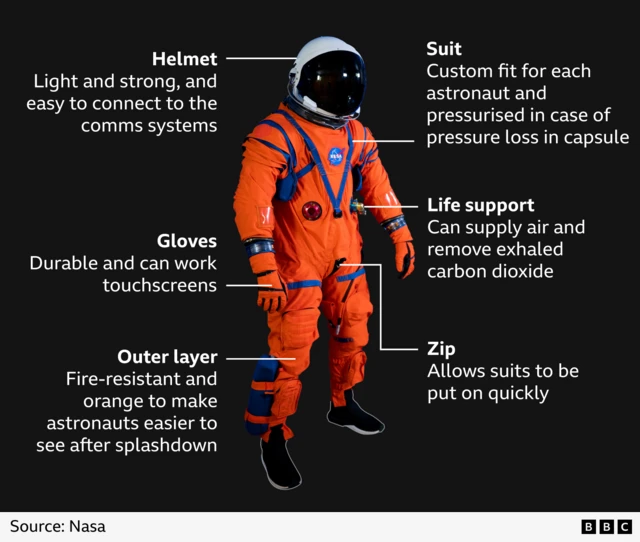
The astronauts are now wearing their bright orange spacesuits, called the Orion Crew Survival System (OCSS).
These suits are worn to protect the crew during launch and re-entry, and also act as vital protection if there is a problem with the capsule.
The suit is pressurised with inbuilt life-support systems.
The bright colour means the astronauts are easy to spot after landing - and equipped with a flashlight, mirror, whistle and light sticks in case the astronauts need to signal where they are after landing.
Rebecca Morelle
Science editor
After their epic journey, it’s time for the astronauts to come home.
And it will be quite a ride as they plunge through the Earth’s atmosphere.
But this is the first time humans have flown in the Orion capsule, so no-one knows exactly what their experience inside it will be like.
We do know they are coming in much faster and hotter than astronauts returning from the International Space Station.
The team here have calculated the crew will experience about 3.9 Gs, so they’ll feel about 3.9 times heavier than they do on Earth. The sensation is like being pushed back into their seats.
And while temperatures outside are super hot, inside they astronauts should stay comfortable, protected by their heatshield.
Howard Hu, Orion’s programme manager, said he can’t wait to speak to the crew when they return to find out how the re-entry felt.
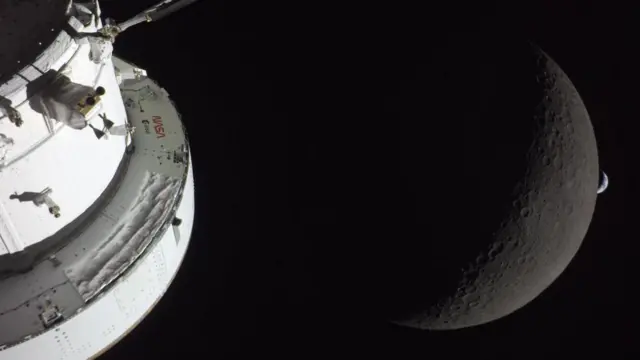 Image source, Nasa
The Orion spacecraft seen in front of the Moon and Earth
The journey back to Earth for the Orion crew is a process involving numerous manoeuvres, ultimately culminating in the astronauts splashing down in the Pacific Ocean.
Here's a look at the upcoming schedule:
Rebecca Morelle
Science editor
The Artemis astronauts have travelled further than any humans have ever flown from Earth. They’ve flown a whopping 252,756 miles (406,771km), exceeding Apollo 13’s distance record by more 4,100 miles (6,600 km).
But they won’t break the record for the fastest re-entry through the Earth’s atmosphere. That’s still held by the Apollo 10 crew, who screamed back to Earth at 24,791mph (39,897km/h).
Nasa calculations put the Artemis crew’s re-entry at 24,661mph (39,688km/h) - just 130mph slower. So it’s not record breaking - but still incredibly fast, more than 30 times the speed of sound.
To put this into perspective, astronauts returning home from the International Space Station come in at speeds of about 17,500mph (28,163kmh).
 Peter Gillibrand
BBC Newsbeat
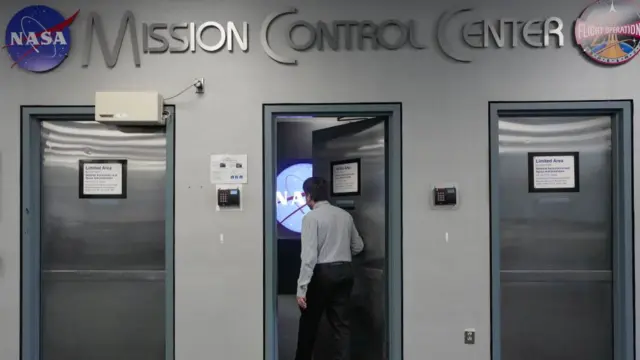 Image source, Getty Images
As Nasa's Lyndon B. Johnson Space Centre in Houston prepares for splashdown, we're hearing the vibes are “pretty awesome”.
That's from Antonia Jaramillo, who works for Nasa.
"We are eagerly awaiting them to make sure they return home safely," Jaramillo tells BBC Newsbeat.
She compares the atmosphere to a big sports match.
"It's always going to be a little bit nerve-wracking, but in the best way,” she says.
Jaramillo thinks people will start to relax when the parachutes are deployed in splashdown.
"The big celebrations, that big sigh of relief, the cheering, the whooping, the high fives, the hugs, everything is going to happen once Orion is down on Earth and we have that crew back on land,” she says.
On the significance of the mission, Jaramillo explains: "This is not just for Nasa. Not just for our international partners. Not just for America. But for everyone. For the next generation too, of space explorers."
 Joe Coughlan
Live reporter
The Artemis II mission has had no shortage of memorable moments. Not only collecting images never seen before, but also the crew's messages back to Earth.
'Sights no human has ever seen'
The astronauts described the "spectacular" scale of the beauty in space several times, with commander Reid Wiseman telling US President Donald Trump: "We saw sights that no human has ever seen, not even Apollo, and that was amazing for us."
A touching tribute
Mission specialist Jeremy Hansen shared a poignant moment, when he and the crew named one of the Moon's craters after Wiseman's late wife Carroll. He said to mission control: "A number of years ago we started this journey... and we lost a loved one," adding at certain times in future the crater will be seen from Earth.
Emotional crew names Moon crater after commander's late wife
A space plumber who sleeps like a bat?
Christina Koch became Orion’s self-appointed "space plumber" following issues with the capsule's toilet. She said: "I like to say that [the plunger] is the most important piece of equipment in space."
Koch also drew attention from the rest of the crew for "sleeping like a bat" during the rest periods, according to Wiseman.
‘We love you from the Moon’
Shortly before the crew began their flyby around the far side of the Moon, and a 40-minute break from communications with Nasa, pilot Victor Glover sent out a touching message to those listening from Earth.
"To all of you down there, we love you from the Moon."
 Jacob Phillips
Live reporter
Over ten ground-breaking days, the crew of Artemis II have broken a record, seen the far side of the Moon and fallen victim to a broken toilet.
Before the spacecraft splashes down in the Pacific Ocean in the next few hours, here's a moonwalk back through the mission:
First, liftoff.
Artemis II began its journey on 1 April with a dramatic blast off from Florida - watch that moment below:
Day two saw the crew fire the spacecraft's main engine - sending the Orion capsule out of Earth's orbit and on track for the Moon.
Once they were on the right flight path, the four astronauts prepared for a lunar flyby, bracing for 40 minutes of no contact with Earth as they circled behind the Moon.
The history-making moment came on day five of the mission, when the crew were further away from Earth than any human had ever been before.
During their historic moment, the crew photographed its craters, ridges and signs of ancient lava flows.
They also witnessed a solar eclipse as the spacecraft, the Sun and the Moon aligned.
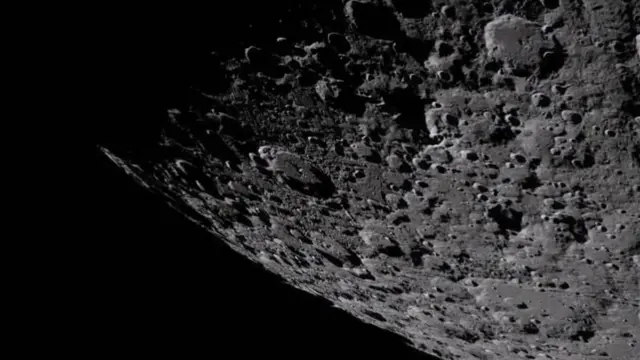 Image source, NASA
Craters, ridges and a view of the Moon unseen by human eyes - until now