Summary

  1. Wiseman extracted and Koch and Glover touch downpublished at 02:58 BST 11 April

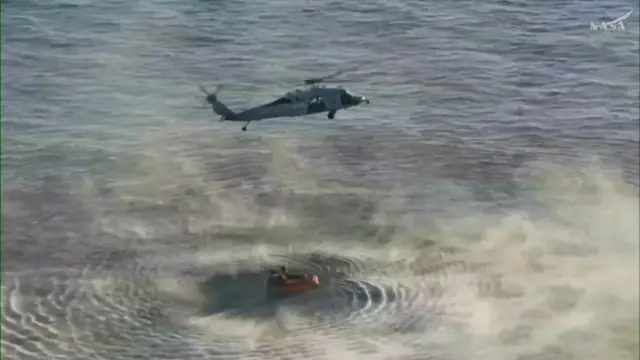
    Reid Wiseman is on his way back to the USS John P Murtha with his fellow astronauts, having been hoisted off the front porch.

    The first helicopter has touched down, carrying Christina Koch and Victor Glover.

  2. Crew hoisted off the front porchpublished at 02:54 BST 11 April
    Breaking

    Rebecca Morelle
    Science editor

    As if a white-knuckle ride of a 24,000mph re-entry through the Earth's atmosphere wasn't enough, there's one last adventure to go as the crew are airlifted one by one back to the recovery ship where they will undergo medical checks.

    A helicopter above the Orion crew of the Artemis II mission, ready to extract themImage source, NASA
    Image caption,

    The helicopter approaches the Orion crew

  3. Wiseman joins his fellow crew members on front porchpublished at 02:37 BST 11 April

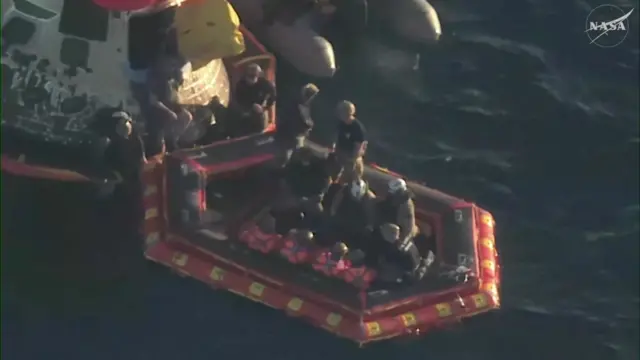
    The crew of the successful Artemis II mission seen sitting on the front porch, with various rescue personnel around them.Image source, Nasa
    Image caption,

    The crew of the successful Artemis II mission seen sitting on the front porch

    Commander Reid Wiseman has now exited the Orion module, shortly after the third crew member left the spacecraft.

    All the astronauts are now waiting on the front porch to be escorted by two Navy helicopters.

  4. Crew begin exiting Orion modulepublished at 02:33 BST 11 April
    Breaking

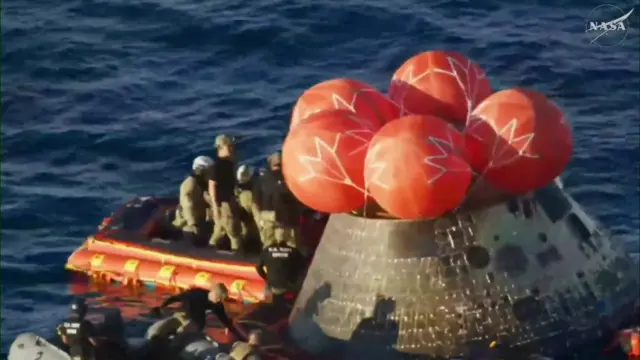
    The first two members of the Orion crew have exited the module.

    Applause can be heard from the Houston control room as the silhouettes of the astronauts and rescue personnel are visible on the rescue boats.

    Rescue personnel standing on the front porch assist the Orion crew out of the module, both stationed in the Pacific OceanImage source, Nasa
    Image caption,

    Rescue personnel assist the Orion crew out of the module

  5. Flight controllers await crew exitpublished at 02:32 BST 11 April

    Hundreds of flight controllers are in the Houston control room, eagerly awaiting the crew's exit from the Orion module.

    The flight controllers have been invited to the room to share in the "mutual glow" of the successful mission.

    Nasa says things continue to go "nominally" with the astronauts' extraction, meaning as expected.

    Flight controllers stand around chattingImage source, Nasa
  6. Nasa confirms crew are 'green' following initial assessmentpublished at 02:20 BST 11 April

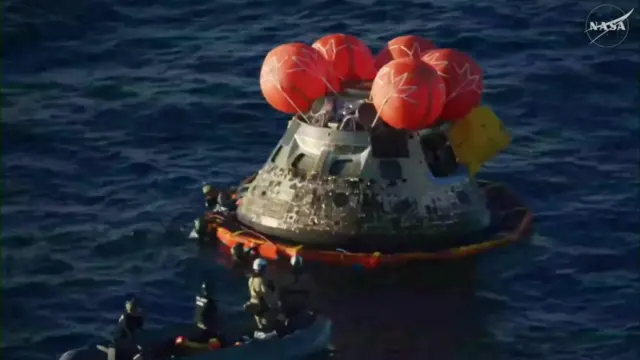
    The stabilisation ring is secured to the Orion module, with various rescue personnel stationed around the spacecraftImage source, NASA
    Image caption,

    The stabilisation ring is secured to the Orion module

    A medical officer inside the Orion capsule confirms all four members of the crew are green.

    "Green, meaning they are feeling great, not the complexion of their skin," jokes Megan Cruz, speaking on behalf of Nasa from the USS John P Murtha, where the astronauts will be taken shortly.

  7. Astronauts sit in 'waiting room' before boarding helicopters, says Navy diverpublished at 02:15 BST 11 April

    A stabilisation collar is attached to the Orion module to keep it steady in the Pacific while the astronauts are recovered, according to a US Navy diver.

    In a pre-recorded interview, David McMahan says the collar is used because "we don't know how good the weather or the waves will be on that day".

    After the collar is secured, the "front porch" is attached.

    This is described by McMahan as a "waiting room" for the astronauts to sit in before helicopters escort them away.

    Nasa says currents are currently "hindering" personnel from inflating the collar and front porch.

  8. Trump welcomes astronauts homepublished at 02:08 BST 11 April

    US President Donald Trump has just posted on social media welcoming the crew members home to Earth and inviting them to the White House.

    Here is the president's message in full:

    "Congratulations to the Great and Very Talented Crew of Artemis II. The entire trip was spectacular, the landing was perfect and, as President of the United States, I could not be more proud! I look forward to seeing you all at the White House soon. We’ll be doing it again and then, next step, Mars!"

  9. Side hatch opens as personnel enter modulepublished at 02:00 BST 11 April

    The side hatch of the Orion module is now open, with one of the Navy personnel having entered the spacecraft.

    Four personnel are due to enter the module, which Nasa describes as "a little bit of a tight squeeze".

    This is to allow each astronaut to have an individual assessing them.

    Nasa has said there is "no rush" to get the crew out, with the priority being their safety.

  10. Recovery personnel engage Orion modulepublished at 01:53 BST 11 April

    Joe Coughlan
    Live reporter

    Rescue personnel seen alongside the Orion spacecraft in the Pacific OceanImage source, NASA
    Image caption,

    Rescue personnel alongside Orion

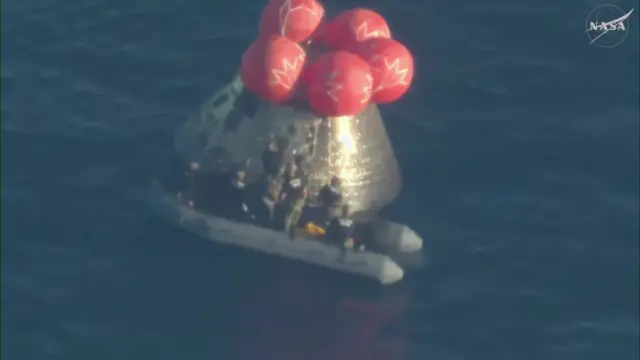
    The first team of recovery personnel have pulled up alongside the module.

    The individuals on the boat have trained for years for this moment.

    Nasa also confirms that the Orion spacecraft has been powered down and that no hazardous gas is emanating from it, allowing the recovery crew to engage with the module.

  11. From temperamental toilets to a solar eclipse: a look back at Artemis IIpublished at 01:50 BST 11 April

    Rebecca Morelle
    Science editor

    We've followed these astronauts on every mile of their epic journey.

    From seeing them blast off at launchpad 39b at the Kennedy Space Center in Florida, to moving to mission control in Houston, to watching them head to the Moon and back home.

    With much of their journey live streamed, it’s felt like the world has been able to ride alongside them.

    We’ve witnessed their magnificent views of the Moon - and who can forget that solar eclipse. But there have been more mundane matters too - like their faulty Universal Waste Management System, aka their temperamental toilet.

    Landing was the riskiest moment, and you could almost feel the team here in Houston willing them to get down safely.

    But they are now back on Earth - phew! - and ready to take their first breaths of fresh Earth air.

  12. Mission length totals just over nine dayspublished at 01:47 BST 11 April

    Nasa has confirmed the time of splashdown was 19:07:27 CDT (20:07:27 EDT, 01:07:27 BST).

    This brings the total length of the mission to nine days, one hour, 32 minutes and 15 seconds.

    Not bad for a round trip to the Moon.

  13. 'Back in the business of sending astronauts to the Moon', Nasa boss sayspublished at 01:46 BST 11 April

    Tiffanie Turnbull
    Live reporter

    A very excited Jared Isaacman - the Nasa Administrator - was on-air a moment ago describing how watching this mission crew splash down had left him lost for words.

    "Childhood Jared right now can't believe what I just saw."

    "This is just the beginning," he added.

    "We are back in the business of sending astronauts to the Moon, bringing them back safely."

  14. Recovery team due to approach crew shortlypublished at 01:39 BST 11 April

    Joe Coughlan
    Live reporter

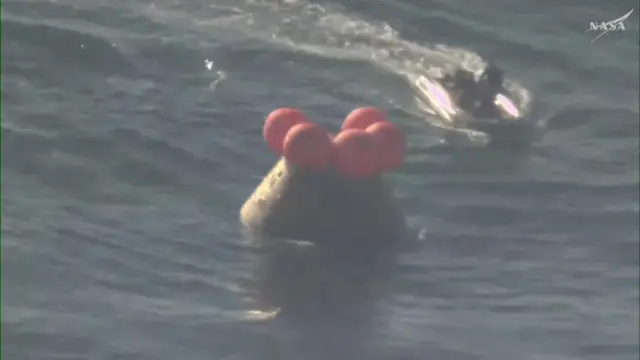
    The recovery team will shortly be approaching the Orion module.

    From then, the "front porch" inflatable raft will be deployed - which allows the crew to move out of the spacecraft.

    Two Navy helicopters will be waiting for the crew, with two astronauts due to be carried away in each vehicle.

    The Orion module in the Pacific Ocean with a small raft approaching it.Image source, NASA
    Image caption,

    A recovery boat beside the Orion module

  15. Crew in 'excellent shape' after 'textbook touchdown'published at 01:28 BST 11 April

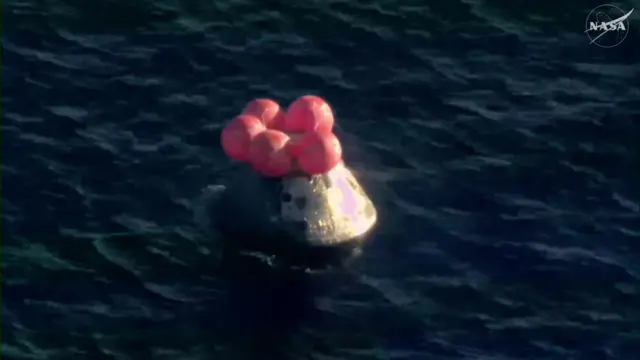
    The Orion spacecraft in the Pacific ocean, which is in a dark blue colourImage source, Nasa
    Image caption,

    Orion seeing in the Pacific after its splashdown

    “What a journey," Artemis II commander Reid Wiseman said as the crew splashed down.

    "We are stable one, four green crew members,” he said, describing the capsule's position and the health of his team.

    There's been a communications problem with the crew since, but Nasa has called their return a "textbook touchdown".

    In a livefeed, an announcer can be heard saying the four astronauts are "in great condition".

    "They're all in excellent shape."

  16. Crew and control team coordinate recovery team approachpublished at 01:23 BST 11 April

    Joe Coughlan
    Live reporter

    The Orion crew are coordinating with the flight control team in Houston to determine the timing of the power down to allow the recovery teams to approach.

    Nasa confirms there are no issues with the spacecraft but there are some difficulties in establishing satellite phone communications between the crew and the recovery team - but this is said to be resolved shortly.

  17. What it feels like as the capsule hits the waterpublished at 01:17 BST 11 April

    Helen Sharman
    The UK’s first astronaut

    Splashdown itself is over in an instant – but my body still remembers it. As we came down, I was strapped in, almost lying on my back, braced for the final jolt. We had warning it was coming, with a countdown on our systems, but even so I definitely felt the bump.

    The capsule slammed into the sea harder than I’d expected, then rocked and bobbed as the waves grabbed hold. After the controlled violence of re-entry, that motion felt surprisingly unsettling. My inner ear, rewired by weightlessness, struggled to make sense of the sudden lurching and tilting.

    It was a bit like standing up too quickly when you’re not well – your head feels floaty and you’re not quite sure which way is up. That’s why you sit tight at first, strapped in, letting your senses catch up before the hatch opens and you try to move.

  18. Celebrations at space center as Artemis splashes downpublished at 01:13 BST 11 April

    Regan Morris
    BBC reporter

    People clap hands and cheer

    They’re chanting “Artemis” here at the Columbia Memorial Space Center.

    The crowd is clapping and screaming every step of this mission. It’s standing room only with about 600 people packed in viewing in various rooms and levels.

  19. What happens now after splashdownpublished at 01:09 BST 11 April

    Pallab Ghosh
    Science correspondent

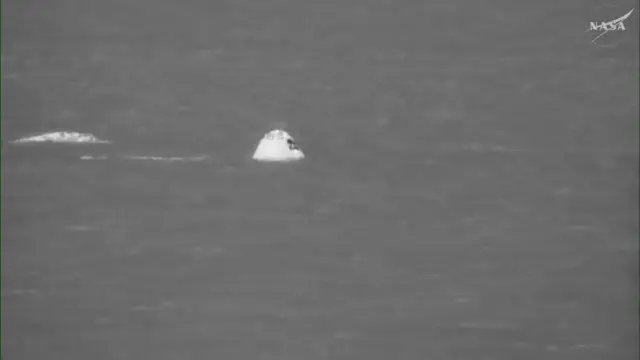
    The Orion capsule seen in the Pacific Ocean, highlighted in bright white against the ocean's grey colour through a thermal camera effectImage source, NASA
    Image caption,

    Orion shortly after splashdown

    Splashdown confirmed. Orion is down. The capsule struck the Pacific Ocean off San Diego at approximately 20mph — and the Artemis II crew have survived. Twenty miles per hour sounds manageable. It is not. Water does not compress. When Orion hit the surface, the impact was a sharp, hard thud.

    Astronauts who have experienced it describe the water as a solid wall rather than a yielding medium. After that, the capsule bobs and pitches in the ocean swell, and the crew — having spent 10 days in microgravity — will feel every movement with unusual intensity.

    The five orange airbags around the capsule's base will have activated automatically, keeping Orion upright and stable.

    Navy divers from Explosive Ordnance Disposal Group 1, who have been circling in inflatable craft, are already approaching.

    MH-60S Sea Hawk helicopters from HSC-23 are overhead. There is a strict protocol now. The capsule is still hot from re-entry, potentially outgassing. Every step of the extraction follows a carefully rehearsed sequence developed over years of testing and two Artemis I recovery drills.

    The crew will not be rushed out. Divers will assess the air and water around the capsule before anyone opens the hatch.

    Inside that capsule, four human beings are hearing the waves for the first time in 10 days.

  20. Crew splash down in Pacificpublished at 01:08 BST 11 April
    Breaking

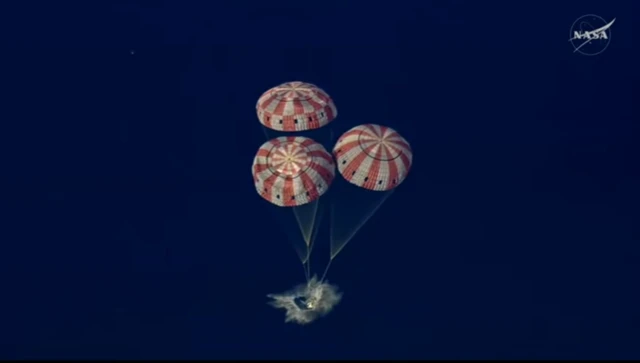
    Orion has splashed down in the Pacific Ocean, completing the crew’s journey of 694,481 miles (1,117,659km) to the Moon and back.

    Orion crew splashdown in Pacific Ocean, with the three main parachutes visible aboveImage source, NASA
    Return to the latest post