Is this the beginning of the end for LIV Golf?
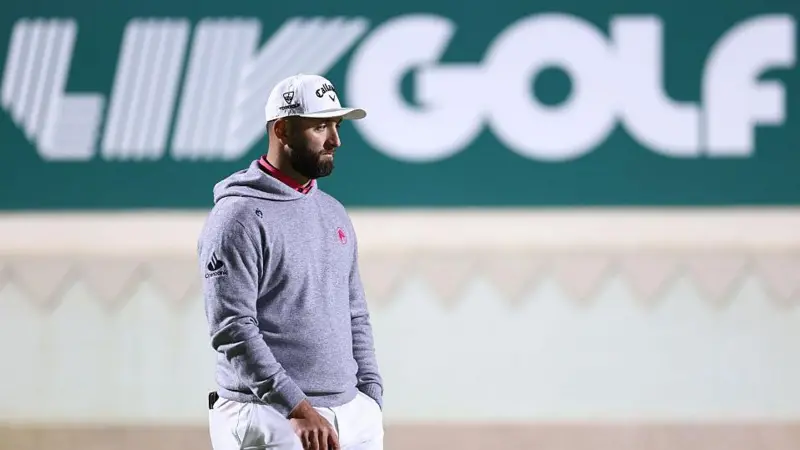
Two-time major champion Jon Rahm's switch to LIV Golf in 2023 was a seismic moment for the sport
- Published
LIV Golf was supposed to be the breakaway tour that changed golf as we know it.
Little over four years ago, LIV threw wads of money at a host of star names and shook the sport to its core with its promise of revolution.
Now, with speculation intensifying that Saudi Arabia's Public Investment Fund (PIF) is set to pull financial support, the future of a tour which has relied on more than $5bn (£3.7bn) from the Gulf state looks to be in severe doubt.
Named after the Roman numerals of its rebellious 54-hole concept, LIV certainly managed to disrupt the status quo.
But it didn't produce the swift, conclusive victory - over the PGA Tour and DP World Tour - that those behind the breakaway hoped.
And while LIV chiefs have bullishly insisted it is business as usual, senior figures in European golf have told BBC Sport they believe LIV will not continue past this year.
So where does it go from here? What happens to superstar players including Jon Rahm who were lured to LIV? And is this a clear sign that Saudi Arabia, which has pumped cash into several sports, is tightening its spending?
Does LIV have the money to continue?
Discussion about LIV's future went into overdrive on Wednesday as the tour prepared for its latest event in Mexico.
Several media outlets - across golf, sports news and finance - reported its imminent closure, before LIV chief executive Scott O'Neil insisted it was business as usual in a tubthumping email to staff.
"Our season continues exactly as planned, uninterrupted and at full throttle," O'Neil wrote.
It was striking O'Neil only spoke about 2026 and did not address what might lie ahead.
Players were told last month that funding was in place until 2032 but well-placed figures in European golf have told BBC Sport they believe PIF is withdrawing its financial support.
One source said he fully expected 2026 to be LIV's last season and another felt its leadership was trying to convince itself other revenue could be found.
But many - as one summarised - think it may fall apart quickly.
The LIV project, which pivoted to a more traditional 72-hole format this year, has been bankrolled by an eye-watering amount of money from PIF.
The overall investment surpassed $5bn (£3.8bn) when fresh capital of $266.7m was injected earlier this year., external
The tour's net losses in markets outside the US increased to $462m (£340m) in 2024, meaning it had lost more than $1.1bn (£810m) since it was established in 2021.
With vast amounts of money pumped into the US arm of the operation, losses look likely to run to several billion dollars.
"If there is no PIF funding, there is a real question of whether they are viable given the losses," one of the European sources added.

Australia's Cameron Smith was the star attraction at the LIV Adelaide event, which organisers say attracted a tournament-record 115,000 fans
O'Neil said earlier this year the tour would not be profitable for another 5-10 years.
On Thursday, a LIV source told BBC Sport that four of its 14 events would be profitable in 2026, along with 10 of its 13 teams.
It also said a revenue increase of $100m (£74m) after its first five events of the year, compared to the same period in 2025, painted a positive picture.
It remains a low return for the huge investment.
Money brought in from sponsorship deals with global brands was said to have increased 40% year on year, while revenue from ticket sales (130%), hospitality (67%), merchandise (26%) and YouTube content (303%) also improved.
The source only provided percentage figures and not amounts of revenue.
In January, LIV executive Katie O'Reilly said the organisation was continuing to lay a platform for growth through driving sponsorship revenue.
"Our goal is to build 13 billion-dollar franchises," said O'Reilly, who is LIV's executive vice-president of team business operations.
"That is our goal. Are we there yet? No. But right now we are building the foundation for that."
Is there a way out for Rahm and other LIV stars?
If LIV does fold, the routes back to the PGA Tour and DP World Tour are varied.
Returning to either tour requires eating a slice of humble pie and, for some, paying a fortune to sweeten the deal.
LIV's credibility as a major force capable of challenging the long-established tours was underpinned by signing several huge names on multi-million deals.
Persuading major champions at the peak of their powers - Brooks Koepka, Cameron Smith and Bryson DeChambeau - was complemented by the additions of European titans Ian Poulter and Lee Westwood.
In 2023, there was an even bigger statement. Rahm - then the Masters champion and fresh from helping Europe win the Ryder Cup - was lured over. A year later, Tyrrell Hatton followed suit.
In February, Rahm, Smith and DeChambeau turned down a one-time opportunity to apply for reinstatement to the PGA Tour under its 'Returning Member Programme', which was facilitated for those who had won a major - or The Players Championship - since 2022.
Five-time major winner Koepka was the only player to take up the offer and smoothed his return by paying fines said to be worth about £63m.
It remains unclear if LIV's potential demise would see that path reopened, and what terms might be issued.
Shortly after Koepka's decision, 2018 Masters champion Patrick Reed, who did not fulfil the criteria, also decided to leave LIV.
Reed has been playing on the DP World Tour this year - winning two tournaments and leading the Race to Dubai seasonal standings - while knowing he can return to the PGA Tour in 2027 once a year has passed since his last LIV appearance.
He has, essentially, taken his medicine. Others might have to do the same.
Rahm continues to be in dispute with the DP World Tour after rejecting its terms to remain a member, meaning he would have to pay a fine and serve a suspension.
The same would apply to Westwood and Poulter, who resigned from the tour in order to avoid the fines.
Hatton would be permitted to play full-time on the tour because he was one of eight players who paid the fine imposed and agreed to a series of other conditions.
The 34-year-old Englishman, who finished tied third at the Masters last week, was joined by Laurie Canter, Thomas Detry, Tom McKibbin, Adrian Meronk, Victor Perez, David Puig and Elvis Smylie in agreeing a deal.
Is PIF tightening the purse strings?
In January, a senior source in Saudi Arabia told BBC Sport that towards the end of last year there was "a shift" in the kingdom's attitude towards some investments, with "everything in the PIF world under serious review".
The change in the strategy - with an emphasis on more sustainable investments - came after a major budget deficit of $73bn last year, which was driven by increased spending and lower oil revenues.
This position also appears to have been accelerated by the Iran war, which has caused severe disruption to Saudi Arabia's oil exportation.
But the Gulf state remains committed to other expensive projects.
Plans to build Neom Super City - a futuristic, carbon-free metropolis - may have been scaled down, but the vision remains the same.
Hosting the 2034 World Cup means constructing up to 15 new stadiums, as well as a significant airport expansion to accommodate the hundreds of thousands of visitors.
There was no mention of LIV Golf - or sport specifically - when PIF announced its 2026-2030 strategy on Wednesday.
But the message was clear: there will be a more savvy approach to its spending.
"The new plan suggests PIF is no longer willing to keep pumping resources into projects that offer little prospect of profitability," Dr Kristian Ulrichsen, who shapes policy and provides analysis on the Middle East at the Baker Institute in the US, told BBC Sport.
"The perception that resources - and ambitions - were limitless has given way to a more realistic assessment of what is feasible in a more constrained financial environment.
"That predated the war with Iran and has been under way for more than a year."
This tone - and the discussion about LIV Golf's future - has inevitably led to discussion about other international sports which have relied on huge sums of Saudi cash, such as boxing, F1, tennis and even teams like the Premier League football club Newcastle United.

Brazil superstar Neymar was one of the most high-profile transfers to the Saudi Pro League when he joined Al-Hilal in 2022
Domestically, there is further evidence of a subtle shift of strategy.
The Saudi Pro League has lured many high-profile players in recent years - most notably Cristiano Ronaldo - by offering lucrative contracts and paying substantial transfer fees.
The PIF fund has owned a 75% stake in four clubs - Al-Hilal, Al-Nassr, Al-Ahli and Al-Ittihad - since 2023.
On Thursday, PIF announced it had sold 70% of Al-Hilal's share value, which it said is worth £275m, to publicly listed Saudi investment firm Kingdom Holding Company (KHC).
A source close to PIF said the move should not be seen as a sign of any lessening in interest in sports investments.
"This is not to say that PIF or Saudi Arabia is pulling out of sports investment but that the authorities are having to prioritise the allocation of resources more carefully," added Dr Ulrichsen.
"It is likely that PIF and the Saudi state will prioritise the World Cup going forward, at the expense of other sports projects, including LIV Golf."
What next for LIV?
The proof of whether it is "business as usual", as O'Neil suggested, will be seen when the Mexico event gets under way on Thursday.
Spain's Sergio Garcia - captain of the Fireballs team - said on Wednesday that players had been told earlier this year that the tour would run for "many years".
Players are likely to be asked questions after Thursday's rounds.
Mexico is the sixth tournament of LIV's 2026 season, following events in Saudi Arabia, Australia, Singapore, Hong Kong and South Africa.
The remaining nine - including two events at Donald Trump-owned courses in the United States, and one at the JCB Golf and Country Club in the UK - are set to take place over the next four months.
Beyond that, only time will tell what the future holds for LIV.