Full programme transcript >> Full programme transcript >>
Prescriptions
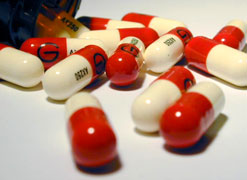
About 1.3 million paper prescriptions are issued every working day in England, and over two thirds of these are for repeat medicines.
In this episode of Case Notes Dr Mark Porter looks at all aspects of prescribing drugs, from the politics of compliance and prescription charges, to solutions to the age-old problem of reading doctors' bad handwriting.
Mark visits the Bristol Royal Infirmary to find out how a new high-tech robot will help the hospital deal with prescriptions more accurately and safely. The robot can also dispense drugs more quickly than humans, leaving pharmacists free to focus on the patients.
Mark also discovers the history of prescriptions, and deciphers the Latin abbreviations that are still written on them today. Briony Hudson of the Royal Pharmaceutical Society's museum has produced an information sheet which helps historians to unravel the mystery that doctors and pharmacists deliberately cloaked prescriptions in.
Nowadays, even though the language used on prescriptions is clearer, a doctor's poor handwriting can sometimes mean that the wrong drug, or the wrong dose is dispensed. Mistakes are less common now that many GP's practices use printed prescriptions - as long as the doctor presses the right buttons in the first place!
However, getting the correct medicine to the patient is sometimes only half the battle. The issue of non-compliance, where a patient doesn't follow their prescription properly, is a big concern for many doctors. According to recent reports, 15% of prescriptions are not taken to the pharmacist and another 25% of patients do not take their drugs well enough to get any medical benefit. Mark asks why.
From 2007 prescriptions will be free to everyone in Wales - Mark finds out why the Welsh Assembly took the decision, and asks if the English, Scottish or Northern Irish authorities will ever follow suit.
|





 30 min