Summary

  • The Artemis II crew members have detailed their experiences from the historic 10-day mission around the Moon

  • Mission commander Reid Wiseman says when the Sun eclipsed behind the Moon it was "otherworldly", and they have found it hard to "fully grasp" what they've been through

  • Pilot Victor Glover says when they splashed down into the ocean after returning to Earth it was like diving "off a skyscraper backwards"

  • Mission specialist Christina Koch says she's woken up from dreams thinking she is floating since returning to Earth, and was surprised when she held a shirt up and it just fell on the floor

  • Specialist Jeremy Hansen says the public reaction since their return has brought him joy and hope for the future

  • They began their mission on 1 April, blasting off from Nasa's Kennedy Space Center in Florida, and viewing previously unseen parts of the Moon

  • The goal of the Artemis missions is to eventually return humans to the lunar surface, to establish a permanent presence there, and to send the first astronauts to Mars

  1. Echoes of the Apollo 8 missionpublished at 20:59 BST

    Pallab Ghosh
    Science correspondent

    Watching the Artemis II crew from launch to splashdown to today's press conference, I keep thinking back to another lunar fly‑round in a very different age.

    In 1968, Apollo 8 was officially a test flight, sent to check out navigation and communications ahead of the first Moon landing. For many in my generation, it became something much bigger.

    That mission gave us Earthrise: the first colour photograph of our planet, a jewelled blue marble hanging in the blackness above the grey lunar surface.

    It helped kick‑start the modern environmental movement and made people feel, perhaps for the first time, that the Earth was fragile and needed friends.
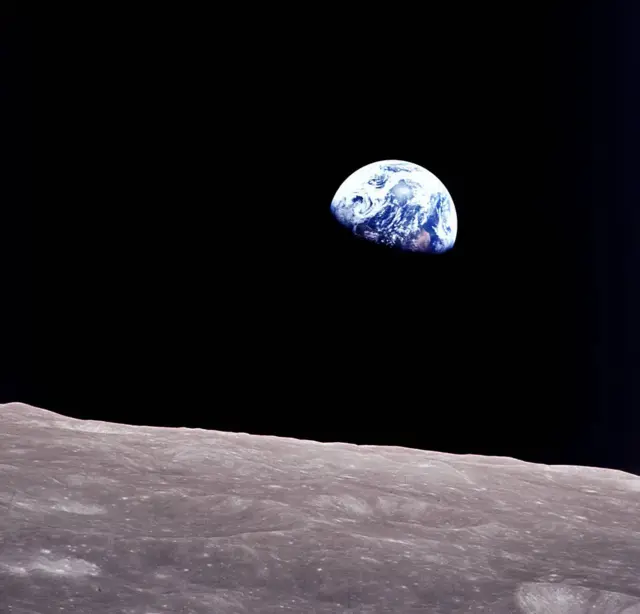
    Sun lights up two-thirds of the earth surface as it floats in space aboce the grey surface of the MoonImage source, NASA
    Image caption,

    Earthrise over the lunar landscape

    Apollo 8’s crew read from the Book of Genesis on Christmas Eve and closed with a blessing “to all of you on the good Earth”, as one quarter of humanity listened.

    They were speaking into a year marked by the Vietnam war and the assassinations of Martin Luther King and Robert Kennedy – a world that felt wretched to many adults, even as children like me were simply transfixed by the Moon on television.

    Today, the parallels are hard to miss: a planet riven by conflict, environmental crisis and political division. Artemis II is again a loop around the Moon, again at a time when the news is often bleak.

    In 1968 it was the astronauts that gave us hope of a better future. Perhaps the words from the next generation of lunar explorers can give us an echo of that hope and inspiration.
  2. Superlatives are great, but team matters more, Koch advises future first woman on the Moonpublished at 20:39 BST

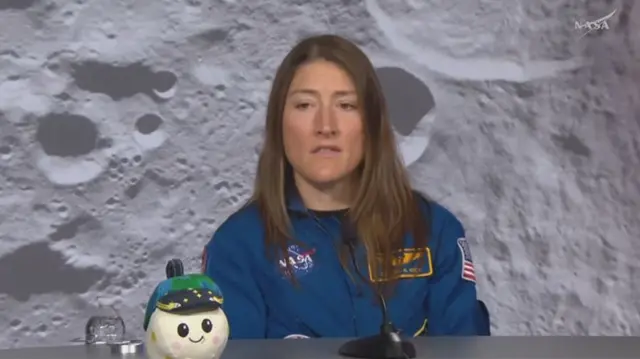
    Christina Koch speaking in front of a microphone, wearing a blue NASA outfitImage source, Reuters

    Christina Koch has more words of advice, this time for whoever becomes the first woman to walk on the moon in the future.

    Koch answers that being a superlative is humbling, but being part of a team is the main goal, and that should be put ahead of anything else.

    "When the world tries to make the accomplishment something different than what it really is, which is a team accomplishment, you will know, and the things that you say will reflect how you really see it," she says.

    With that, the press conference concludes.

  3. A word of advice for the next Artemis astronautspublished at 20:36 BST

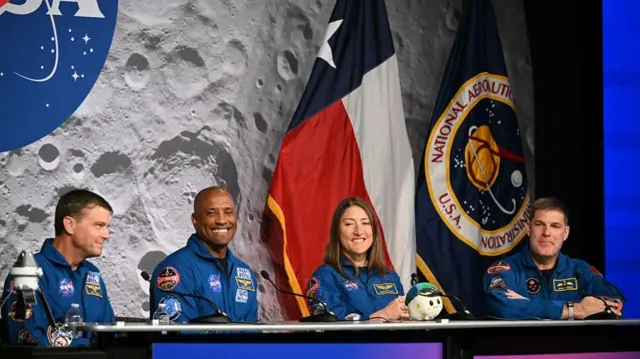
    (L-R) NASA's Artemis II mission astronauts, commander Reid Wiseman, Victor Glover, Christina Koch and Canadian Space Agency's Jeremy Hansen attend a press conference at Johnson Space Center in Houston,Image source, AFP via Getty

    A journalist asks what advice the astronauts have for the future Artemis crew who will land on the Moon.

    Reid Wiseman says "you have got to invest in each other" and Victor Glover says "ask more questions".

    Christina Koch tells future astronauts to "remember you are part of a team" and to "say congratulations" to the whole team every day.

    "You're probably the last one that got added to this team," she says.

    Jeremy Hansen goes technical with his answer, saying future astronauts should get to know parts of the spacecraft really well in case "you end up alone".

  4. 'A very smooth ride' back down to Earthpublished at 20:34 BST

    Artemis II came back to Earth hot, reaching temperatures about half that of the sun.

    Mission commander Reid Wiseman is asked how the craft's heat shield fared on reentry.

    He says they still need to see what Nasa says.

    "We came in fast, we came in hot and I would tell you looking out the window, that whole way in, it was a very smooth ride," he says.

    After their landing, the crew looked at the heat shield and it "looked wonderful to us," he says.

  5. Astronauts share their ideas for a potential Artemis moviepublished at 20:32 BST

    A Hollywood movie about Artemis? The astronauts are asked about that possibility - and what aspects of the mission would be the most important to get right.

    Glover says it would have to be a series, not a movie, because there's so much to cover.

    Koch says it would be important to convey "how much it meant to us to bring everyone along with us, and how much it meant to us to hear that the mission had an impact" on the world.

  6. Post-mission medical care is 'important', Glover sayspublished at 20:30 BST

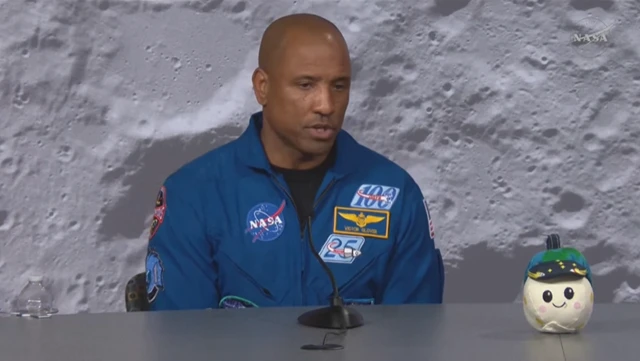
    Victor Glover speaking in front of a microphone, wearing a blue NASA outfitImage source, Reuters

    A reporter asks how much longer the astronauts will be in post-mission care and whether they have found it useful in recovering from their journey.

    Victor Glover takes this one, saying this was a short mission compared to a long stay on the International Space Station, for example, so the post-mission phase is not as long.

    He says, however, that "it is important for us to run these processes out" because they are learning and making changes for future, longer missions.

  7. Koch thinks a permanent base on the Moon is indeed possiblepublished at 20:27 BST

    Nasa has laid out its next steps - which is establishing some kind of permanent base on the Moon. The team is asked how realistic that goal is.

    Christina Koch says she thinks it's possible and is excited for what comes next.

    "There's just so many examples where we've shown that we can," Koch says. "All of the analysis that we do prior to missions, all of the talking that we do, all of the what ifs, just coming up with every possible operational work-around for anything you might encounter."

    She adds: "Accomplishing the near impossible is exactly what we do".

    Reid Wiseman adds that a lunar landing is not far off based on what he saw.

    "It's not the leap I thought it was," he says. "If you had given us keys to a lander, we would've taken it down and landed on the Moon... It is absolutely doable and it is doable soon."

  8. Artemis II 'flew like a dream', mission pilot sayspublished at 20:26 BST

    Next is a question on how the spacecraft worked compared to the simulator, and also compared to the SpaceX Dragon spacecraft, which Victor Glover previously piloted.

    Glover says this craft "flew like a dream", describing it as an "immense privilege".

    "The training worked, the team that came up with that plan was fantastic," he says.

    Reid Wiseman addresses the Nasa team. He says the first day was "daunting" but it "really reminded me that when you are extremely highly trained and very prepared you can go knock that thing out".

  9. Which space photo should end up on the next US Postal stamp?published at 20:23 BST

    The crew is asked which photo they would want to use if the US Postal Service wanted to make a stamp from the mission.

    Glover says his pick would be the picture of the Earth where you can see the Northern Lights.

    He adds that the crew isn't trying to take individual photo credits but says that specific picture was taken by Wiseman.

    "It was not the first try," he says. "He made the adjustments to the camera and got a great picture."

  10. If they had to fix one thing...published at 20:19 BST

    Asked whether there was anything on the spacecraft they'd improve, Wiseman says the toilet was wonderful and worked fine, but the vent line did get jammed at one point.

    Overall the spacecraft worked great and any issues were fixed quickly, like it being cold on the first couple days of the trip, he says.

    There are lots of nuances that were found along the way, and the team has started debriefing on how to improve things going forward, Wiseman says.

    You can read more about the astronauts' toilet trouble here.

  11. Christina Koch says more women and people of colour will 'naturally' go to spacepublished at 20:19 BST

    A reporter asks a question about Nasa prioritising sending women and people of colour to the Moon, a mission that Nasa laid out before 2025.

    That language has since been "removed from agency material", the reporter said, asking reporters whether they think Nasa should still adhere to that commitment.

    Christina Koch says her understanding of the statement is that the Artemis campaign as a whole "will usher in an era where that is true" and that it "would happen naturally".

    The astronaut corps, because of decisions made decades ago, "represents our entire country and our entire world in many ways", she adds.

    "You don't have to try too hard to make that come true... you'd actually have to try harder to not make that true in the astronaut corps that we have," she says.

  12. Psychologists helped the crew get mentally ready for spacepublished at 20:15 BST

    In between questions, mission pilot Victor Glover steps in to emphasise the importance of mental health. He says the crew had plenty of mental health support throughout the whole process.

    "We have a team of operational psychologists and psychiatrists that help us skill up to be ready to accomplish things like this," Glover says. "We did not do that on our own."

  13. There's not a lot of 'me time' in a small spaceshippublished at 20:14 BST

    The team is asked how they managed their mental health in space, and if they got any "me time".

    "Everything we did was a four person thing," Victor Glover answers. "It was a team effort."

    "When you're talking to your family, it did feel like being teleported out of the vehicle, but you teleported right back. And so we embraced that," Glover says.

    Reid Wiseman adds that the team got "exceptionally good at communicating" with each other.

    Media caption,

    Crew had no 'me time' in spaceship

  14. Astronauts share words of advice for young people who want to go to spacepublished at 20:14 BST

    A journalist asks about what advice the astronauts have for those "looking skywards" now and wanting to become astronauts.

    "We're starting to lose scope as a society that you have to go do things... really hard, really challenging things," Reid Wiseman says."Our hands and our minds have got to be engaged."

    Victor Glover encourages young people to "start now", and before they embark on a professional path, "to really get comfortable asking questions and then listening".

    "We have to rely on the wisdom of the village so much," he adds.

    Christina Koch replies "find what you can do the slowest for the longest and still absolutely love it", "do what scares you", and "support those around you".

    And Jeremy Hansen finishes up: "Don't do it alone... you need the support of others to do big things."

  15. Mission commander says he took a bracelet from his daughter to spacepublished at 20:12 BST

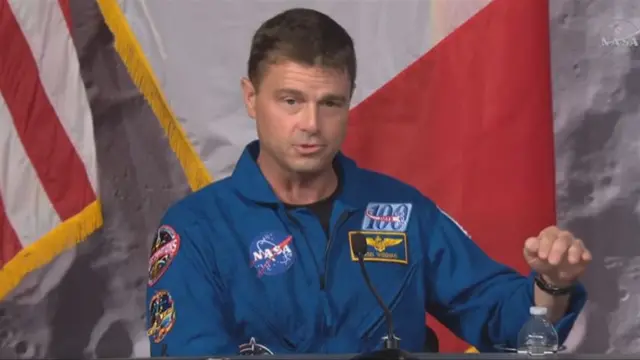
    Reid Wiseman speaking in front of a microphone, wearing a blue NASA outfitImage source, Reuters

    Reid Wiseman explains that each astronaut could take a "very small" allocation of items to space, and he took a couple of notes from friends and a bracelet made by his daughter.

    "It was the coolest thing for me to just be grounded every night when I would get in my sleeping bag," he says.

    Each crew member got two opportunities to speak to their families for 15 minutes during the mission, he says.

    "Nobody got through those things without crying", he adds.

  16. Landing in the ocean felt like jumping off a skyscraper, Glover sayspublished at 20:10 BST

    The astronauts are asked how it felt splashing down into the ocean after being in deep space.

    "I've never been base jumping, I've never been skydiving, but if you dove off a skyscraper backwards, that's what it felt like for five seconds," Victor Glover says. "And then the pilots and the mains came out, and it was glory."

    Return to the latest post
  17. View from space reinforces the need for people to work together on Earth, Hansen sayspublished at 20:08 BST

    Hansen gets another question, this time in French, about the physical and psychological changes he experienced.

    He explains that going to space has not changed his world view but instead "reinforced just the need for us to collaborate on this planet".

  18. Reaction to the mission has brought 'hope for our future', Hansen sayspublished at 20:04 BST

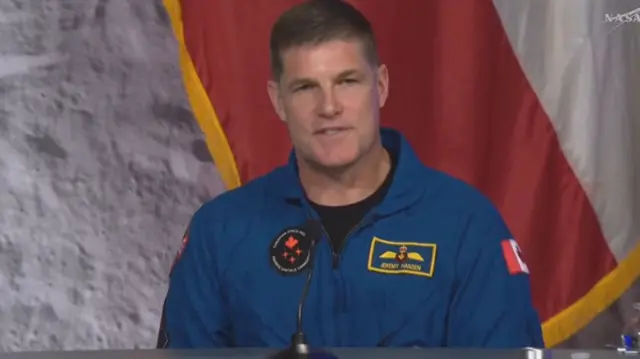
    Jeremy Hanson speaking into a microphone, wearing a blue NASA outfitImage source, Reuters

    A question comes from Canada to astronaut Jeremy Hansen, the only Canadian crew member on Artemis II.

    He is asked if there are emotions that have come to him and the crew since embarking on the mission.

    "I found it really refreshing to see how people have followed the mission," back on it, he says. "Humans are just great people...What I have seen has brought me more joy and more hope for our future."

  19. Fire alarm went off a day before landing on Earth, Wiseman sayspublished at 20:02 BST

    A reporter asks if the astronauts ever felt unsafe with minor challenges they experienced.

    Reid Wiseman says they were all very supportive of each other. There was some anxiety, but they managed it well when minor issues arose, like the fire alarm going off just a day before they landed back on Earth, he says.

    There are always things that need to be improved with the machinery, but they could launch Artemis III tomorrow and the crew would be fine, he says.

  20. Have the astronauts been dreaming of the Moon?published at 20:02 BST

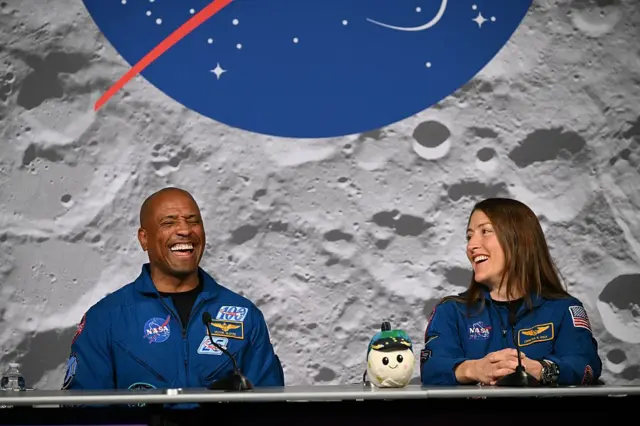
    Victor Glover (L) and Christina Koch (R) share a light moment during a press conferenceImage source, AFP via Getty
    Image caption,

    Victor Glover (L) and Christina Koch (R)

    Sleep has been a strange experience after returning from the Moon, the astronauts say. They're asked if they have been dreaming of the Moon.

    Christina Koch says she has been sleeping well, mostly out of exhaustion.

    "Every time I've been waking up or in the first few days, I thought I was floating... and I had to convince myself I wasn't," she adds.

    She says she was "actually surprised" when she held up a shirt one day and it fell to the floor instead of floating.

    Koch adds that when they got back down and were in recovery beds, they felt "too far apart", as she was used to sleeping much closer to her fellow crew members.