Summary

  • The Artemis II crew members have detailed their experiences from the historic 10-day mission around the Moon

  • Mission commander Reid Wiseman says when the Sun eclipsed behind the Moon it was "otherworldly", and they have found it hard to "fully grasp" what they've been through

  • Pilot Victor Glover says when they splashed down into the ocean after returning to Earth it was like diving "off a skyscraper backwards"

  • Mission specialist Christina Koch says she's woken up from dreams thinking she is floating since returning to Earth, and was surprised when she held a shirt up and it just fell on the floor

  • Specialist Jeremy Hansen says the public reaction since their return has brought him joy and hope for the future

  • They began their mission on 1 April, blasting off from Nasa's Kennedy Space Center in Florida, and viewing previously unseen parts of the Moon

  • The goal of the Artemis missions is to eventually return humans to the lunar surface, to establish a permanent presence there, and to send the first astronauts to Mars

  1. 'Hard to grasp' what we went through, mission commander sayspublished at 19:59 BST
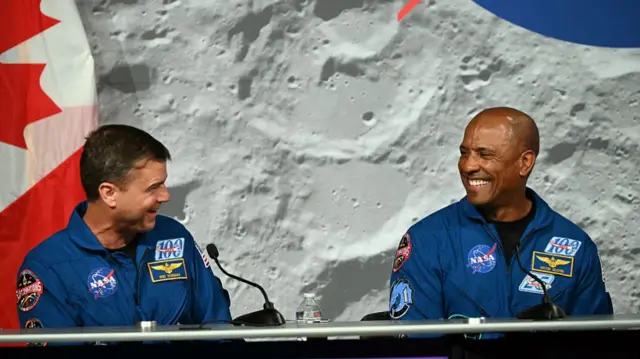
    NASA's Artemis II mission commander Reid Wiseman (L) and pilot Victor Glover speak during a press conferenceImage source, AFP via Getty
    Image caption,

    NASA's Artemis II mission commander Reid Wiseman (L) and pilot Victor Glover (R)

    The astronauts are asked if their mission to space has shifted their consciousness or their perspective on the world.

    "It's very hard to fully grasp what we just went through," Reid Wiseman answers. He says he's not a religious person, but after he splashed back down to Earth, he asked for the chaplain on the navy ship.

    "And when that man walked in, I'd never met him before in my life, but I saw the cross on his on his collar, and I just I broke down in tears," he says.

    He says that during the mission, when the Sun eclipsed behind the Moon, he turned to Victor Glover and said, "I don't think humanity has evolved to the point of being able to comprehend what we're looking at right now".

    Glover adds that he feels the same as Wiseman, except for the fact that he is a religious person.
  2. Seeing the galaxy up close was the most remarkable part, Hansen sayspublished at 19:58 BST

    The astronauts are asked about the most remarkable experiences of their journey - those that couldn't captured through photos and videos.

    Canadian astronaut Jeremy Hansen, who unlike the others was on his first space flight, took the question.

    He says they had many amazing experiences, but what kept grabbing his attention was the "depth of the galaxy" that he hadn't experienced before.

    Stars "looked like you could tell where they are in 3D," he says.

    Seeing the Moon and Earth from that perspective made him feel "small and powerless, yet powerful together," he says.

  3. Astronauts say they're coming to grips with the scope of their missionpublished at 19:53 BST

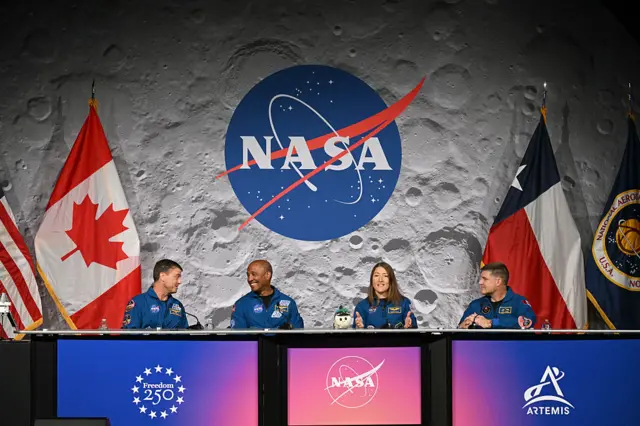
    (L-R) NASA's Artemis II mission astronauts, commander Reid Wiseman, Victor Glover, Christina Koch and Canadian Space Agency's Jeremy Hansen attend a press conference at Johnson Space Center in Houston, Texas, on April 16, 2026. The astronauts did the first slingshot around the Moon in more than 50 years and traveled deeper into space than any humans before, culminating in a smooth splashdown on April 10 off the coast of California.Image source, AFP via Getty

    The Artemis II mission touched millions of people on Earth, many of whom tuned in to watch the mission's launch and splashdown.

    A reporter tells a story about his four-year-old daughter, who he says was entranced by the videos and photos of the mission, and asks if the astronauts are coming to grips with the scope of what they did.

    Artemis II pilot Victor Glover says he has been trying to "live in a little hole" for the week since splashdown, but it is "hard" now.

    "We did what we said we were going to do and now we've got to step out and just face that reality," he says.

    Mission Specialist Jeremy Hansen reflects on the moment the flight lost connection with ground crew as it hurtled back toward Earth.

    "We didn't have that connection with you, we lost that connection with earth," he says. "We just leaned into what we had, we leaned into each other and mission control which was really all we had and our families a couple times."

    Mission Specialist Christina Koch says she doesn't like attention, but her husband had a conversation with her brothers and sisters about "who's going to tell her" about the impact of the mission.

  4. Name of spacecraft 'Integrity' captured spirit of the mission, Wiseman sayspublished at 19:47 BST

    The first question goes to Wiseman, who is asked about Integrity, the name of the spacecraft, and the spirit of the mission.

    He described the 10 days they spent in flight as a surreal experience.

    "It's a beautiful thing what we got to witness," he says. "We named that space craft Integrity and it just kind of coalesced this thread in the four of us."

  5. Mission commander Reid Wiseman says crew became 'best friends' while in spacepublished at 19:42 BST

    Artemis II mission commander Reid Wiseman is the first to speak, opening the news conference by thanking the whole world - and particularly his fellow crew members.

    "We are just we are bonded forever. I mean, that's the closest four humans can be and not be a family," he says, adding that they came back as "best friends".

    He also thanks Nasa, its international partners and the crew that built the ship, as well as the media, content creators and others who tuned in to watch the mission.

    Media caption,

    Reid Wiseman thanks Artemis crew after mission

  6. Watch live as astronauts answer questions about Moon missionpublished at 19:32 BST

    The four Artemis II astronauts are about to appear for their media conference.

    You can watch live at the top of this page, and we will also bring you all of the key updates in text.

  7. What it feels like to come back from spacepublished at 19:28 BST

    Helen Sharman
    The UK’s first astronaut

    From my own experience coming back from space, I can tell you what the Artemis II crew likely went through after splashing back down on Earth.

    What they might have felt, first of all, is just really heavy. I remember just lifting up my little finger and noticing how heavy that felt. Then I lifted up the manual that we have for the re‑entry and that again felt really heavy.

    The human body is very adaptable. Nonetheless, that feeling of weight continues.

    After space you also feel a little bit dizzy and lightheaded. It's like when you have an ear infection and you feel like your head is sort of floating.

    It took a few minutes before I started to feel more confident to stand up and probably twenty or thirty paces to learn again to walk in a straight line.

  8. We get to find out about the most dangerous part of the missionpublished at 19:14 BST

    Alison Francis
    Senior science journalist

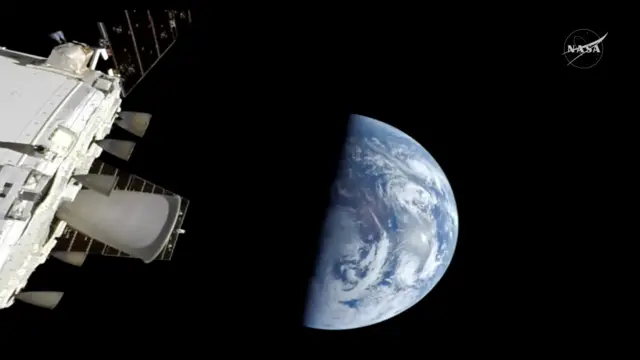
    A handout screen grab taken from a video and made available on 10 April 2026 at 16:16 CST by the National Aeronautics and Space Administration (NASA) shows Earth as seen from the Orion spacecraft 'Integrity' during its approach to re-entry, 10 April 2026. The spacecraft is expected to reach speeds of up to Mach 32 during atmospheric re-entry. Artemis II spacecraft approaches re-entry to Earth, Space - 10 Apr 2026Image source, Nasa Handout

    The Orion capsule had never been used for crewed flight before, and part of the Artemis II mission was to put the spacecraft through its paces.

    Coming back into Earth’s atmosphere, the crew inside hurtled at nearly 25,000 miles an hour (40,233km/h) with the outside of the capsule reaching temperatures half as hot as the sun.

    Whilst many hours of life on board Orion were streamed throughout the 10 days that the crew were in space, there were no pictures of the crew, or the capsule, as it came back to Earth in a fireball.

    During that time, there were also six minutes of communications blackout when mission control could not speak to the crew, and they could not send any messages back.

    No one has any idea what that part of the journey was like.

    Howard Hu, NASA’s Orion Programme Manager told us he was looking forward to asking the astronauts how their ride home went.

    Now we’ll find out just how bumpy or smooth the most dangerous part of their journey was.

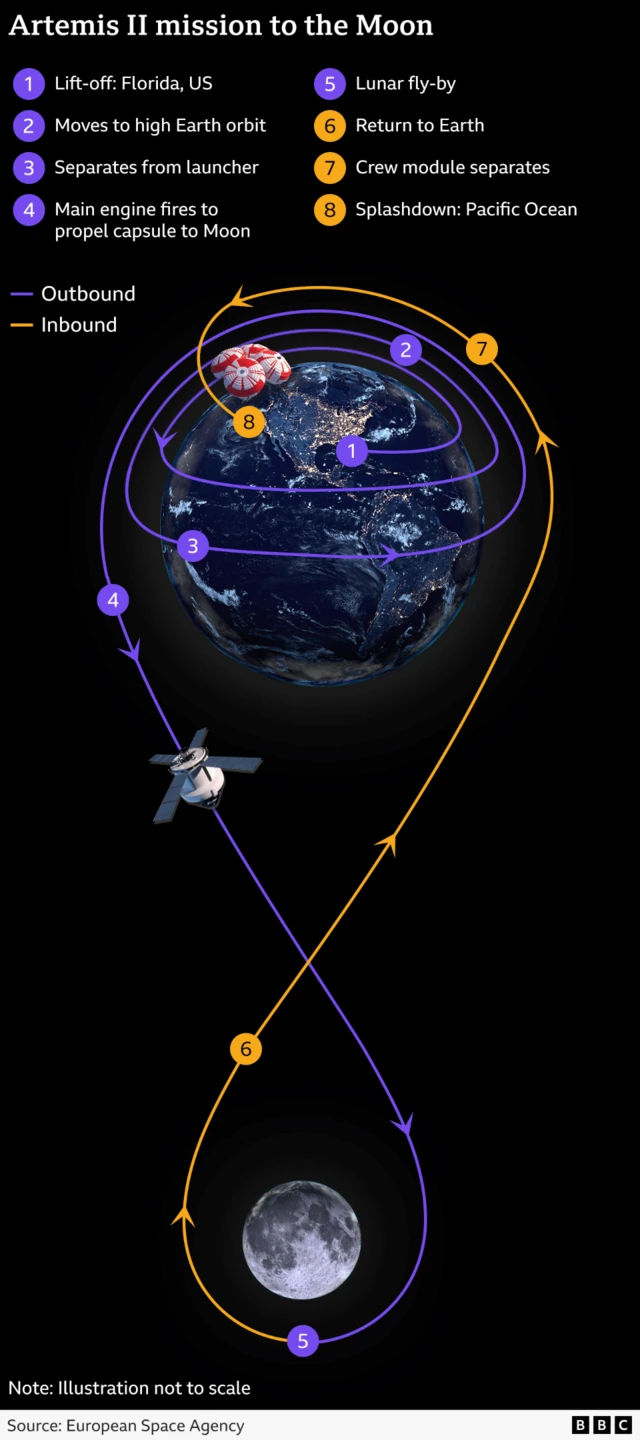
  9. The path the astronauts took to the Moon and backpublished at 19:01 BST

    The Artemis II crew lifted off from the US state of Florida and splashed down off the coast of California.

    Here's what their path through space looked like.

    Graphic showing the Earth and the Moon, with the spacecraft’s figure of eight orbital trajectory highlighted. Specific points are labelled. These are: 1. Lift-off at the Kennedy Space Centre, 2. Orbit around the Earth, 3. Rocket separation, 4. Main engine fires to take spacecraft to the Moon, 5. Lunar fly-by, 6. Return to Earth, 7. Crew module separates, 8. Splashdown in Pacific Ocean
  10. Has it all started to sink in yet for the Artemis II crew?published at 18:48 BST

    Rebecca Morelle
    Science editor

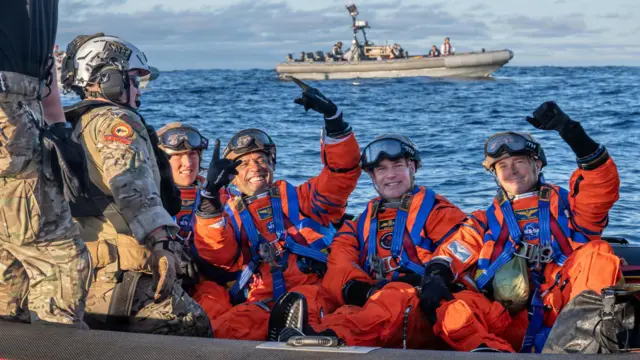
    From left to right, NASA astronauts Christina Koch, Victor Glover, Canadian Space Agency astronaut Jeremy Hansen and NASA astronaut Reid Wiseman pose for a photo on the front porch before transiting to amphibious transport dock ship USS John P. Murtha (LPD 26), April 10, 2026. John P. Murtha is underway in the U.S. 3rd Fleet area of operations supporting NASA’s Artemis II mission, retrieving the crew and spacecraft following their return to Earth and splashdown in the Pacific Ocean. NASA's Artemis II mission sent four astronauts on a flight around the moon in the Orion space capsule, marking the first time humans journeyed to deep space in over 50 years. (U.S. Navy photo by Mass Communication Specialist David Rowe)Image source, U.S. Navy photo by Mass Communication Specialist David Rowe
    Image caption,

    (From left) NASA astronauts Christina Koch, Victor Glover, Canadian Space Agency astronaut Jeremy Hansen and NASA astronaut Reid Wiseman

    On Saturday, just a few hours after their dramatic landing, the astronauts had a chance to speak to Nasa friends and colleagues in Houston.

    In an emotional homecoming, it was clear they couldn’t quite believe what they’d just been through.

    Commander Reid Wiseman said it had felt like a dream, and pilot Victor Glover said he was afraid to even start trying to process the extraordinary experience.

    They’ve had a few more days back on Earth now, so we’ll find out more about whether their voyage has started to sink in.

    But it may take some time. Astronauts returning home often speak of the “overview effect” - the experience of seeing their home planet hanging in the darkness of space, which can cause a profound shift in perspective.

    We’ll also find out the crew are coping with their newfound celebrity - the astronauts went to space relatively unknown, but they’ve become household names.

  11. Remind me, what was this mission all about?published at 18:39 BST

    More than 50 years have passed since Nasa's Apollo missions landed humans on the Moon for the first time in July 1969.

    And, while Nasa's Artemis II crew didn't make a lunar landing themselves, their mission will pave the way for the next human footsteps on the Moon.

    During their trip the four astronauts flew beyond the far side of the Moon, which always faces away from the Earth. This mission marked the first time it has been seen by human eyes.

    Nasa says the mission will set the stage for future missions to explore the Moon's South Pole region.

    Studies on the astronauts' health will also help Nasa to better understand how deep space travel influences the human mind and body, protecting astronauts on future lunar missions as well as travel to Mars.

    Nasa's goal is for Artemis IV and V to become lunar landing missions - and is aiming for both to happen in 2028.

  12. The four person crew that made space travel historypublished at 18:33 BST

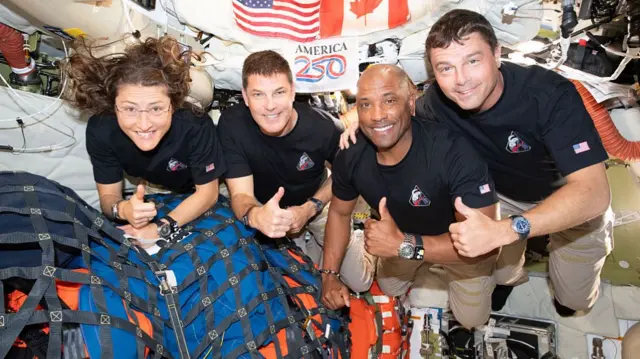
    The four Artemis II astronauts smile and pose aboard the spacecraftImage source, Getty Images
    Image caption,

    From left: Astronauts Christina Koch, Jeremy Hansen, Victor Glover and Reid Wiseman.

    Four astronauts - three Americans and one Canadian - trained for more than two years before taking Artemis II around the Moon. They have decades of experience between them - although one had never been to space before.

    The Nasa astronauts, who have all previously been to space, are:

    Reid Wiseman, 50, the mission's commander.

    Victor Glover, 49, the mission's pilot.

    Christina Koch, 47, a mission specialist.

    And the Canadian Space Agency astronaut is:

    Jeremy Hansen, 50, a specialist. This was Hansen's first time in space.

    All of the astronauts said they sat down with their families to talk about the risks involved before the launch.

    "We've all got someone, an astronaut, that is going to be with our family members when they're watching launch, which can be this terrific and terrifying moment all at the same time," Glover said ahead of the trip.

    Return to the latest post
  13. Artemis II astronauts to talk about experience after historic Moon missionpublished at 18:30 BST

    Sakshi Venkatraman
    US reporter

    We watched them take off, circle unseen parts of the Moon, and splash back down in the ocean last week.

    Now, the four astronauts who crewed the Artemis II mission will speak to the media about what it was all like.

    Nasa astronauts Reid Wiseman, Victor Glover, and Christina Koch, and Canadian Space Agency astronaut Jeremy Hansen will answer questions about their historic mission.

    We will bring you all the key lines here, as well as analysis about the mission from our science experts.

    You can watch live at the top of this page from 14:30 ET (19:30 GMT).