Summary

  1. A recap of Trump's call to spacepublished at 04:16 BST
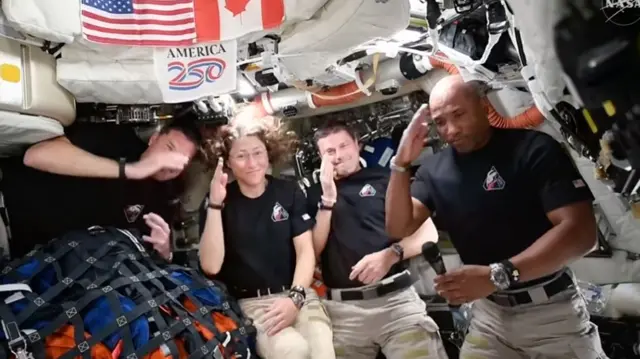
    Four astronauts saluting to the camera while in the Artemis II spacecraft.Image source, NASA

    US President Donald Trump had a short conversation with the four astronauts aboard the Orion spacecraft. As a microphone floated in front of the astronauts on their journey back to Earth, Trump praised the crew for their achievements.

    • He congratulated the Artemis II crew for making history and breaking the all-time record for the furthest distance from planet Earth
    • Trump also asked the crew a couple of questions, including what it was like to lose contact with Earth
    • There were also several references to Mars throughout the call; Commander Reid Wiseman told the president that all of the crew had commented "how excited we are to watch this nation and this planet become a two planet species"
    • Canadian Space Agency astronaut Jeremy Hansen also gave a special thanks to Trump on behalf of Canada; Trump responded by saying he had spoken to Canadian Prime Minister Mark Carney and former Canadian ice hockey player Wayne Gretsky, who had both expressed how proud they were of Hansen and the Artemis II crew
    • The president wrapped up the conversation by inviting the four astronauts to the White House once they return to Earth - he said he rarely asks for autographs, but he wanted to get theirs
  2. Trump invites crew to White Housepublished at 03:44 BST

    Before the call ended, Trump said he will be seeing the Artemis crew at the White House once the mission is complete.

    "I've been pretty busy also, as you know, but I will absolutely find the time," Trump said, before adding he would like to give "a big salute on behalf of the American people and beyond that".

    "Thank you for that, Mr President," pilot Victor Glover replied.

  3. 'Saw sights that no human has ever seen'published at 03:39 BST

    Trump continues with questions, asking the crew: "What is the most unforgettable part of this really historic day?"

    Commander Reid Wiseman was the first to respond, and starts by saying that the call from the president was "certainly very special to all of us".

    "We saw sights that no human has ever seen, not even Apollo, and that was amazing for us," said Wiseman.

    He went on to explain the crew's observations of the solar eclipse, and said all four of the crew had commented on how "excited we are to watch this nation and this planet become a two-planet species" in reference to goals of future ventures to Mars.

  4. Trump asks crew what it was like to lose contact with Earthpublished at 03:36 BST

    Trump asks the Artemis crew: "What was your feeling when you had no communication all of a sudden?"

    Astronaut Victor Glover answers by saying he said "a little prayer" but then had to keep working to record scientific observations of the far side of the moon.

    "We were busy up here and working really hard, and I must say it was actually quite nice," Glover adds.

  5. Trump congratulates Artemis crew and Nasapublished at 03:31 BST

    Trump continues and says: "Humans have really never seen anything quite like what you're doing."

    "It's really special."

    He then congratulates each crew member of the Artemis crew and the entire team at Nasa.

  6. Donald Trump speaking to Artemis II crew nowpublished at 03:29 BST

    US President Donald Trump is speaking directly to the crew aboard Artemis II in a surprise appearance.

    "Today, you've made history and made all America really proud, incredibly proud," he tells the four astronauts.

    "We have a lot of things to be proud of lately, but this is... there's nothing like what you're doing, circling around the moon for the first time in more than a half century, and breaking the all time record for the farthest distance from planet Earth."

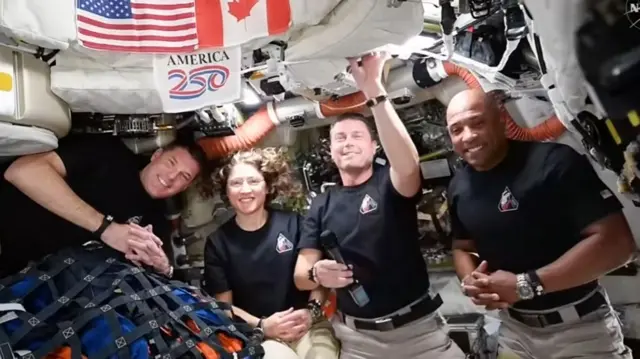
    Four astronauts float inside a spacecraft, one holds a microphone. All are smiling.Image source, NASA
  7. Watch the moment Artemis II regains contact with Earthpublished at 03:12 BST

  8. Eclipse observation period endspublished at 02:46 BST

    The Nasa science crew has just signed off, thanking the Artemis II crew for their observations.

    Mission control says the solar eclipse observation period has closed, and the team aboard the Orion spacecraft will now begin "down-linking" all of the images and data they have captured over the past seven hours of observation.

  9. Not enough adjectives to describe observations, astronaut sayspublished at 02:32 BST

    Artemis II pilot Victor Glover has just told the crew on the ground that what the four astronauts are currently seeing is "truly hard to describe".

    "I know this observation won't be of any scientific value but I'm really glad we launched on April 1st, because humans have probably not evolved to see what we are seeing," he tells them.

    Commander Reid Wiseman jumped in with his observations:

    "It's just indescribable. No matter how long we look at this, our brains are not processing this image in front of us. It is absolutely spectacular, surreal... there's no adjectives, I'm going to need to invent some new ones, there's absolutely no words to describe what we are looking at out this window."

    As Glover described something he said was orange, the crew on the ground said the reddish object was likely Mars.

    "Good opportunity to look to the future of where we're going," mission control tells the four aboard the Orion spacecraft.

    The crew joked they wanted 20 new superlatives added to the mission summary tomorrow, to assist with their descriptions.

  10. 'The Earth is so bright out there'published at 02:24 BST

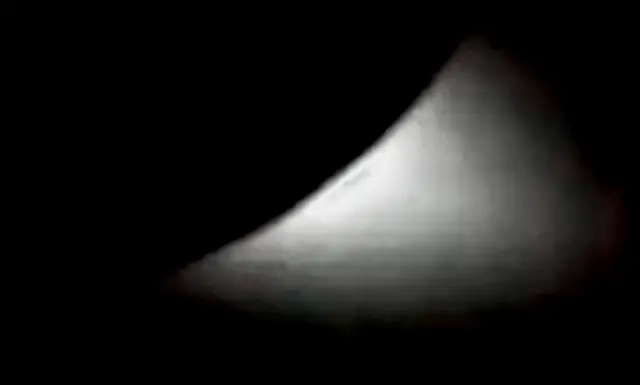
    Earlier we heard Nasa astronaut Victor Glover describe what he was seeing during the solar eclipse period as "sci-fi" and "unreal". He also described the view of the corona of the sun.

    Here is what he said:

    "This continues to be unreal.

    The Sun has gone behind the Moon and the corona is still visible, and it's bright and creates a halo almost around the entire moon.

    But when you get to the Earth side, it's the Earth shine that's already shown.

    I mean almost seconds after the Sun set behind the Moon, you could see Earth shine.

    The Earth is so bright out there and the Moon is just hanging in front of us.

    This black orb out in front of us now, not the blackness but the grey that blends and drifts into the blackness. We can see stars and planets behind it.

    Christina is in window one, Reid is in window two with the long lens and Jeremy is describing it in window three.

    It is quite an impressive sight.

    You can still see the horizon with a brighter... where the sun set on that side of the Moon. And the Earth shine is very distinct and it creates quite an impressive visual illusion.

    Wow it's amazing."

    A black and white low-resolution image shows a solar eclipse as seen by the Artemis II astronauts
    Image caption,

    An image of the solar eclipse

  11. Who are the four astronauts in the Artemis II crew?published at 02:17 BST

    As a reminder, there are four astronauts aboard the Orion spacecraft that make up the Artemis II crew.

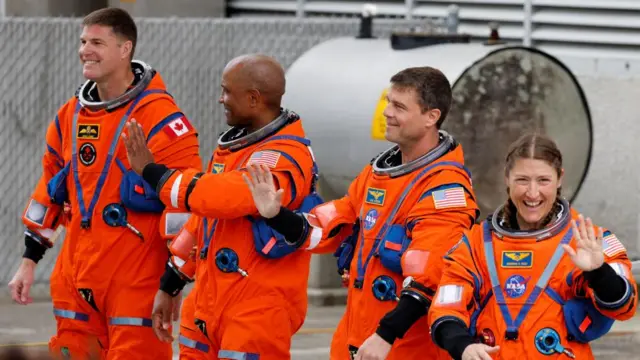
    It includes three Nasa astronauts - Commander Reid Wiseman, Victor Glover and Christina Koch - along with Jeremy Hansen of the Canadian Space Agency.

    For those following the mission via the Nasa livestream, you will regularly hear the astronauts recording their observations and communicating with the crew on the ground.

    You can read more on the four astronauts and their stories here.

    The crew of the Artemis II launch mission to fly by the moon, NASA astronauts Reid Wiseman, Victor Glover and Christina Koch and CSA (Canadian Space Agency) astronaut Jeremy Hansen greet people before boarding the astronaut van for their drive to launch pad 39B at the Kennedy Space Center in Cape Canaveral, Florida, U.S. April 1, 2026Image source, Reuters
  12. Artemis II crew experience brief loss of signalpublished at 02:07 BST

    Nasa mission control says they have been experiencing a "forward link loss of signal", which means that for a brief and expected period, the ground crew was unable to speak to the astronauts aboard the Orion spacecraft.

    However, mission control says that the astronauts' observations of what they were seeing were still able to reach the ground crew - and the waiting science team on Earth.

    After about five minutes, signal returned.

  13. Mission control team confirms 'tiny dot' is Venuspublished at 02:05 BST

    Just minutes ago, Artemis mission control confirmed that a tiny dot seen during the live broadcast from Nasa was Venus.

    "You are currently seeing a live view of the solar array wing of the Orion spacecraft", the mission control member said.

    "We spoke with our science team, and they did determine that that dot in the distance is Venus."

    Venus is the second planet from the Sun, and the sixth largest planet in our solar system.

  14. 'We just went sci-fi. It looks unreal'published at 01:58 BST

    Victor Glover, the pilot onboard the Orion spacecraft, has just given a quick insight into what the Artemis crew has been seeing during the eclipse period.

    "This is, we just went sci-fi. It just looks unreal," Glover says.

    Return to the latest post
  15. Artemis II crew currently observing the solar eclipsepublished at 01:55 BST

    The Artemis II crew are currently observing a solar eclipse, which will go on for the next 35 minutes.

    The four astronauts were told to prepare to observe the eclipse by calibrating their cameras' exposure.

    They will split into a "window team", and a "cabin team", says Angela Garcia, a science officer for the Artemis mission.

    The cabin team supports the window team in their observations by using the onboard cameras and sensors.

    Nasa said the astronauts have been provided with a "fleet of cameras" to capture images during their mission, which will include photographs of the solar eclipse.

  16. Crew reached furthest point from Earthpublished at 01:37 BST

    While flying behind the Moon, the Orion spacecraft reached its maximum distance from Earth - a new record for furthest distance travelled by humans from our home planet.

    Nasa says that was 252,756 miles (406,771km).

    Earlier today, the Artemis II crew broke the previous record for the furthest distance humans have travelled from Earth - set by Apollo 13 in 1970.

  17. Astronauts prepare for total solar eclipsepublished at 01:07 BST

    Pallab Ghosh
    Science correspondent

    Next up, the astronauts will witness a total solar eclipse.

    On our planet, total eclipses happen when the Moon's shadow sweeps across a narrow strip of ground, briefly turning day to twilight.

    This time the Moon's shadow will not fall on the Earth, but on the Orion spacecraft.

    Orion is parked in just the right spot so that the Moon blocks the Sun from the crew's view, revealing the star's pale outer atmosphere – the corona – as a shimmering halo around a darkened lunar disc.

    Cameras have been set up at the windows to capture the stages of the event, from the first "bite" out of the Sun to the moment of totality and the delicate "diamond ring" effect as sunlight peeks round the edge.

    What makes this sight even more striking is what hangs nearby.

    Off to one side, the Earth is still visible - a small, glowing globe, partly in shadow, its cloud systems and continents just about discernible.

  18. Orion spacecraft bound for Earthpublished at 00:49 BST 7 April

    Pallab Ghosh
    Science correspondent

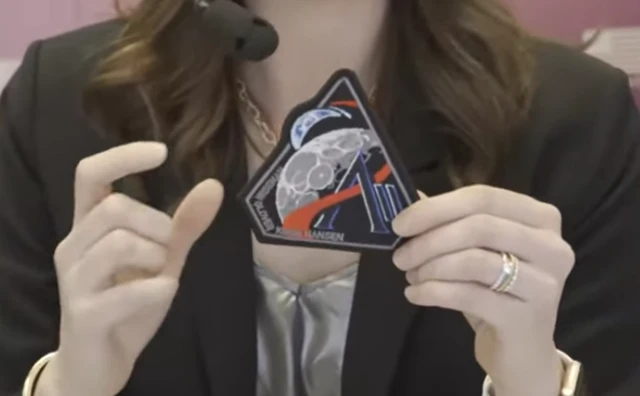
    A triangular patch showing stylised representations of the Moon in front of the Earth, with the AII logo of Nasa's Artemis II mission is held by a person.
    Image caption,

    The astronauts and mission control crew have flipped their patches as the journey back to Earth begins

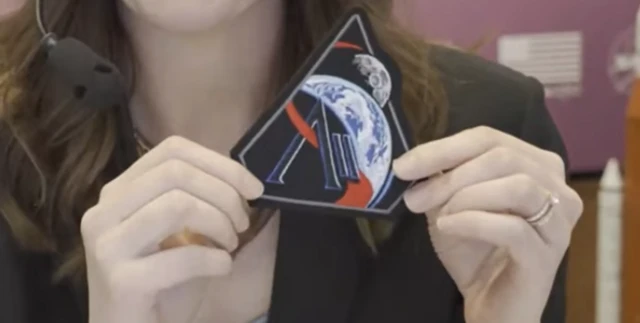
    In a small but carefully choreographed moment, the Artemis II astronauts and mission control teams have "flipped their mission patches" as the journey home begins.

    They’ve rotated the special double‑sided emblem so it now shows the Moon in the foreground and Earth rising beyond it – the reverse of how they wore it on the way out.

    On launch and during the outbound cruise, the patch was oriented with Earth dominant and the Moon on the horizon, underlining that their target lay ahead.

    Now, with the fly-by complete and Orion arcing back towards our planet, the crew have switched to the "homeward" view, a quiet signal that the riskiest part of the voyage is behind them and the priority is getting safely back to Earth.

    Mission patches have been part of NASA culture since the Gemini and Apollo days, but this reversible design – deliberately created so it can be flipped mid‑mission – is new with Artemis II rather than a tradition that goes back to the original Moon landings.

    It's a tiny detail, but one future crews may choose to copy.

    A triangular patch showing stylised representations of the Earth in front of the Moon, with the AII logo of Nasa's Artemis II mission is held by a person.
    Image caption,

    The patches were worn like this on the way to the Moon

  19. Astronauts studying 'impact flashes'published at 00:45 BST 7 April

    Pallab Ghosh
    Science correspondent

    Astronauts have been studying "impact flashes".

    These are the tiny, split-second bursts of light when small space rocks slam into the Moon fast enough to vaporise themselves and a patch of lunar surface.

    The astronauts now have a one-hour observation break.

    That’s a chance to rest their brains from checklists while still doing useful observing on the darkened Moon.

    Coming up in an hour or so – a total solar eclipse, which should be a mind-blowing moment for the crew.

  20. First words beamed back from astronautspublished at 00:43 BST 7 April

    The first words are now back from Integrity.

    "Houston, Integrity, comms check," were the first words from mission specialist Christina Koch, after a tense 40 minutes of radio silence while the crew was on the far side of the Moon.

    "It is so great to hear the Earth again," she says.

    She then addresses the residents of Asia, Africa and Oceania.

    "We are looking back at you. We hear you can look up and see the Moon right now. We see you, too," Koch says.

    Houston responds: "Integrity from Earth. Our single system, fragile and interconnected, we copy. Those of us that can, are looking back."

    A few minutes later, mission control adds: "You are Earthbound, and we're ready to bring you home."