Summary

  1. Pakistan congratulates BNP and Tarique Rahmanpublished at 03:31 GMT 13 February

    Pakistan's President Asif Ali Zardari has congratulated the BNP and its leader, Tarique Rahman, on securing a "landslide majority". Just a reminder that final results are yet to be released by the election commission, but the BNP and its allies are on track to win.

    Zardari added that Pakistan supports Bangladesh's democratic aspirations, and that Pakistan looks forward to working with the new government to strengthen cooperaiton in trade, defence and cultural exchange.

    The president also says he hopes the new political environment in Dhaka will contribute to "more balanced, independent and mutually respectful engagement" across the region.

  2. Does this election represent a generational change?published at 03:22 GMT 13 February

    Azadeh Moshiri
    Reporting from Dhaka

    This election couldn't have happened if it wasn't for the 2024 student uprising.

    But what is surprising to some is that although the faces of that uprising formed their own political party - the National Citizen Party which is also contesting in this election - they really struggled to gain support.

    The youth of Bangladesh just didn't rally behind them. As a result, they were in some ways forced into a very controversial alliance with Jamaat-e-Islami, the Islamist party that is now coming in second in the polls.

    Not only were the NCP unable to stand on their own, the party also faced internal divisions. Dozens who resigned saw the alliance as deeply controversial, saying that the NCP was meant to be a break from the past.

    Now, this morning, we are waking up to the news that another long-established party could be winning and forming a new government.

    The BNP suffered political motivated arrests under Sheikh Hasina, according to independent human rights groups. Tarique Rahman, the head of the party who is now the potential future prime minister of this country was in self-imposed exile for 17 years.

    But they have been in government before. The party was formed in the 1970s, and they are a political dynasty.

    The party don't completely represent change in the country. But they've been convincing voters, working very hard for that vote to argue this is a party of change now.

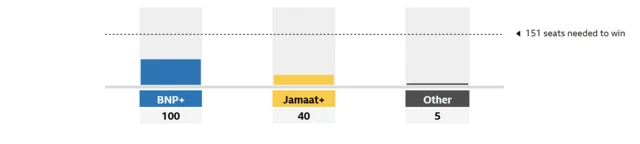
  3. Official results: BNP secures 100 seatspublished at 03:13 GMT 13 February

    The BNP has now secured 100 seats according to the official results released by the election commission, which means they are just 51 seats shy of the majority needed to form govenrment.

    Final results are to come, but the party has claimed victory and congratulations have begun to trickle in.

    Meanwhile Jamaat, the Islamist party, is in second place with 40 seats.

    Bangladesh election results
  4. If you're just joining uspublished at 03:02 GMT 13 February

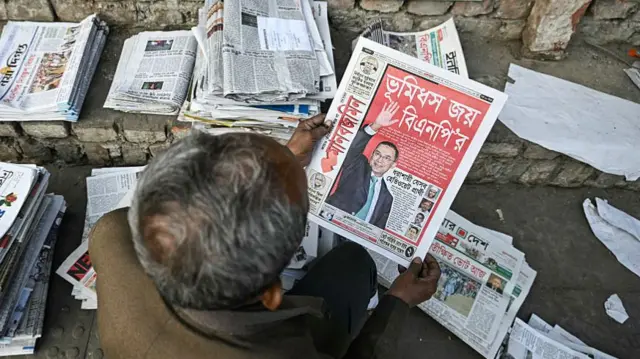
    top view of a man reading a newspaperImage source, AFP via Getty Images

    Results are still trickling in for Bangladesh's landmark election - the first one held since ex-Prime Minister Sheikh Hasina was dramatically ousted by a youth-led protest movement in 2024.

    If you're just joining us, here's what to know:

    • Final results are still not fully in - but official results show the Bangladesh Nationalist Party (BNP) well ahead in polls
    • Local media are projecting a landslide victory for the BNP - though their estamtes vary. The party and its allies are projected to win around two-thirds of the seats
    • Their main rival is the alliance led by the Islamist Jamaat-e-Islami which also includes the student protesters who ousted Hasina
    • If BNP wins as projected, its leader Tarique Rahman will become the next prime minister - a huge change of fortunes considering he had spent 17 years in exile in London
    • The BNP, whose previous term in office was marked by political violence, told the BBC earlier that it would "absolutely guarantee" democracy and free speech if they come to power
    • Voters have also taken part in a referendum on sweeping constitutional reforms. Unofficial results show the majority in favour of the charter. Read this post for more on the July Charter
    • The election is being closely watched by neighbouring India which is trying to salvage bilateral ties that have sunk to their lowest point in decades
  5. BNP announces nationwide prayer programme after projected majoritypublished at 02:44 GMT 13 February

    The BNP has announced a nationwide prayer programme after local media projected a sweeping win for the party.

    A press release from the party says the programme will be held in mosques across the country after Friday prayers.

    "Prayers will be offered for the late former Prime Minister Khaleda Zia and for the well-being of the countrymen," the statement reads.

    Khaleda Zia, Bangladesh's first female prime minister, was the long-serving leader of the BNP. She died on 30 December aged 80.

    The BNP statement also says that no celebratory processions or meetings will be held by the party to mark its victory.

  6. For India, this vote is about more than personalitiespublished at 02:33 GMT 13 February

    Soutik Biswas
    India Correspondent

    For Delhi, this election is less about personalities and more about stability.

    Policymakers recognise that no government in Dhaka can afford to ignore India. Geography, trade, food security, border management and shared security threats bind the two neighbours in hard reality.

    Yet managing Sheikh Hasina’s continued presence in Delhi - and her periodic political statements from exile - remains a delicate issue that could complicate any reset.

    High-pitched Hindu nationalist rhetoric from across the border further irks many Bangladeshis, narrowing the space for genuine rapprochement.

    For India, this vote is about damage control and preventing further strategic drift - not restoring an old comfort zone.

    DHAKA, BANGLADESH - FEBRUARY 9: BNP Chairman Tarique Rahman speaks at a massive BNP rally at Kalabagan Krira Chakra filed in Dhaka. Tarique Rahman meets members of the public while carrying out his election campaign for the forthcoming 13th Parliamentary Election 2026 (Photo by Suman Kanti Paul/Drik/Getty Images)Image source, Getty Images
  7. Huge change of fortunes for Tarique Rahmanpublished at 02:22 GMT 13 February

    Azadeh Moshiri
    Reporting from Dhaka

    People in Bangladesh are waking up to the news that the BNP are in the lead and on track to form the next government.

    Although the results remain unofficial, local newspapers have already taken certain liberties in declaring a BNP victory. Many people here will now be thinking that Tarique Rahman, the leader of the BNP, could become the next prime minister.

    This is a huge change of his fortunes. In the last election in 2024, he was in self-imposed exile in London, and his party was boycotting the elections altogether, with thousands of its members and supporters in jail.

    Now, thanks to the student uprising and the youth of Bangladesh that ousted years of authoritarian rule under Sheikh Hasina, he could be the next leader of the country.

  8. US ambassador congratulates BNP on 'historic victory'published at 02:16 GMT 13 February

    The US ambassador to Bangladesh has congratulated the BNP and its leader Tarique Rahman on a "successful election" and a "historic victory".

    "The United States looks forward to working with you to realize shared goals of prosperity and security for both our countries," wrote Ambassador Brent T. Christensen.

    As as reminder, the official results are not in yet - though local media have projected a sweeping victory for the BNP.

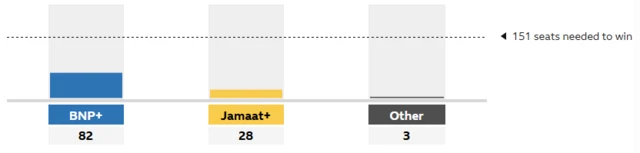
  9. Official results: 82 seats for BNPpublished at 02:09 GMT 13 February

    Now bringing you more updates on the official results from the Election Commission. Here's where things stand as of 08:04 local time (02:04 GMT):

    Chart showing seats held by BNP, Jamaat and others
  10. 'We absolutely guarantee democracy and freedom of expression' - BNP to BBCpublished at 01:53 GMT 13 February

    Yogita Limaye
    Reporting from Dhaka

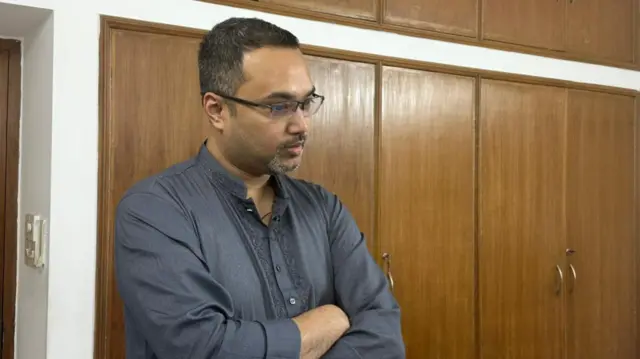
    Mahdi Amin crossing his arms

    A BNP spokesperson told the BBC on Thursday night that the party would "absolutely guarantee" democracy and freedom of speech, should they come to power.

    "We expect to fulfil the aspirations of the people of Bangladesh", added Mahdi Amin, the party's key spokesperson.

    On the credibility of an election where the Awami League was effectively banned from participating, Amin said, "Once elected, we'll go back to people and we'll follow what the people want. But as of now, it's very clear that the people have decided not to endorse any political party who has lost its political character and become a tool which was responsible for gross human rights violations."

    The Awami League has rejected the allegations and denounced the legitimacy of the election.

    Mahdi Amin also said the safety and freedom of minorities would be protected.

    The BNP’s time in power was marred by violence, and allegations of corruption and human rights violations.

    People will be watching to see if their governance is different this time. And reviving the country’s economy, reducing inflation, and creating jobs will not be an easy task.

  11. An update on the referendumpublished at 01:42 GMT 13 February

    Now bringing you an update on the referendum vote:

    More than 860,000 people have voted yes as of this morning, according to the state-owned BSS news agency. Meanwhile around 420,000 people voted no.

    That's 67% of the vote in support of the July Charter, a set of reforms that lays out the framework for the governance of the country.

    Read our earlier post for more on the Charter and why it matters.

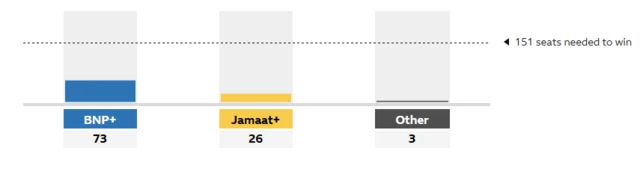
  12. Official results show BNP has won 73 seatspublished at 01:36 GMT 13 February

    Official results from the election commission are coming in faster now.

    Here is a snapshot of where things stand in terms of the results as of 07:36 local time.

    GraphicImage source, BBC Bangla
  13. The violent cloud that hangs over the BNP's last time in powerpublished at 01:22 GMT 13 February

    Anbarasan Ethirajan
    Global Affairs Reporter

    Results so far show the Bangladesh Nationalist Party is headed for victory in this election.

    But a violent cloud hangs over their previous term in office.

    Soon after the party-led alliance began their last stint in power in 2001, hopes of economic reform and local investment soured as violence broke out.

    Attacks were unleashed against supporters of the Awami League and religious minorities, particularly Hindus, who alleged that crimes such as murder, looting and rape began as soon as the results were announced.

    To control spiralling violence and Islamic militancy, the BNP set up the controversial paramilitary force the Rapid Action Battalion (RAB) - but it was later accused of carrying out extrajudicial killings and enforced disappearances, a charge denied by the authorities.

    BNP leader Tarique Rahman has promised to establish "a safe Bangladesh for all, regardless of their political allegiance, opinion, religion, caste and tribe".

  14. Local media projections for BNP seats vary significantlypublished at 01:14 GMT 13 February

    As we reported earlier, the official election results are still trickling in.

    According to the latest from the Election Commission, the Bangladesh Nationalist Party and its allies have secured 69 seats; Jamaat-e-Islami and its allies have secured 24 seats; and 3 seats are going to other candidates.

    Local media have all projected sweeping wins for the BNP, but their projections on how many seats the party will win significantly differ.

    Here's where things stand, according to these projections:

    • Jamuna TV: 211 seats for the BNP alliance; 70 for the Jamaat alliance; and 6 for others
    • Somoy TV: 197 seats for the BNP alliance; 58 for the Jamaat alliance; and 4 for others
    • Daily Star: 137 seats for the BNP alliance; 34 for the Jamaat alliance; and 5 for others
  15. India watches anxiouslypublished at 01:05 GMT 13 February

    Soutik Biswas
    India Correspondent

    India will be watching Bangladesh’s election anxiously, as ties have sunk to their lowest point in decades.

    In Dhaka, Delhi is widely seen as having enabled democratic backsliding by supporting ousted prime minister Sheikh Hasina - a perception that has sharpened anti-Indian sentiment and hollowed out what was once touted as a model neighbourhood relationship.

    Now, with the Awami League barred from contesting and unlikely to return to power soon, India is adjusting to new realities.

    It appears increasingly prepared to work with a BNP-led government, particularly as the party has distanced itself from Jamaat, signalled interest in engaging with Delhi, and reiterated commitments against militancy.

    At the same time, India has kept channels open to all major players - a pragmatic effort to repair a frayed partnership.

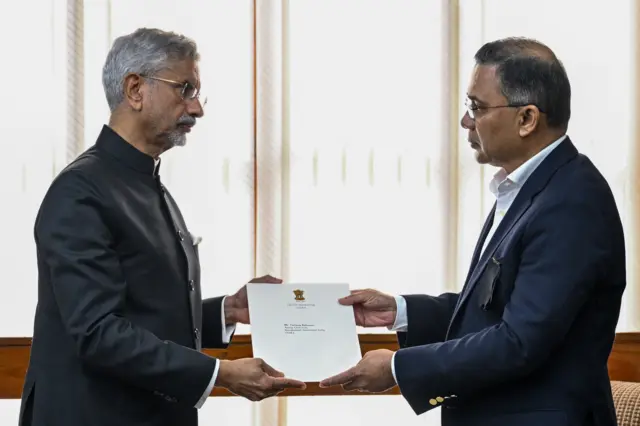
    India's Foreign Minister S Jaishankar recently visited Dhaka and met BNP acting chairman Tarique RahmanImage source, Reuters
    Image caption,

    India's Foreign Minister S Jaishankar recently visited Dhaka and met BNP acting chairman Tarique Rahman

  16. Official results website inaccessiblepublished at 01:01 GMT 13 February

    While vote counting is underway, the official election website is not accessible.

    At the time of writing this post, users trying to access the site are seeing a message that reads, "This site can't be reached".

    The official results are expected to be announced later today.

    A webpage displays the message "This site can't be reached"Image source, Bangladesh Election Commission
  17. What you need to know about the Bangladesh Nationalist Partypublished at 00:45 GMT 13 February

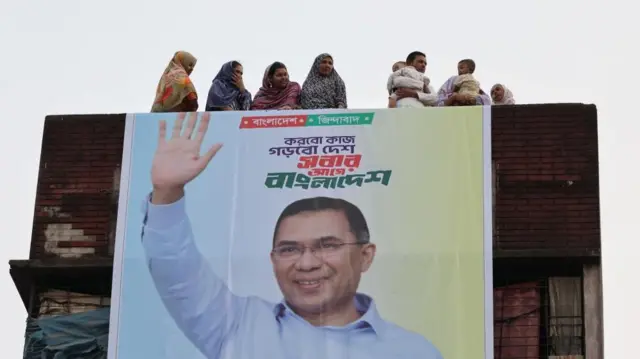
    People watch the BNP rally from their rooftopsImage source, Reuters
    Image caption,

    People watch the BNP rally from their rooftops

    The Bangladesh National Party or BNP are ahead in most seats according to preliminary unofficial results. Here is more about the party:

    Founded in 1978 by Bangladesh's former president Ziaur Rahman, who was also one of the leading figures in the country's independence war, the BNP has ruled the country multiple times, often exchanging power with the now-banned Awami League.

    With its main rival absent, it was widely expected that the BNP would perform well in this election. If it wins, as projected, Tarique Rahman, the son of Ziaur and late former PM Khaleda Zia, is expected to be the next prime minister.

    In its manifesto, the BNP vowed to build a "welfare-oriented and prosperous" nation. Among its key pledges are more financial support for low-income families, an expansion of the healthcare workforce, education reforms and a boost to climate resilience.

    The BNP boycotted past elections, including the most recent one in 2024, accusing them of being neither free nor fair - yet has also been criticised for corruption and poor governance.

  18. BNP on track to win two-thirds of seats - local mediapublished at 00:34 GMT 13 February

    Local broadcasters are projecting that the BNP could win around two-thirds of the seats up for grabs in parliament.

    As a reminder, these results are not official. We'll have to wait for the Election Commission to share the final results.

    Stick with us as we bring you more updates.

  19. Parties make allegations of vote riggingpublished at 00:27 GMT 13 February

    As Bangladesh waits for election results to come in, contesting parties have voiced allegations of vote rigging.

    The National Citizens Party (NCP) - representing the youth-led movement that had ousted Sheikh Hasina in 2024 - has demanded a recount of votes, after alleging that results have been rigged.

    Candidates from at least two other parties have also gone to the Election Commission with similar allegations.

    On Thursday, a scuffle broke out at the polling station in the the Dhaka-8 constituency after NCP candidate Nasiruddin Patwary was reportedly blocked by supporters of Mirza Abbas, his BNP rival.

    The BNP meanwhile has accused Jamaat-e-Islami of fraud, with a spokesperson telling reporters earlier that "election was done to make certain candidates win in certain seats".

    "Despite all this, the unofficial results we are getting show that the party that is loved by the people will form the government," he said.

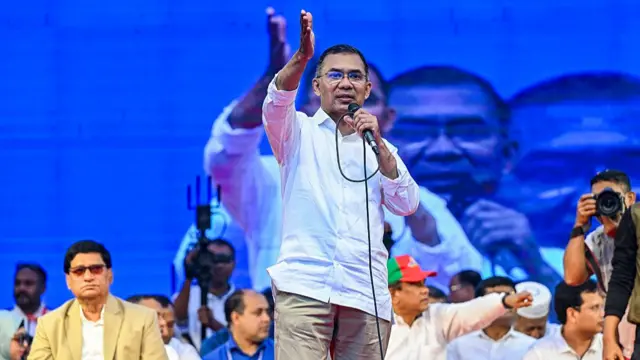
  20. Who is Tarique Rahman, the front-runner to be PM?published at 00:16 GMT 13 February

    Tarique Rahman gestures as he holds a microphoneImage source, LightRocket via Getty Images

    Tarique Rahman and his Bangladesh Nationalist Party (BNP) are ahead in counting so far with many media outlets projecting an outright majority.

    Rahman, who has lived in London since 2008, is expected to become the country's new leader if the BNP emerges as the largest party.

    The 60-year-old is the figurehead of the influential Zia family and the son of former prime minister Khaleda Zia - who died in December - and Ziaur Rahman, who was assassinated while serving as president in 1981.

    Rahman had been the subject of various criminal investigations launched while Sheikh Hasina's Awami League party was in power, but he was cleared of all charges when her regime fell.

    Last December, he returned to the country after 17 years in exile.

    Return to the latest post